
Abyssinian Crimsonwing
Cryptospiza salvadorii
Order: Passeriformes / Family: Estrildidae
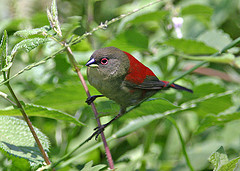
Wikimedia Commons
About the Abyssinian Crimsonwing
The Abyssinian Crimsonwing (Cryptospiza salvadorii) is a small, strikingly colored bird belonging to the family Estrildidae and is predominantly found in the montane forests of East Africa. Its vivid crimson coloration makes it one of the most visually arresting finches in the region. This bird plays a significant ecological role, particularly in seed dispersal, due to its granivorous diet. Notably, the Abyssinian Crimsonwing inhabits countries like Ethiopia, Uganda, and Kenya, favoring the subtropical or tropical moist montane forests. Within these regions, it often frequents areas with dense understory vegetation, where it finds ample food and cover from potential predators.
The significance of the Abyssinian Crimsonwing extends beyond its ecological contributions. Its presence serves as an indicator of healthy montane forest ecosystems, which are crucial for maintaining biodiversity. The crimsonwing's reliance on these forests underscores the importance of conserving such habitats, which face threats from deforestation and climate change. As a non-migratory species, the Abyssinian Crimsonwing exhibits seasonal behaviors such as altitudinal movements within its range, seeking optimal foraging conditions as the seasons shift.
In terms of behavior, the Abyssinian Crimsonwing is relatively elusive, often observed alone or in pairs rather than forming large flocks. This behavior can make it challenging for birdwatchers to spot and study. However, during the breeding season, these birds become more vocal and conspicuous as they engage in courtship displays and territorial disputes. Given its confined range and specific habitat requirements, the Abyssinian Crimsonwing holds a particular fascination for ornithologists and bird enthusiasts who seek to better understand the dynamics of East Africa's montane avifauna.
The Abyssinian Crimsonwing belongs to the family Estrildidae, within the order Passeriformes. These birds typically live average 3-5 years, with a maximum recorded of 8 years..
How to Identify a Abyssinian Crimsonwing
The Abyssinian Crimsonwing is a small bird, measuring about 12 cm in length. Adult males are easily identifiable by their bright crimson plumage, which covers most of their body, with contrasting olive-green wings and back. The tail is also crimson, ending in a black tip. Females, while similar, exhibit a slightly duller red coloration and more extensive olive tones on the wings and back, making them less conspicuous. Juveniles are markedly different, sporting a predominantly olive-brown plumage with only hints of crimson on the rump and tail, which gradually intensifies as they mature.
Field identification of the Abyssinian Crimsonwing can be challenging due to its secretive nature and preference for dense undergrowth. However, its distinctive coloration aids in spotting it when it ventures into more open areas. In flight, the crimsonwing presents a compact silhouette with rapid, direct flight patterns. Perching birds often adopt a horizontal posture, which can help distinguish them from other small passerines in the area.
Confusion with similar species is possible but limited. The Red-headed Bluebill shares some habitat overlap but differs significantly in coloration, with its blue-black body and red head. Observers should note the striking crimson of the Abyssinian Crimsonwing, a key differentiator when comparing with other finches in overlapping ranges.
Having trouble telling birds apart? Upload a photo to our bird identification tool for an instant species match.
Abyssinian Crimsonwing Habitat and Range
Preferred Habitat
The Abyssinian Crimsonwing thrives in montane forest habitats, particularly those that are subtropical or tropical in nature. These forests, rich in dense undergrowth, provide essential cover and foraging opportunities. Typically found at elevations ranging from 1,500 to 3,000 meters, these birds exploit the cooler climates and diverse plant life available at these altitudes.
Forests in Ethiopia, Uganda, and Kenya are primary habitats, where they often inhabit areas near streams or wetlands within the forest. Seasonal habitat shifts are minimal due to their non-migratory nature, but they may adjust their altitude within their range to follow food availability.
While primarily forest dwellers, the Abyssinian Crimsonwing occasionally ventures into nearby rural gardens and edges of agricultural lands, though they remain rare in urban settings. The species' dependence on specific forest conditions underscores the importance of habitat preservation for their survival.
Geographic Range
The Abyssinian Crimsonwing's range is confined to the highland regions of East Africa. They breed and reside year-round in Ethiopia, Uganda, and Kenya, specifically within the montane forests of these countries. In Ethiopia, they are notably present in areas like the Bale Mountains and the Simien Mountains National Park.
In Uganda, the species is found in places such as the Rwenzori Mountains and Bwindi Impenetrable National Park, while in Kenya, they inhabit the forested regions of the Aberdare Mountains and Mount Kenya. These areas are characterized by their rich biodiversity and complex ecosystems that support the specific needs of the Abyssinian Crimsonwing.
The population density of the Abyssinian Crimsonwing can vary significantly within its range, with hotspots typically occurring in regions with well-preserved forest habitats. The species does not undertake long migrations, but some altitudinal movements within their range may occur in response to seasonal changes in food availability.
Want to know which birds visit your area? Browse our backyard birds by location guides for region-specific species lists.
What Does the Abyssinian Crimsonwing Eat?
The Abyssinian Crimsonwing primarily feeds on a diet of seeds, which it skillfully extracts from grasses and low-lying shrubs. Its strong, conical bill is well-adapted for breaking open tough seed casings, allowing it to access a variety of seeds including those from grasses like Poaceae species and small weeds.
During the breeding season, the diet may expand to include small insects and larvae, providing necessary protein for chick development. Foraging typically occurs on the ground or in low vegetation where the bird can remain concealed from predators.
Feeding schedules are influenced by the availability of food, often peaking in the early morning and late afternoon when temperatures are cooler and insect activity is higher. The Abyssinian Crimsonwing employs a methodical foraging technique, hopping along the ground or through undergrowth to locate seeds and insects. This behavior is often conducted quietly, minimizing the risk of attracting predators.
Abyssinian Crimsonwing Behavior and Social Structure
Abyssinian Crimsonwings exhibit a range of intriguing behaviors that reflect their adaptation to montane forest environments. These birds are generally solitary or found in pairs, especially outside the breeding season, which aligns with their territorial nature. Pairs may display strong attachments to specific territories within their range, where they actively defend their feeding and nesting grounds from intruders.
During courtship, males perform distinctive displays to attract females, which include fluttering flights and vocalizations. These displays are accompanied by the bright exposure of their crimson plumage, enhancing their visibility to potential mates. Once paired, both members of the pair contribute to nest building and rearing of young.
In response to predators, the Abyssinian Crimsonwing relies on its cryptic coloration and dense forest habitat to evade detection. When threatened, they may freeze or retreat silently into thicker cover. Daily activity patterns revolve around foraging and maintenance behaviors such as preening and sunning, with peak activities occurring during cooler parts of the day.
Abyssinian Crimsonwing Nesting and Reproduction
The nesting behavior of the Abyssinian Crimsonwing reflects its adaptation to forest environments. Nests are typically constructed low in dense undergrowth or shrubs, rarely exceeding heights of 1.5 meters above the ground. The nest itself is a dome-shaped structure, intricately woven from grasses and fine twigs, lined with softer materials such as feathers and plant down to ensure insulation and comfort for the eggs and chicks.
A typical clutch consists of three to five eggs, which are white and slightly glossy. Both parents share incubation duties, which last about 12 to 14 days. Once hatched, the chicks are altricial, requiring continuous parental care. The parents diligently feed the chicks a diet rich in seeds and insects until they fledge, approximately 21 days post-hatching.
The Abyssinian Crimsonwing may raise two to three broods per year, depending on environmental conditions and food availability. Parental roles are well-defined, with both sexes actively involved in feeding and protecting the young. This division of labor ensures high survival rates for their offspring in the competitive forest environment.
Abyssinian Crimsonwing Sounds and Vocalizations
The Abyssinian Crimsonwing produces a primary song that is a series of high-pitched, melodic notes, reminiscent of a rapid, tinkling waterfall. This song serves both to establish territory and to maintain pair bonds. Call notes are typically short, metallic 'tink' sounds, used for communication between mates or signaling alarm.
Alarm calls are sharper and more urgent in tone, often prompting nearby birds to freeze or seek cover. During the dawn chorus, the Abyssinian Crimsonwing's song can be heard echoing through the forest, blending with those of other montane species, creating a vibrant and dynamic soundscape.
To the human ear, the Abyssinian Crimsonwing's calls may resemble the sound of falling water droplets, a trait that aids in distinguishing it from other avian vocalizations in its habitat.
Interesting Facts About the Abyssinian Crimsonwing
- 1The Abyssinian Crimsonwing is often elusive, making sightings a cherished experience for birdwatchers.
- 2Despite its vibrant color, the Abyssinian Crimsonwing can be surprisingly difficult to spot due to its preference for dense cover.
- 3The species' vivid red plumage is thought to play a role in courtship and mate selection, providing a visual cue of fitness.
- 4Abyssinian Crimsonwings are part of the Estrildidae family, which includes many colorful and socially complex finches.
- 5This bird's presence in a forest often indicates a healthy ecosystem, as it thrives in undisturbed habitats.
- 6The Abyssinian Crimsonwing's diet shifts to include more insects during breeding season to provide protein for growing chicks.
- 7Elevational movement in response to food availability is a key adaptation for the non-migratory Abyssinian Crimsonwing.
Abyssinian Crimsonwing Conservation Status
The Abyssinian Crimsonwing is currently listed as Least Concern by the IUCN, reflecting a stable population trend. However, its dependence on montane forest habitats makes it vulnerable to habitat loss and degradation, particularly due to deforestation for agriculture and timber. Conservation efforts focus on habitat preservation and sustainable land-use practices to protect the forest ecosystems these birds depend on. Historical population changes are not well-documented, but localized declines may occur where forest fragmentation is most severe. Engagement with local communities and the establishment of protected areas have been crucial strategies in maintaining suitable environments for the Abyssinian Crimsonwing. Ongoing monitoring and research are essential to ensure that any potential threats are identified and mitigated promptly.
Other Estrildidae Species


Birds Similar to the Abyssinian Crimsonwing
These species are often confused with the Abyssinian Crimsonwing due to similar appearance or overlapping range.

