
Andean Tit-Spinetail
Leptasthenura andicola
Order: Passeriformes / Family: Furnariidae
Wikimedia Commons
About the Andean Tit-Spinetail
The Andean Tit-Spinetail (Leptasthenura andicola) represents a fascinating example of avian adaptation to high-altitude environments. Found predominantly along the Andean mountain ranges, this small bird thrives in elevations ranging from 2,500 to 4,500 meters. Its ability to navigate the sparse, rugged terrains of the Andes is a testament to its specialized evolutionary traits. Occupying regions from Venezuela and Colombia down through Ecuador, Peru, Bolivia, and into northern Argentina, the Andean Tit-Spinetail adapts well to the varied climatic conditions of these areas.
Significantly, the bird plays a crucial ecological role as part of the Furnariidae family, which is known for its diverse and adaptive members. The Andean Tit-Spinetail contributes to the balance of its ecosystem by participating in the control of insect populations, thus maintaining the health of its high-altitude habitats. These habitats often include Polylepis woodlands, a unique type of Andean forest under threat from human activity. The bird's presence in these areas is an indicator of ecological health and biodiversity.
Seasonally, the Andean Tit-Spinetail demonstrates flexibility in its behavior. During breeding season, typically from October to January, it becomes more territorial and active in nest-building activities. Outside of this period, the bird may be observed in small flocks, showcasing its social nature. Its adaptation to the harsh, variable climates of the Andes allows it to remain active year-round, a remarkable feat given the challenging conditions it faces.
The Andean Tit-Spinetail's ability to thrive in such specialized environments highlights its importance in the study of avian adaptation and biodiversity. As human impact on these regions increases, understanding and preserving the habitats of such species becomes ever more critical. Researchers continue to monitor the population trends of the Andean Tit-Spinetail, recognizing it as a key species for conservation efforts in the Andean highlands.
The Andean Tit-Spinetail belongs to the family Furnariidae, within the order Passeriformes. These birds typically live average 4-6 years, with a maximum recorded of 8 years..
How to Identify a Andean Tit-Spinetail
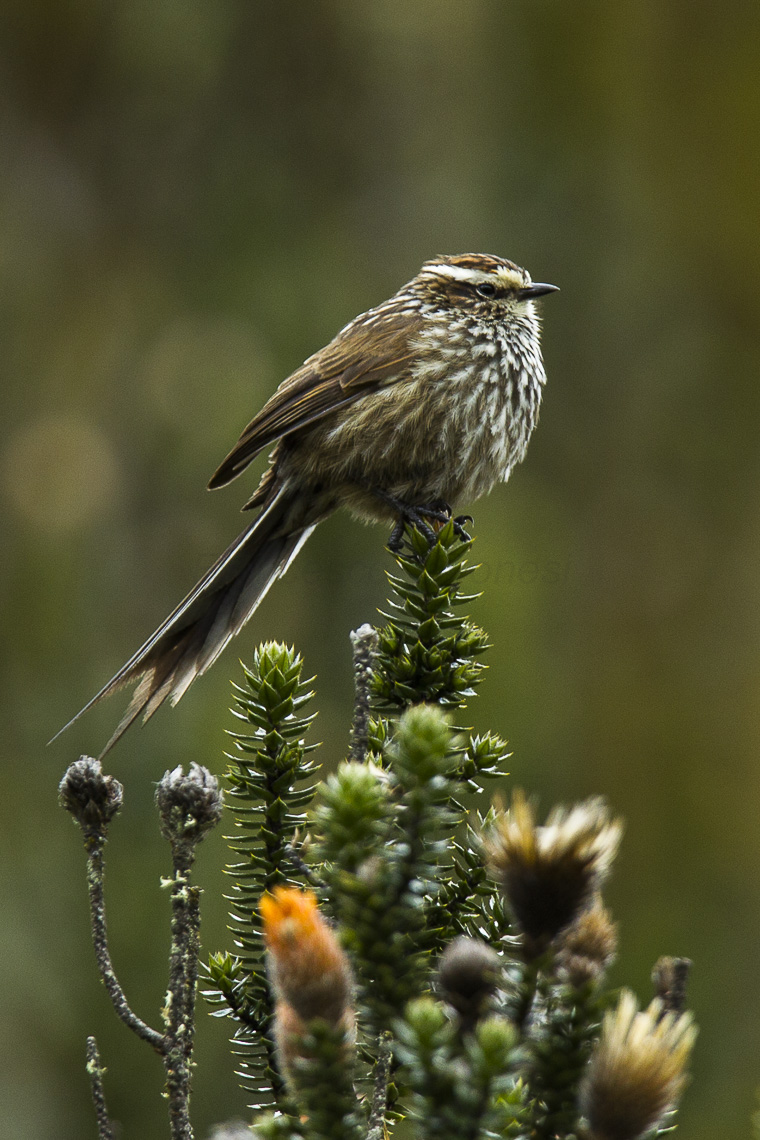
The Andean Tit-Spinetail is easily recognizable by its long, graduated tail, which is often held upright. Adults possess a distinctive plumage characterized by a brownish back, grayish underparts, and a striking rufous crown. This crown sets it apart from many other Furnariidae members. Juveniles, however, tend to have less pronounced crown coloring and slightly duller plumage overall.
In terms of sexual dimorphism, males and females of the Andean Tit-Spinetail appear quite similar, making field identification based on sex challenging without behavioral context. However, males may sometimes show slightly brighter plumage during the breeding season, a subtle cue for the observant birder.
When comparing the Andean Tit-Spinetail to similar species, such as the Rusty-crowned Tit-Spinetail, careful attention should be paid to the specific shade and pattern of the crown and back. In flight, the Andean Tit-Spinetail presents a unique silhouette with its long tail trailing behind, often appearing as an agile, darting presence among mountain scrub and shrubland. Its perching posture involves a characteristic flick of the tail, a behavior that can aid in its identification.
Having trouble telling birds apart? Upload a photo to our bird identification tool for an instant species match.
Andean Tit-Spinetail Habitat and Range
Preferred Habitat
The Andean Tit-Spinetail primarily inhabits high-altitude mountain regions, favoring the open scrublands and Polylepis woodlands of the Andes. These habitats are typically found at elevations ranging from 2,500 to 4,500 meters. The bird is well adapted to the cool, often harsh climate of these altitudes, where vegetation is sparse and temperatures can fluctuate dramatically.
Seasonal habitat shifts are not common for the Andean Tit-Spinetail, as its specialized adaptation allows it to thrive year-round in these challenging environments. Unlike some avian species, it does not typically venture into urban areas, as it relies heavily on the unique vegetation and ecological niches provided by its high-altitude habitats. The presence of the Andean Tit-Spinetail is often an indicator of the health of the Polylepis woodlands, which are vital ecosystems for many Andean species.
Geographic Range
The range of the Andean Tit-Spinetail extends along the Andes, from Venezuela in the north, through Colombia, Ecuador, Peru, and Bolivia, reaching as far south as northern Argentina. This extensive range reflects its adaptability to a variety of high-altitude environments across South America. Within this range, the bird is primarily non-migratory, maintaining a stable presence in its preferred habitats year-round.
Population density tends to be higher in areas where Polylepis woodlands are well-preserved, as these provide essential resources and shelter. However, the bird's distribution can be patchy, influenced by habitat degradation and deforestation. Conservation efforts are critical in maintaining these population hubs, particularly in countries like Peru and Bolivia, where deforestation poses a significant threat to its preferred habitats.
Want to know which birds visit your area? Browse our backyard birds by location guides for region-specific species lists.
What Does the Andean Tit-Spinetail Eat?
The diet of the Andean Tit-Spinetail consists primarily of insects, which it skillfully extracts from the bark and foliage of shrubs and trees in its mountainous habitat. This bird employs a variety of foraging techniques, including gleaning and probing, to capture its prey. The size of its typical prey ranges from small to medium-sized insects, such as beetles and caterpillars.
Seasonal changes in diet are minimal, as the Andean Tit-Spinetail remains in the same habitat throughout the year. However, occasional consumption of plant material like seeds and berries may occur, especially during times when insect availability is reduced. Active throughout the day, the bird's feeding schedule consists of frequent foraging intervals, ensuring it meets its energy needs in the demanding high-altitude environment.
Andean Tit-Spinetail Behavior and Social Structure
The Andean Tit-Spinetail exhibits a complex social structure, often observed in small flocks outside the breeding season. These flocks may consist of family groups or mixed-species gatherings, highlighting the bird's sociable nature. During the breeding season, territorial behavior becomes more pronounced, with pairs defending nesting sites and foraging territories fiercely.
Courtship displays involve vocalizations and synchronized movements between pairs. These displays strengthen pair bonds and ensure successful mating. In response to predators, such as hawks or owls, the Andean Tit-Spinetail relies on its agility and the cover provided by dense vegetation. Alarm calls are used to alert others in the flock, prompting a coordinated escape.
Daily activity patterns include periods of intense foraging activity interspersed with rest and preening. The bird's adaptability to its environment allows it to maintain consistent activity levels, even in the face of changing weather conditions and resource availability.
Andean Tit-Spinetail Nesting and Reproduction
The Andean Tit-Spinetail constructs its nest in crevices among rocks, tree cavities, or dense shrubbery, using materials such as grasses, moss, and feathers to create a well-insulated structure. The location of the nest is typically chosen for its protection from the elements and predators.
A typical clutch consists of two to four eggs, with incubation lasting approximately 14 to 16 days. Both male and female share incubation duties, although the female may take the lead. After hatching, the young remain in the nest for another two to three weeks, during which time both parents are involved in feeding and caring for the chicks.
The number of broods per year is generally limited to one, given the demanding environmental conditions and the high energy expenditure required for raising young in these high-altitude regions.
Andean Tit-Spinetail Sounds and Vocalizations
The primary song of the Andean Tit-Spinetail is a series of rapid, high-pitched notes, often described as a trilling sequence. This song is used predominantly during the breeding season to establish territory and attract mates. Call notes are typically short and sharp, serving as communication between flock members.
Alarm calls are harsher and more urgent, alerting others to potential threats. The bird's vocal activity peaks during the dawn chorus, when it joins other avian species in a symphony that heralds the start of the day. The Andean Tit-Spinetail’s sounds can be likened to the rapid ticking of a small clock, providing a distinctive auditory cue for identification.
Interesting Facts About the Andean Tit-Spinetail
- 1The Andean Tit-Spinetail has adapted to altitudes where oxygen levels are significantly lower than at sea level, showcasing its remarkable physiological resilience.
- 2This species can be a valuable indicator of the health of Polylepis forests, which are unique ecosystems in the Andes.
- 3Despite being a small bird, the Andean Tit-Spinetail is known for its agile climbing abilities, often seen darting through dense vegetation.
- 4The long tail of the Andean Tit-Spinetail is not just for show; it aids in balance and maneuverability as the bird forages among branches.
- 5While primarily insectivorous, the Andean Tit-Spinetail has been observed occasionally consuming seeds, especially when insect prey is scarce.
- 6The Andean Tit-Spinetail exhibits a unique nesting strategy by utilizing natural crevices and cavities to protect its young from the harsh Andean climate.
- 7Its presence in high-altitude ecosystems makes it a critical species for understanding avian adaptation to extreme environments.
Andean Tit-Spinetail Conservation Status
Currently, the Andean Tit-Spinetail is not considered globally threatened and is listed as Least Concern by the IUCN. However, its population is believed to be declining due to habitat loss and fragmentation, particularly the degradation of Polylepis woodlands. Conservation efforts focus on habitat preservation and restoration, with initiatives in place to protect key areas in countries like Peru and Bolivia. Historical population changes have been linked primarily to human activities, including deforestation and agricultural expansion. Continued monitoring and conservation initiatives are essential to ensure the long-term survival of the species in its natural habitat.
Other Furnariidae Species


Birds Similar to the Andean Tit-Spinetail
These species are often confused with the Andean Tit-Spinetail due to similar appearance or overlapping range.
