Anthus bosniaskii
Anthus bosniaskii
Order: Passeriformes / Family: Motacillidae
About the Anthus bosniaskii
The Anthus bosniaskii, commonly known as Blyth's Pipit, presents a fascinating study in adaptation to open landscapes across its range. This species thrives in the expansive grasslands and steppe regions of Central Asia, from the Altai Mountains to the plains of Mongolia. Its presence in these areas underscores the ecological importance of these habitats, which support a diverse range of avian life. Blyth's Pipit plays a crucial role in the ecosystem by controlling insect populations, a staple of its diet, and by serving as prey for larger raptors. Seasonal migrations take the Blyth's Pipit from its breeding grounds in Asia to wintering areas in the Indian subcontinent, where it inhabits rice paddies and agricultural fields. This migration underscores its adaptability to different environments, although it prefers open areas for foraging. Blyth's Pipit is a ground-nesting bird, which makes it particularly susceptible to habitat disturbance and changes in land use. The species' ability to thrive in different habitats during its annual cycle highlights its ecological flexibility. During breeding season, males display vigorous territorial behaviors, often involving conspicuous aerial displays to attract mates and deter rivals. The conservation of Blyth's Pipit is linked to the preservation of its natural habitats, which face threats from agricultural expansion and habitat fragmentation. Understanding the life cycle and habitat needs of Blyth's Pipit is vital for conservation efforts, as it is a species that can indicate the health of grassland ecosystems.
The Anthus bosniaskii belongs to the family Motacillidae, within the order Passeriformes. These birds typically live average 3-4 years with a max recorded of 7 years..
How to Identify a Anthus bosniaskii
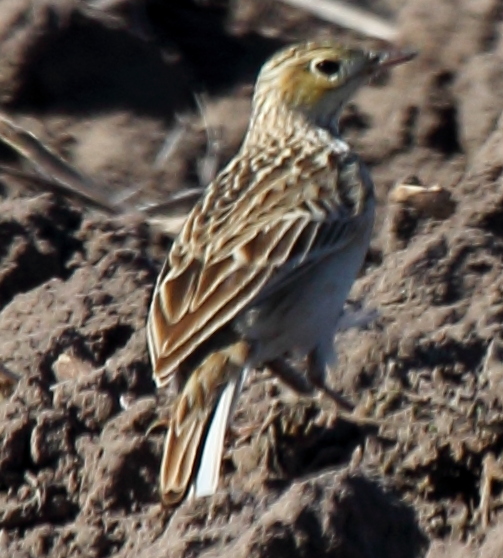
Blyth's Pipit can be identified by its streaked brown upperparts and pale underparts, with a subtle buff tone on the breast. The bird's crown and back are marked with fine, dark streaks, while its wings display two faint wing bars. Adults show a distinct white outer tail feather, which becomes apparent in flight. Juveniles resemble adults but often exhibit more pronounced streaking on the underparts. Males and females are similar in appearance, making sex differentiation challenging in the field. Blyth's Pipit can be confused with similar species like the Richard's Pipit, Anthus richardi, but is generally smaller and less robust, with shorter legs and a more delicate bill. In flight, Blyth's Pipit shows a slender silhouette with an undulating flight pattern. When perched, it often adopts an upright stance, which aids in scanning its surroundings for potential threats.
Having trouble telling birds apart? Upload a photo to our bird identification tool for an instant species match.
Anthus bosniaskii Habitat and Range
Preferred Habitat
Blyth's Pipit is predominantly associated with grassland habitats, favoring open plains and steppe regions. It thrives at elevations ranging from lowland fields to upland meadows. During breeding, it inhabits the open grasslands of Central Asia, while in winter, it moves to agricultural fields and open country in the Indian subcontinent. Seasonal shifts see it occupying different habitats, yet always favoring open landscapes. Urban presence is minimal, as it prefers rural settings where natural grassland remains undisturbed.
Geographic Range
The breeding range of Blyth's Pipit spans the grasslands of Central Asia, including Kazakhstan, Mongolia, and parts of Russia. During its migration, it travels south through China and Tibet, reaching wintering grounds in India, Nepal, and Pakistan. These areas provide the open fields and agricultural lands it requires outside the breeding season. Population density is highest in its breeding range, particularly in regions with extensive grassland. Migration corridors follow major river valleys and mountain passes, facilitating its journey between breeding and wintering areas.
Want to know which birds visit your area? Browse our backyard birds by location guides for region-specific species lists.
What Does the Anthus bosniaskii Eat?
Blyth's Pipit's diet primarily consists of insects, particularly grasshoppers and beetles, which it captures using a methodical walk-and-peck foraging technique. During the breeding season, its diet remains largely insectivorous, although it may occasionally consume seeds. In winter, when insect availability decreases, it relies more on seeds and small invertebrates found in cultivated fields. Its foraging typically occurs during daylight hours, with peak activity in the early morning and late afternoon. Prey size varies, but the bird generally consumes small to medium-sized insects, suited to its slender bill and agile foraging style.
Anthus bosniaskii Behavior and Social Structure
Blyth's Pipit exhibits a solitary or paired existence during the breeding season, with males fiercely defending their territories through song and aerial displays. These displays involve short, fluttering flights with exaggerated wing beats, often accompanied by singing. During migration and winter, the species may form loose flocks, though it remains largely inconspicuous. When threatened, Blyth's Pipit employs a series of rapid, low flights to evade predators, seeking cover in grass or low shrubs. Daily activities include periods of foraging interspersed with rest and preening. Its response to predators includes both vocal alarm calls and evasive maneuvers.
Anthus bosniaskii Nesting and Reproduction
The nesting habits of Blyth's Pipit involve constructing a simple cup-shaped nest on the ground, hidden among dense grass or low vegetation. The nest is made from grass, roots, and other plant materials, lined with finer grasses for insulation. A typical clutch consists of 3-5 eggs, with incubation primarily undertaken by the female, lasting about 11-14 days. Both parents participate in feeding the young, which fledge approximately 12-14 days post-hatching. Blyth's Pipit usually raises one brood per year, although favorable conditions may lead to occasional second broods.
Anthus bosniaskii Sounds and Vocalizations
The primary song of Blyth's Pipit is a series of melodious trills and whistles, delivered in a rhythmic sequence that rises and falls in pitch. Its call notes are simple and sharp, often described as 'tsip' sounds, used for communication between individuals. Alarm calls are more urgent, consisting of repeated high-pitched notes. During the dawn chorus, males sing persistently, marking territory and attracting mates. The song's quality is sweet and musical, reminiscent of other pipits but distinct in its phrasing.
Interesting Facts About the Anthus bosniaskii
- 1Blyth's Pipit is named after the British zoologist Edward Blyth, who contributed significantly to the study of Indian birds.
- 2Unlike many pipits, Blyth's Pipit shows a preference for habitats at varying elevations, from sea level to high-altitude regions.
- 3The species migrates over 3,000 kilometers between its breeding and wintering grounds, showcasing impressive navigational skills.
- 4Blyth's Pipit can be elusive, often blending seamlessly into the grassland, relying on camouflage to avoid predators.
- 5During courtship, male Blyth's Pipits perform dramatic aerial displays, showcasing their fitness and attracting potential mates.
Anthus bosniaskii Conservation Status
Blyth's Pipit holds a status of Least Concern according to the IUCN, with populations considered stable. However, habitat loss due to agricultural expansion poses a significant threat. Conservation efforts focus on preserving grassland ecosystems and managing land to support biodiversity. Historically, population numbers have fluctuated with land use changes, making habitat protection critical. Monitoring programs aim to track population trends and inform conservation strategies.