
Band-bellied Crake
Porzana paykullii
Order: Gruiformes / Family: Rallidae
Wikimedia Commons
About the Band-bellied Crake
The Band-bellied Crake, scientifically known as Porzana paykullii, is a small, elusive bird that belongs to the family Rallidae and order Gruiformes. This species is notable for its striking plumage and secretive nature, often making it a challenge for birders to spot. The Band-bellied Crake primarily inhabits wetland areas across East Asia, particularly in China, Japan, and Korea, where it frequently dwells in marshes, rice paddies, and reed beds. These environments offer the dense cover and shallow waters that cater to the crake’s needs for feeding and nesting. Despite its elusive reputation, the Band-bellied Crake plays a significant ecological role in its habitat. It acts as both a predator and prey, contributing to the balance of wetland ecosystems. Its diet consists of small invertebrates and plant material, which helps control insect populations and seed dispersion. In turn, the crake is preyed upon by larger birds and mammals, thus integrating into the broader food web. Seasonal behaviors of the Band-bellied Crake are influenced by its migratory patterns. During the breeding season, which occurs in the warmer months, these birds establish territories in suitable wetland habitats. Post-breeding, they migrate to more temperate regions, often moving southward in search of warmer climates and abundant food resources. This migration highlights the crake's adaptability and resilience as it navigates various environmental challenges. The conservation status of the Band-bellied Crake is currently of concern due to habitat loss and degradation. Wetland drainage and agricultural expansion pose significant threats, underscoring the need for targeted conservation efforts. Protecting wetland habitats and ensuring the availability of suitable breeding grounds are crucial measures to support the survival of the Band-bellied Crake.
The Band-bellied Crake belongs to the family Rallidae, within the order Gruiformes. These birds typically live 5-7 years in the wild, with limited data on maximum age..
How to Identify a Band-bellied Crake
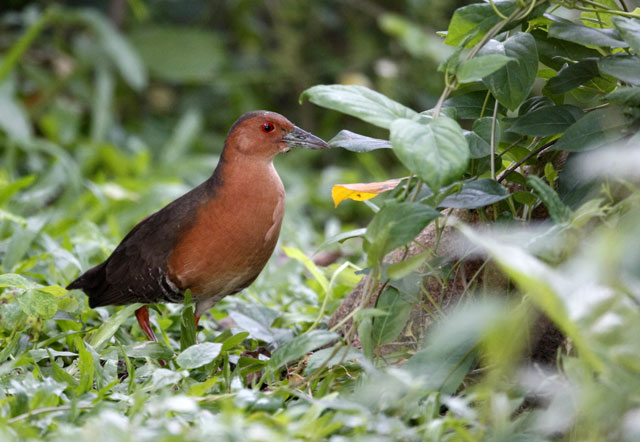
Adult Band-bellied Crakes exhibit a distinctive plumage characterized by chestnut-brown upperparts and a series of subtle white bands across their underparts. These bands, however, are more prominent in some individuals, providing a key identification trait. The crake's underparts also display a grayish hue, tapering into a short tail. Juvenile crakes, in contrast, have a duller appearance, with less defined banding and a more muted coloration overall. Both male and female Band-bellied Crakes appear similar, though males may exhibit slightly brighter plumage. Differentiating between sexes in the field can be challenging without close observation. This species can be confused with the slightly larger Ruddy-breasted Crake, but the Band-bellied Crake's white banding and smaller size offer distinguishing features. In flight, the Band-bellied Crake presents a silhouette with rounded wings and a short, straight tail. It typically flies low over water or vegetation, using rapid wingbeats. When perched, these crakes often remain low, favoring dense cover where their cryptic coloring provides excellent camouflage.
Having trouble telling birds apart? Upload a photo to our bird identification tool for an instant species match.
Band-bellied Crake Habitat and Range
Preferred Habitat
The Band-bellied Crake predominantly inhabits wetland areas, thriving in environments such as marshes, swamps, rice paddies, and reed beds. These habitats, rich in invertebrates and aquatic vegetation, provide both food and cover. The crake’s preference for low-lying areas often places it at elevations below 1,000 meters. During different seasons, the Band-bellied Crake may shift habitats slightly in response to changes in water levels and food availability. In regions with significant human activity, such as agricultural landscapes, these birds may also be observed in artificial wetlands like rice paddies. Despite their adaptability, Band-bellied Crakes are rarely found in urban environments, preferring rural or semi-rural settings where wetland habitats are more prevalent.
Geographic Range
The Band-bellied Crake exhibits a range primarily in East Asia, where it breeds from northeastern China to the Korean peninsula and parts of Japan. During the breeding season, the crake occupies suitable wetland habitats within these areas. As the seasons change, many Band-bellied Crakes migrate southward to escape the harsh winter conditions. Their wintering grounds extend to southern China and occasionally reach northern parts of Southeast Asia. Migration corridors often follow major river systems and wetland complexes, providing necessary stopover sites. Population density hotspots include the expansive wetlands along the Yangtze River in China, which offer abundant resources for both breeding and migrating individuals.
Want to know which birds visit your area? Browse our backyard birds by location guides for region-specific species lists.
What Does the Band-bellied Crake Eat?
The diet of the Band-bellied Crake primarily consists of small invertebrates, including insects, mollusks, and crustaceans, which it actively forages for in shallow waters and mudflats. Plant material, such as seeds and aquatic vegetation, forms a secondary component of its diet, especially during periods when invertebrate prey is scarce. Seasonal changes in food availability influence the crake's diet, with a greater reliance on plant matter in the non-breeding season. The Band-bellied Crake employs a foraging technique that involves probing and picking at the substrate with its bill, often seen moving methodically through dense vegetation. Typical prey items are small, generally less than 2 centimeters in size, allowing the crake to feed efficiently throughout the day.
Band-bellied Crake Behavior and Social Structure
Band-bellied Crakes exhibit solitary and secretive behavior, often remaining hidden within dense vegetation. They are territorial during the breeding season, with males defending their territories by vocalizing and occasionally engaging in physical displays. Courtship displays involve both vocalizations and a series of mutual posturing between mates. Outside the breeding season, these crakes become less territorial and may occasionally be observed in loose associations, particularly in areas with abundant food resources. Their response to predators is characterized by stealth, often freezing or retreating into cover rather than taking flight. Daily activity patterns are crepuscular, with peak activity occurring during the early morning and late afternoon, coinciding with optimal foraging conditions.
Band-bellied Crake Nesting and Reproduction
The Band-bellied Crake constructs a nest that consists of a shallow depression lined with plant material, often concealed within dense vegetation such as reeds or grasses. Nests are typically located low to the ground or slightly elevated on tussocks, ensuring protection from flooding. The clutch size ranges from 4 to 7 eggs, with both parents sharing incubation duties over a period of approximately 18 to 21 days. Once hatched, the young are precocial, leaving the nest shortly after hatching but remaining under parental care. Fledging occurs within 35 to 40 days, during which time the young develop the necessary skills for independent survival. Band-bellied Crakes usually produce one brood per year, though favorable conditions may lead to a second brood.
Band-bellied Crake Sounds and Vocalizations
The primary song of the Band-bellied Crake is a series of soft, rhythmic ‘kek-kek-kek’ notes, each note delivered with a consistent pitch and quality. These vocalizations serve as territorial calls and can be heard during the breeding season. Call notes include a sharper ‘pip’ sound, used for communication between individuals. Alarm calls are harsher and more abrupt, alerting nearby crakes to potential threats. During the dawn chorus, Band-bellied Crakes participate actively, their calls blending into the symphony of wetland sounds. The song bears some resemblance to the calls of other crakes, though it can be distinguished by its unique rhythm and clarity.
Interesting Facts About the Band-bellied Crake
- 1The Band-bellied Crake's scientific name, Porzana paykullii, honors the Swedish entomologist Gustaf von Paykull.
- 2Unlike many birds, the Band-bellied Crake prefers to run rather than fly when startled, showcasing its terrestrial adaptations.
- 3Peak migration for the Band-bellied Crake coincides with the autumn equinox, a time when many migratory birds undertake long journeys.
- 4The Band-bellied Crake's elusive nature makes it challenging for ornithologists to study, adding to its mystique among birdwatchers.
- 5In its preferred habitats, the Band-bellied Crake often coexists with the Ruddy-breasted Crake, although the latter is more numerous.
- 6The Band-bellied Crake can survive in both freshwater and brackish wetlands, demonstrating its adaptability to different water conditions.
- 7During the breeding season, male Band-bellied Crakes are noted for their persistent calling, which serves to establish and defend territories.
Band-bellied Crake Conservation Status
The IUCN lists the Band-bellied Crake as Near Threatened, with population numbers showing a decreasing trend due to habitat loss. The primary threats include wetland drainage, agricultural expansion, and pollution. Conservation efforts focus on habitat protection and management, including the restoration of degraded wetlands. Historically, the population of Band-bellied Crakes has suffered from significant declines in areas where wetland habitats have diminished. Continued monitoring and research are essential to understand population dynamics and implement effective conservation strategies.
Other Rallidae Species


Birds Similar to the Band-bellied Crake
These species are often confused with the Band-bellied Crake due to similar appearance or overlapping range.
