
Barred Eagle-Owl
Ketupa sumatrana
Order: Strigiformes / Family: Strigidae
Wikimedia Commons
About the Barred Eagle-Owl
The Barred Eagle-Owl, or Ketupa sumatrana, stands as a remarkable example of avian adaptation within the Strigiformes order. This bird, belonging to the family Strigidae, is predominantly found in the lush, dense forests of Southeast Asia, showcasing its predilection for tropical habitats. Its presence spans across regions like the Malay Peninsula, Sumatra, and Borneo, where it resides within primary and secondary forested areas. Despite its seemingly elusive nature, the Barred Eagle-Owl plays a vital ecological role as both predator and prey within its ecosystem. It helps control populations of small mammals and other vertebrates, thereby maintaining a balance within the food web. During the breeding season, which typically coincides with the onset of the rainy season, these owls become more vocal and exhibit increased territorial activity. They are known for their haunting calls that echo through the forest at dusk and dawn. Unlike many other owl species, the Barred Eagle-Owl does not engage in long migrations, remaining a year-round resident of its chosen territories. Its adaptability to various forest types, including selectively logged forests, demonstrates its resilience in the face of habitat modification. However, the species requires large areas of contiguous forest to thrive, making it susceptible to the pressures of deforestation and habitat fragmentation. As an apex nocturnal predator, the Barred Eagle-Owl influences the structure of its ecological community by impacting prey populations and competing with other nocturnal hunters. This owl's adaptability, coupled with its role as a predator, underscores its significance within the tropical ecosystems of Southeast Asia.
The Barred Eagle-Owl belongs to the family Strigidae, within the order Strigiformes. These birds typically live typically 15-20 years in the wild..
How to Identify a Barred Eagle-Owl
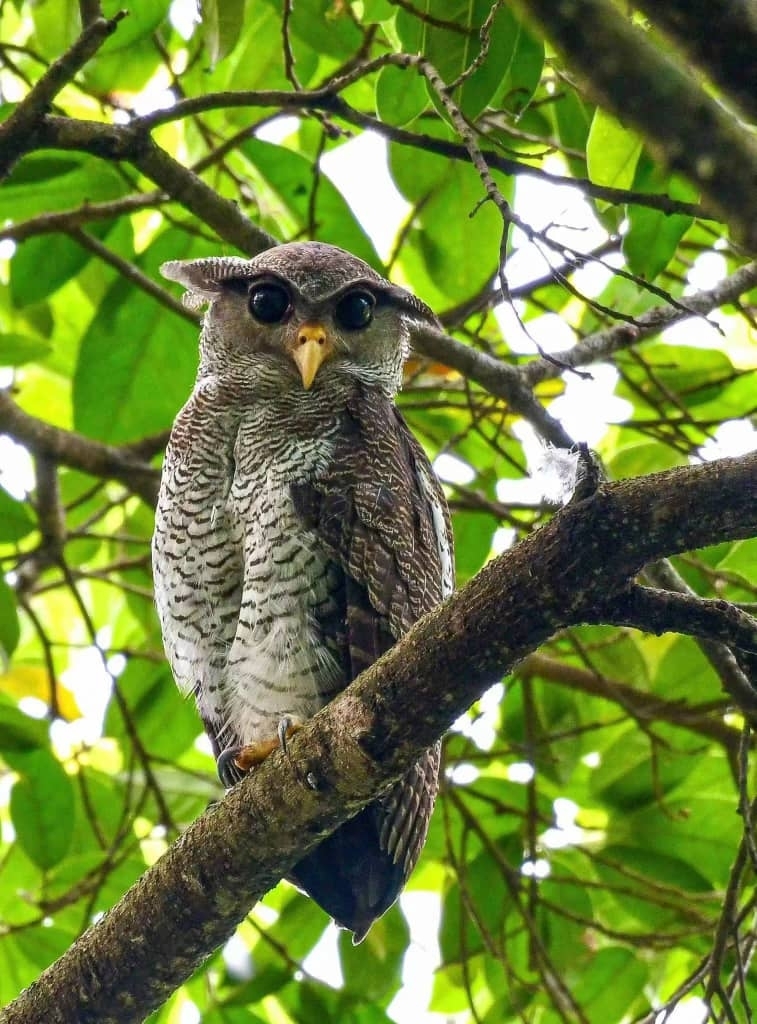
The Barred Eagle-Owl is easily recognized by its distinctive plumage and striking facial features. Adult individuals possess prominent horizontal barring across their chest and belly, which contrasts with the more uniform darker brown of their wings and back. Their facial disc is strikingly lighter, often appearing white or pale gray, accented by bold black markings around the eyes. The eyes themselves are a piercing yellow, a standout feature that aids in identification. Males and females are similar in appearance, though females tend to be slightly larger, a common trait among birds of prey. Juvenile Barred Eagle-Owls resemble adults but have fluffier plumage and less distinct barring, which becomes more pronounced with age. When perched, this owl exhibits an upright posture with its ear tufts often held erect, adding to its formidable appearance. In flight, the Barred Eagle-Owl displays broad wings and a relatively short tail, providing a silhouette that is unmistakable to experienced birders. While other owls such as the Buffy Fish Owl may share its range, the Barred Eagle-Owl's distinctive barring and larger size help distinguish it from similar species.
Having trouble telling birds apart? Upload a photo to our bird identification tool for an instant species match.
Barred Eagle-Owl Habitat and Range
Preferred Habitat
The Barred Eagle-Owl primarily inhabits lowland rainforests, often found at elevations up to 1,500 meters. These owls thrive in both primary and secondary forests, showing a preference for areas with dense canopy cover. While they are most commonly associated with undisturbed tracts of forest, they can also adapt to selectively logged areas, provided sufficient tree cover remains. Unlike some other owl species, the Barred Eagle-Owl rarely ventures into urban environments, preferring the seclusion and resources provided by forested landscapes. Seasonal habitat shifts are minimal due to their non-migratory nature, allowing them to establish and maintain territories year-round. The presence of this species in rural and forested areas indicates healthy forest ecosystems, as they require substantial tracts of habitat to support their predatory lifestyle.
Geographic Range
The Barred Eagle-Owl's range is largely confined to Southeast Asia, encompassing the Malay Peninsula, Sumatra, Borneo, and parts of southern Thailand. Its distribution is closely linked to suitable forest habitats, limiting its presence to regions where dense, humid forests prevail. Within these areas, their population densities can vary, with higher concentrations often found in vast, undisturbed forest tracts. This owl is a resident species, maintaining territories across its range without engaging in long-distance migrations. While some local movements may occur, especially in response to food availability or environmental changes, the Barred Eagle-Owl remains largely sedentary within its home range. The stability of their populations is largely dependent on the preservation of forest habitats, as deforestation poses a significant threat to their continued survival.
Want to know which birds visit your area? Browse our backyard birds by location guides for region-specific species lists.
What Does the Barred Eagle-Owl Eat?
The Barred Eagle-Owl's diet predominantly consists of small to medium-sized mammals, birds, and reptiles. Rodents make up a significant portion of their diet, with the owl's keen sense of hearing and vision allowing it to hunt effectively at night. Their diet also includes snakes, lizards, and occasionally frogs, showcasing their versatility as predators. Seasonal changes in prey availability may influence their diet, with an increase in bird predation during certain times of the year. These owls employ a sit-and-wait hunting strategy, perching silently before swooping down on unsuspecting prey. Their powerful talons and beak enable them to capture and dispatch prey efficiently. Feeding activity primarily occurs at night, with peak hunting periods at dusk and dawn. The Barred Eagle-Owl's role as a predator helps regulate prey populations, contributing to the ecological balance within its habitat.
Barred Eagle-Owl Behavior and Social Structure
Socially, the Barred Eagle-Owl is primarily solitary, coming together only for breeding purposes. They are highly territorial, with pairs maintaining and defending their territories through vocalizations and display flights. Courtship involves a series of calls and aerial displays, with both sexes participating in mutual preening and nest site selection. During the day, these owls roost in secluded spots, often in dense foliage or along tree branches, remaining inactive until dusk. Their nocturnal activities include hunting and territory patrols, with males often more vocal than females. The Barred Eagle-Owl exhibits a strong response to predators or intruders, using alarm calls to alert others of danger. Their daily activity pattern revolves around the availability of prey, with increased activity during periods of high prey density.
Barred Eagle-Owl Nesting and Reproduction
Barred Eagle-Owls typically nest in the cavities of large trees, utilizing natural hollows or abandoned nests of other large birds. The choice of nesting site is critical, as it must provide protection from the elements and potential predators. The female lays a clutch of 1 to 2 eggs, with incubation lasting approximately 28 to 35 days. During this period, the female remains on the nest while the male provides food. After hatching, both parents are involved in feeding and protecting the chicks. The fledging period lasts about 6 to 8 weeks, during which young owls gradually develop their flight capabilities. In a typical year, Barred Eagle-Owls may raise a single brood, although favorable conditions can occasionally lead to a second. The parental roles are well defined, with males primarily responsible for hunting and females focusing on incubation and chick rearing.
Barred Eagle-Owl Sounds and Vocalizations
The Barred Eagle-Owl is known for its deep, resonant hoots that are often described as hauntingly beautiful. Their primary call consists of a series of low-pitched 'woo-hoo' notes, which can carry over long distances in the forest. These calls serve both territorial and mating purposes, particularly during the breeding season. In addition to the primary song, Barred Eagle-Owls produce various other vocalizations, including sharp screeches and softer cooing sounds, used for communication between mates. Alarm calls are more abrupt and higher-pitched, serving to warn of potential threats. The owl's vocal repertoire is most active at dawn and dusk, contributing to the atmospheric soundscape of their forested habitats.
Interesting Facts About the Barred Eagle-Owl
- 1The Barred Eagle-Owl can have a wingspan of up to 125 cm, making it one of the larger owls in its range.
- 2Despite their size, Barred Eagle-Owls are incredibly stealthy hunters, using silent flight to approach prey undetected.
- 3The owl's ear tufts are not related to hearing but are used for communication and camouflage among the forest foliage.
- 4Barred Eagle-Owls have been observed using the same roosting sites for several years, demonstrating strong site fidelity.
- 5Their yellow eyes are adapted for low-light conditions, allowing them to hunt effectively during the night.
- 6Unlike some other owl species, Barred Eagle-Owls do not build their own nests, often relying on natural tree cavities.
- 7This owl species has a relatively long lifespan in the wild, often living over 10 years under favorable conditions.
Barred Eagle-Owl Conservation Status
The Barred Eagle-Owl currently holds a status of Least Concern according to the IUCN, though its populations face pressure from habitat loss due to deforestation and land conversion. While the species remains relatively stable in protected areas, continued logging and forest fragmentation pose significant threats to its habitat. Conservation efforts focus on the preservation of large, contiguous forest tracts, essential for the owl's survival. Historical records suggest a decline in population numbers correlated with habitat destruction, emphasizing the need for sustained conservation initiatives. Protected areas and national parks within its range play a crucial role in safeguarding this species, ensuring that the Barred Eagle-Owl continues to thrive in its natural habitat.


