
Black-and-white Hawk-Eagle
Spizaetus melanoleucus
Order: Accipitriformes / Family: Accipitridae
Wikimedia Commons
About the Black-and-white Hawk-Eagle
The Black-and-white Hawk-Eagle, Spizaetus melanoleucus, is a striking raptor known for its bold black and white plumage. It inhabits the lush tropical and subtropical forests of Central and South America, specifically thriving in countries like Brazil, Colombia, and Peru. This species plays a critical role in its ecosystem as an apex predator, helping to control prey populations and maintain ecological balance. The Black-and-white Hawk-Eagle typically occupies dense forest canopies, where it can expertly maneuver through the trees in search of food. Its presence is often an indicator of a healthy forest ecosystem. Seasonally, the Black-and-white Hawk-Eagle may adjust its range slightly, depending on prey availability, although it does not perform long-distance migrations. Instead, this raptor is mostly sedentary, with individuals maintaining territories that they vigorously defend. Their territories are often defined by the abundance of prey and suitable nesting sites, which are typically located high in the forest canopy. This eagle's keen eyesight and powerful flight make it an efficient hunter, capable of catching a variety of birds and small mammals. Its role as a top predator makes it an integral part of the forest food web. The Black-and-white Hawk-Eagle is also significant to local cultures, often featured in indigenous folklore and viewed as a symbol of power and freedom. Its striking appearance and impressive hunting skills make it a favorite subject for birdwatchers and researchers alike, contributing to its ecological and cultural significance. Despite its importance, the Black-and-white Hawk-Eagle faces threats from habitat loss and fragmentation, primarily due to deforestation for agriculture and logging. Conservation efforts focusing on habitat preservation and restoration are crucial in ensuring the survival of this magnificent bird.
The Black-and-white Hawk-Eagle belongs to the family Accipitridae, within the order Accipitriformes. These birds typically live average 12-15 years, with some individuals reaching 20 years..
How to Identify a Black-and-white Hawk-Eagle
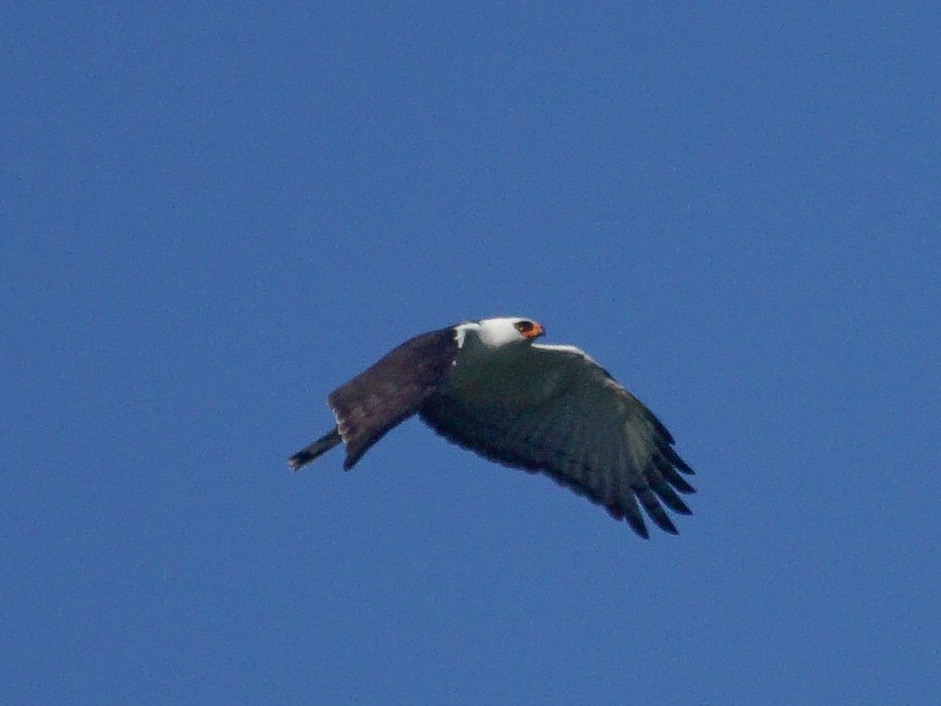
The Black-and-white Hawk-Eagle is a medium-sized raptor, measuring approximately 55 to 65 centimeters in length with a wingspan reaching up to 132 centimeters. Adults display a striking contrast of black upperparts and white underparts, which makes them relatively easy to identify. The head features a prominent black crest, which may be raised when the bird is alert or agitated. Juveniles differ slightly, as they exhibit more mottled brown and white plumage that gradually transitions to the adult pattern as they mature. Both males and females have similar plumage, although females tend to be slightly larger. One potential source of confusion is the Ornate Hawk-Eagle, which also possesses a black and white color scheme. However, the Black-and-white Hawk-Eagle has a simpler, less ornamented pattern and lacks the distinctive throat markings found on its ornate counterpart. In flight, the Black-and-white Hawk-Eagle presents a distinct silhouette with broad wings and a short, fan-shaped tail. While perching, its posture is upright and alert, often on high branches where it can survey its surroundings with a commanding view.
Having trouble telling birds apart? Upload a photo to our bird identification tool for an instant species match.
Black-and-white Hawk-Eagle Habitat and Range
Preferred Habitat
The Black-and-white Hawk-Eagle predominantly inhabits tropical and subtropical forests, including lowland rainforests and montane regions. It is most commonly found in dense, mature forests with tall trees that provide ample cover and hunting opportunities. These areas are often remote, making the bird relatively rare to spot, even within its preferred habitat. The elevation range for this species varies widely, from sea level up to 1,800 meters, although it is more commonly observed in lower elevations. Seasonal shifts in habitat are minimal, as the species is largely sedentary, but slight movements within its territory may occur to exploit prey availability. Urban presence is rare, as the Black-and-white Hawk-Eagle tends to avoid heavily altered landscapes, preferring the undisturbed canopy of primary forests.
Geographic Range
The range of the Black-and-white Hawk-Eagle extends throughout Central and South America. It breeds primarily in countries such as Mexico, through Central America, including Costa Rica and Panama, and into South America, where it is found in Colombia, Ecuador, and Brazil. The species does not undertake long migrations, instead remaining within its established territories year-round. However, it does exhibit some altitudinal movement in response to food availability, moving to lower elevations during periods of prey scarcity. Areas of notable population density include the Amazon Basin, where the extensive forest cover supports a stable population. Despite its widespread range, the Black-and-white Hawk-Eagle is not commonly observed outside of its forest habitats, as it requires large territories and specific environmental conditions to thrive.
Want to know which birds visit your area? Browse our backyard birds by location guides for region-specific species lists.
What Does the Black-and-white Hawk-Eagle Eat?
The diet of the Black-and-white Hawk-Eagle is diverse, consisting primarily of medium-sized birds, such as parrots and pigeons, and small mammals like bats and squirrels. Opportunistic in nature, this raptor also preys on reptiles and amphibians when available. Seasonal variation in diet is influenced by prey availability, with more birds taken during the breeding season when they are more abundant. Foraging techniques are dynamic and involve soaring over the canopy to spot prey or perching silently before making a swift, powerful dive to capture its target. Prey size generally ranges from small to medium, ensuring the eagle can handle its catch efficiently. Feeding often occurs during the early morning and late afternoon, aligning with peak activity periods of many prey species.
Black-and-white Hawk-Eagle Behavior and Social Structure
The Black-and-white Hawk-Eagle is primarily solitary, maintaining and defending its territory with vigor. Territorial behavior includes aerial displays and vocalizations to deter intruders. During courtship, pairs perform synchronized flights and mutual calling to strengthen bonds. These displays are particularly prominent during the breeding season. While not social, the Black-and-white Hawk-Eagle exhibits some tolerance towards neighboring pairs, provided that territorial boundaries are respected. In response to predators or humans, this eagle is wary and tends to retreat to higher perches. Daily activity patterns involve periods of active hunting interspersed with rest and preening, especially during warmer midday hours.
Black-and-white Hawk-Eagle Nesting and Reproduction
Nesting for the Black-and-white Hawk-Eagle occurs high in the forest canopy, typically in tall trees that offer a strategic vantage point and protection from ground predators. Nests are large, constructed from sticks and lined with green leaves, providing a stable and comfortable environment for the eggs and chicks. A typical clutch consists of one to two eggs, with an incubation period lasting approximately 35 to 40 days. Both parents share incubation duties, although the female assumes the primary role while the male provides food. After hatching, chicks remain in the nest for about 50 to 60 days before fledging, during which time both parents continue to feed and protect them. Typically, the Black-and-white Hawk-Eagle raises one brood per year, with successful reproduction closely tied to food availability and environmental conditions.
Black-and-white Hawk-Eagle Sounds and Vocalizations
The vocalizations of the Black-and-white Hawk-Eagle, while not as elaborate as some other raptors, are distinctive and serve important communication functions. Its primary call is a series of sharp, whistling notes that rise in pitch, often used during territorial displays or when alerting a mate. Alarm calls are harsher and more rapid, intended to warn of potential threats. During the dawn chorus, these calls can be heard echoing through the forest, particularly during the breeding season when pairs are most vocal. While not melodious, the calls of the Black-and-white Hawk-Eagle are recognizable and carry well through the dense forest canopy.
Interesting Facts About the Black-and-white Hawk-Eagle
- 1The Black-and-white Hawk-Eagle can spot prey from over 100 meters away thanks to its exceptional eyesight.
- 2Unlike many raptors, the Black-and-white Hawk-Eagle hunts primarily within the forest canopy, showing remarkable agility.
- 3During courtship, pairs of Black-and-white Hawk-Eagles engage in synchronized aerial displays that can last several minutes.
- 4The species is known to occasionally steal prey from other raptors, demonstrating opportunistic behavior.
- 5Despite its striking appearance, the Black-and-white Hawk-Eagle blends well with the dappled light of the forest canopy.
- 6This eagle can live up to 15 years in the wild, provided it has access to adequate food and habitat.
- 7Its large, stick-built nests can reach up to 1.5 meters in diameter, providing a sturdy platform for raising young.
Black-and-white Hawk-Eagle Conservation Status
The Black-and-white Hawk-Eagle is currently listed as Near Threatened by the IUCN, with populations experiencing a decline due to habitat loss and fragmentation. Deforestation for agriculture and logging poses significant threats to its forest habitat. Conservation efforts focus on habitat protection and sustainable land-use practices to mitigate these impacts. Historically, the species has experienced fluctuations in population size, correlating with land-use changes in its range. Active monitoring and research are crucial to understanding population dynamics and implementing effective conservation strategies.
Other Accipitridae Species


Birds Similar to the Black-and-white Hawk-Eagle
These species are often confused with the Black-and-white Hawk-Eagle due to similar appearance or overlapping range.

