
Black-and-yellow Broadbill
Eurylaimus ochromalus
Order: Passeriformes / Family: Eurylaimidae
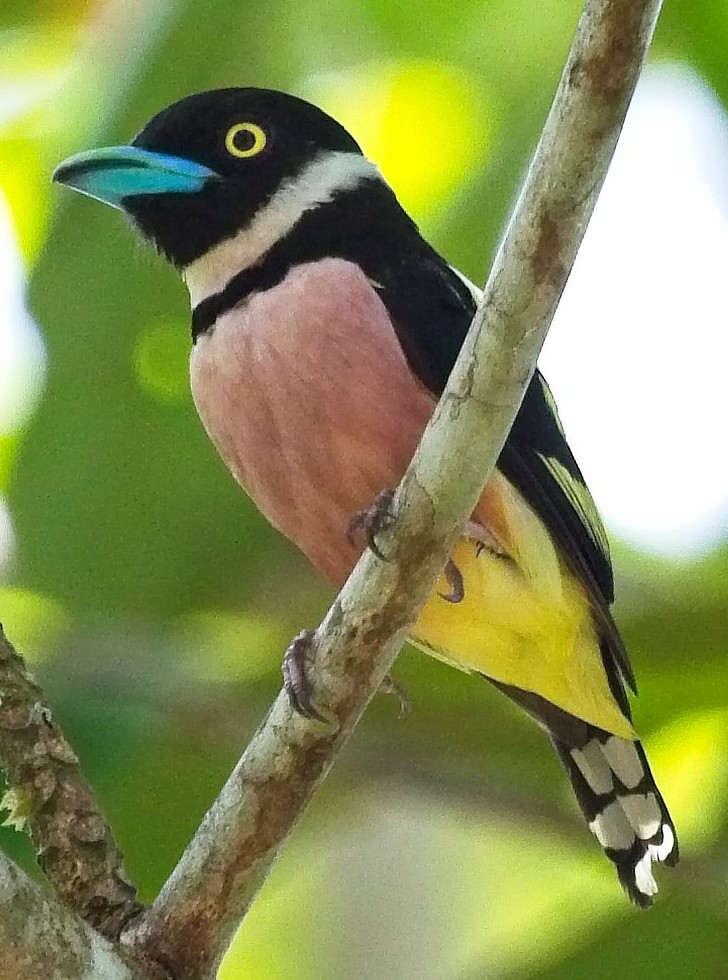
Wikimedia Commons
About the Black-and-yellow Broadbill
The Black-and-yellow Broadbill, scientifically known as Eurylaimus ochromalus, is a remarkable bird species belonging to the Eurylaimidae family, found predominantly in the dense, tropical rainforests of Southeast Asia. This species is especially prevalent in the lowland forests of Malaysia, Indonesia, and Thailand, where it plays a crucial role in the ecosystem as a predator of insects. The broadbill's presence is vital for maintaining insect populations, which in turn supports the delicate balance of forest biodiversity. The bird is often encountered in both primary and secondary forests, thriving in areas with dense foliage that offers ample feeding opportunities and protection from predators. During the breeding season, the Black-and-yellow Broadbill becomes more conspicuous, engaging in elaborate courtship displays and vocalizations that resonate through the forest canopy. These activities not only serve reproductive purposes but also reinforce territorial boundaries. Outside of the breeding season, the bird retains some territoriality, though it is generally more solitary or found in small family groups. Its preference for forested environments makes it susceptible to habitat destruction, yet its adaptability to secondary growth provides some resilience against the pressures of deforestation. Overall, the ecological role of the Black-and-yellow Broadbill extends beyond mere insect predation, as it contributes to the seed dispersal and pollination processes of the forest flora, indirectly supporting a myriad of other wildlife species.
The Black-and-yellow Broadbill belongs to the family Eurylaimidae, within the order Passeriformes. These birds typically live 5-8 years, with a maximum recorded of 10 years..
How to Identify a Black-and-yellow Broadbill
The Black-and-yellow Broadbill is a small bird, measuring approximately 15 centimeters in length. Its distinctive plumage makes it relatively easy to identify in the field. Adults exhibit a striking combination of black, yellow, and pink hues. The head and upper parts are predominantly black, with a bright yellow band running from the nape down the back. The underparts are a soft pinkish color, and the wings are a contrasting mix of black and white. Males and females share similar plumage, though males may have slightly brighter coloration. Juvenile birds, however, can be distinguished by their duller, more muted tones, lacking the full vibrancy of adult plumage. In flight, the Black-and-yellow Broadbill's silhouette is compact, with broad wings and a short tail. Its perching posture is often upright, and it can be observed resting on branches within the forest canopy. While its plumage is unique, the bird could potentially be confused with other broadbills, such as the Banded Broadbill, though the latter lacks the pink underparts and has a more uniform coloration. Birders should note the broadbill's distinctive size and coloration pattern when making identifications.
Having trouble telling birds apart? Upload a photo to our bird identification tool for an instant species match.
Black-and-yellow Broadbill Habitat and Range
Preferred Habitat
The Black-and-yellow Broadbill thrives in a range of forested habitats across Southeast Asia. It primarily inhabits lowland tropical rainforests but is also found in secondary forests and mangroves. These environments provide the dense canopy cover and abundant insect life that are crucial for the broadbill's survival. The bird typically occupies elevations ranging from sea level up to about 1,000 meters, although it is most common in the lower strata of the forest. In some regions, the broadbill may also inhabit edges of forest clearings or plantations, where it can exploit new feeding opportunities. Seasonal habitat shifts are minimal, as the species is largely sedentary, remaining within its home range year-round. While the Black-and-yellow Broadbill is not commonly found in urban areas, it may occasionally venture into gardens or parks adjacent to forested regions.
Geographic Range
The range of the Black-and-yellow Broadbill spans across the tropical regions of Southeast Asia. It is commonly found in countries such as Malaysia, Thailand, and Indonesia, particularly on the islands of Sumatra and Borneo. The bird's range also extends to the southern parts of Myanmar and the Philippines. Unlike many migratory birds, the Black-and-yellow Broadbill is largely resident, meaning it stays within its established range throughout the year. This sedentary nature is likely due to the consistent availability of food sources within its habitat. The broadbill's population density is higher in areas with extensive, undisturbed forest cover, although it can also be found in secondary growth areas where suitable habitat conditions are present. Within its range, the Black-and-yellow Broadbill may exhibit some local movements in response to changes in food availability or habitat conditions, but these movements are typically limited in scope.
Want to know which birds visit your area? Browse our backyard birds by location guides for region-specific species lists.
What Does the Black-and-yellow Broadbill Eat?
The diet of the Black-and-yellow Broadbill primarily consists of insects and other arthropods, which it forages with remarkable agility. This bird employs a sit-and-wait strategy, perching quietly before making swift sorties to capture prey. It predominantly feeds on beetles, caterpillars, grasshoppers, and other small invertebrates. During the rainy season, when insect abundance peaks, the broadbill takes advantage of the bounty by increasing its foraging activity. While insects form the bulk of its diet, the bird occasionally supplements its intake with small fruits and seeds, particularly when insect availability declines. The Black-and-yellow Broadbill's foraging occurs mainly in the early morning and late afternoon, when insect activity is heightened. This schedule allows the bird to avoid the midday heat and maximize its energy efficiency.
Black-and-yellow Broadbill Behavior and Social Structure
The Black-and-yellow Broadbill exhibits a range of intriguing behaviors that reflect its ecological niche and social structure. Generally solitary or found in pairs, this bird is known for its territorial nature, especially during the breeding season. Males perform elaborate courtship displays to attract females, often involving synchronized movements and vocalizations. These displays serve to reinforce pair bonds and establish breeding territories. Outside of the breeding season, Black-and-yellow Broadbills may form small family groups, but they rarely engage in large flocking behavior. When faced with predators, the broadbill employs cryptic behavior, remaining motionless among the foliage to avoid detection. Its daily activity patterns are largely diurnal, with peak activity occurring during cooler parts of the day. The bird's response to potential threats is often subtle, relying on its plumage and stillness for camouflage rather than overt aggression or flight.
Black-and-yellow Broadbill Nesting and Reproduction
The Black-and-yellow Broadbill constructs a unique, purse-shaped nest, often suspended from the end of a branch or vine. The nest is primarily composed of plant materials such as leaves, moss, and bark strips, woven together to form a secure and camouflaged structure. Nesting sites are typically located in well-hidden areas within dense forest foliage, providing protection from predators. The clutch size usually consists of two to three eggs, which both parents incubate for about 18 to 20 days. After hatching, the chicks remain in the nest for an additional 18 to 21 days before fledging. During this period, both male and female broadbills share the responsibilities of feeding and protecting the young. In regions where conditions are favorable, the Black-and-yellow Broadbill may raise two broods per year.
Black-and-yellow Broadbill Sounds and Vocalizations
The vocal repertoire of the Black-and-yellow Broadbill is distinctive and varied. Its primary song is a series of high-pitched, whistling notes that ascend and descend melodiously. These calls are often described as having a mechanical quality, reminiscent of a squeaky wheel. The bird also uses a range of call notes, including sharp, chattering sounds used in communication between mates or to ward off potential intruders. Alarm calls are more abrupt and staccato, serving to alert partners or nearby birds to the presence of danger. During the dawn chorus, the Black-and-yellow Broadbill's song is a prominent feature, adding to the symphony of forest sounds.
Interesting Facts About the Black-and-yellow Broadbill
- 1The Black-and-yellow Broadbill is known for its unusually large eyes, which aid in spotting prey in dimly lit forest environments.
- 2This bird's nest construction is a marvel, often taking several days to complete and featuring a side entrance for added security.
- 3Despite their striking appearance, Black-and-yellow Broadbills rely heavily on their ability to remain still and quiet to avoid predators.
- 4Broadbills have a specialized joint in their jaw that allows them to open their mouths extraordinarily wide, aiding in prey capture.
- 5While they are not migratory, Black-and-yellow Broadbills may travel short distances within their range in search of food or nesting sites.
- 6Their vocalizations are a key part of their identity, with each individual possessing a slightly unique variation of the common song.
- 7The Black-and-yellow Broadbill's vivid coloring is not just for show; it plays a role in social interactions and mate attraction.
Black-and-yellow Broadbill Conservation Status
The International Union for Conservation of Nature (IUCN) currently lists the Black-and-yellow Broadbill as a species of Least Concern, reflecting its relatively stable population. However, the primary threat to this bird is habitat destruction, particularly the ongoing deforestation in Southeast Asia due to logging and agricultural expansion. Conservation efforts focus on preserving large tracts of forest and promoting sustainable land-use practices. While historical population changes have not been drastic, continued habitat loss could pose a significant threat to future stability. Protected areas and ecological reserves play a critical role in safeguarding the broadbill's habitat and ensuring its long-term survival.


