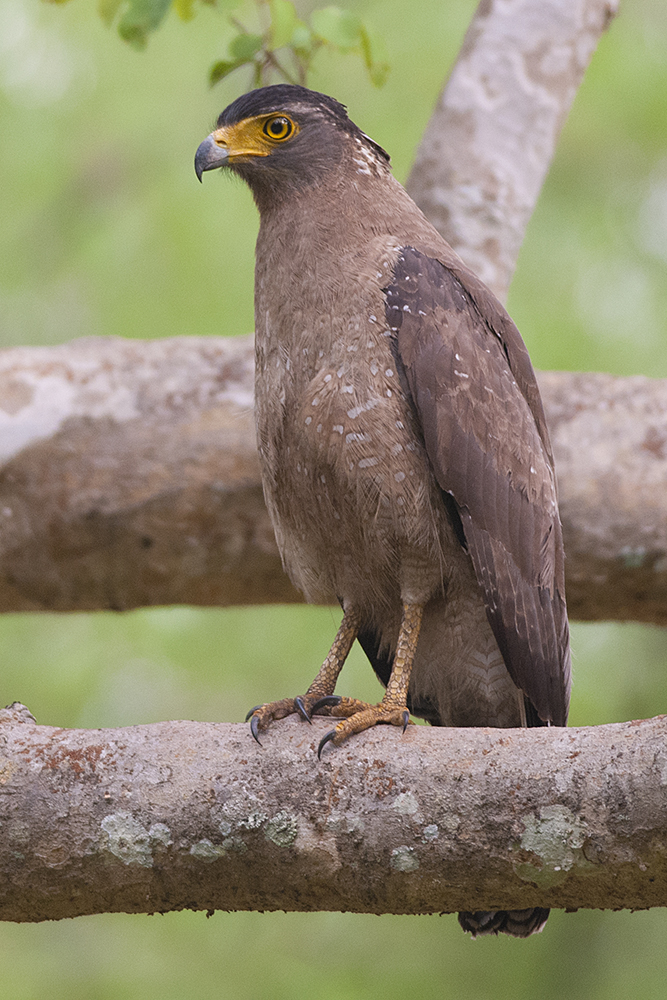
Black Baza
Aviceda leuphotes
Order: Accipitriformes / Family: Accipitridae

Wikimedia Commons
About the Black Baza
The Black Baza (Aviceda leuphotes) is a medium-sized bird of prey belonging to the family Accipitridae. This striking raptor is noted for its contrasting black and white plumage, making it relatively easy to identify. The Black Baza inhabits a range of habitats across Asia, from the Indian subcontinent to Southeast Asia and the southern parts of China. It plays an important ecological role as a predator of insects and small vertebrates, contributing to the control of these populations.
In terms of significance, the Black Baza is often admired for its elegant flight and striking appearance. It serves as an indicator species, reflecting the health of its forested and woodland habitats. This raptor is particularly associated with open woodlands, forest edges, and sometimes plantations, where it can find ample prey. It is a migratory bird, with populations moving between breeding and wintering grounds according to the seasons.
The Black Baza's ecological role extends beyond predation. By hunting insects and small vertebrates, it helps maintain the balance within its ecosystem. This bird is also part of the avian biodiversity that attracts birdwatchers and nature enthusiasts to its habitats, contributing to ecotourism in regions like the Western Ghats in India and the rainforests of Malaysia. Its presence is a sign of healthy ecosystems, as it prefers habitats with a good mix of trees and open areas.
The seasonal behavior of the Black Baza is tied to its migratory patterns. In the breeding season, which typically occurs from March to June, it remains in its northern range, including parts of India, Nepal, and Bhutan. Following breeding, the Black Baza migrates to its southern range, reaching as far as Indonesia and the Philippines, where it spends the winter months from October to February.
The Black Baza belongs to the family Accipitridae, within the order Accipitriformes. These birds typically live typically around 8-10 years, with a maximum recorded at 15 years..
How to Identify a Black Baza
The Black Baza is distinctive with its bold black and white plumage, making it one of the more easily identifiable raptors. Adults have a glossy black head, crest, and upperparts, contrasted by pure white underparts and a striking pattern of white bands across the wings. The tail is relatively short and features narrow white bands. Juveniles differ somewhat, possessing a more mottled appearance with less pronounced black and white contrasts. As they mature, their plumage gradually darkens.
Males and females of the species are similar in appearance, although females tend to be slightly larger. The crest is notably more prominent when the bird is alert or displaying. This crest, along with the bird's small size relative to other raptors, gives the Black Baza a unique silhouette in flight. Its wings are broad and rounded, facilitating agile flight among trees and forest edges.
The Black Baza might be confused with other black and white raptors, though its crest and the specific banding on its wings and tail help distinguish it from others. Its perching posture, often upright with the crest visible, and its habitual association with open woodlands and edges of forests, also aid in identification.
Having trouble telling birds apart? Upload a photo to our bird identification tool for an instant species match.
Black Baza Habitat and Range
Preferred Habitat
The Black Baza primarily inhabits open woodlands and forest edges, thriving in areas that offer a mix of trees and open space for hunting. These habitats can include subtropical and tropical forests, such as those found in the Himalayan foothills or the dense woodlands of Southeast Asia. The bird is also known to utilize plantations and secondary growth forests, where it can find suitable prey.
In terms of elevation, the Black Baza is typically found from lowland areas up to about 1,800 meters. This range allows it to exploit various ecological niches, from dense forests to more open savannas. Seasonal habitat shifts occur as the bird migrates, moving from breeding grounds in the north to wintering areas in the south.
While the Black Baza is primarily a forest-dwelling bird, it occasionally ventures into more urbanized areas, particularly when forests are adjacent to human developments. However, it generally avoids highly urbanized environments, preferring the cover and resources provided by more natural settings.
Geographic Range
The Black Baza's breeding range extends across the Indian subcontinent, including northern India, Nepal, and Bhutan. During the breeding season, it is also found in parts of southern China and northern Myanmar. Post-breeding migration sees the Black Baza moving southwards to its wintering grounds, which stretch across Southeast Asia to Indonesia and the Philippines.
During migration, the Black Baza travels through the Malay Peninsula and the islands of Sumatra and Borneo. These migration corridors are critical for the species, providing necessary stopover sites that offer food and rest.
Population density hotspots for the Black Baza include the Western Ghats in India and the rainforests of Malaysia, where the availability of prey and suitable habitats support larger populations. In these areas, the bird can be relatively common, though its presence is often tied to the availability of undisturbed forested habitats.
Want to know which birds visit your area? Browse our backyard birds by location guides for region-specific species lists.
What Does the Black Baza Eat?
The diet of the Black Baza primarily consists of large insects, with a strong preference for cicadas, locusts, and beetles. It also consumes small vertebrates, including lizards and frogs, which it captures with agile, swift movements. The Black Baza's foraging technique involves watching from a perch and then swooping down on its prey, often catching insects in mid-air.
Seasonal changes in diet occur in response to prey availability. During the breeding season, when energy demands are higher, the Black Baza may increase its intake of larger prey, such as small birds and mammals, to provide for its young. In contrast, during the winter months, its diet may shift more towards readily available insects.
The Black Baza typically feeds during the day, with peak activity occurring in the early morning and late afternoon. This feeding schedule aligns with the activity patterns of many of its prey species, which are more active and easier to catch during these times.
Black Baza Behavior and Social Structure
Black Bazas are social birds, often observed in small flocks outside the breeding season. These flocks can range from five to twenty individuals, sometimes more, as they migrate or forage together. During the breeding season, pairs become territorial, defending their nesting areas from intruders.
Courtship displays are a notable aspect of their behavior, involving aerial acrobatics and vocalizations. Males engage in impressive flight displays, showcasing their agility and strength to attract a mate. Once paired, Black Bazas exhibit strong pair bonds, collaborating closely in nest building and chick rearing.
In response to predators, the Black Baza relies on its agile flight to evade capture. It may also employ alarm calls to warn conspecifics of danger. This bird is primarily diurnal, engaging in most of its activities during daylight hours. It is most active during the morning and late afternoon, times when it can effectively hunt and forage.
Black Baza Nesting and Reproduction
The Black Baza constructs a small, flimsy nest made of twigs and lined with leaves, typically situated in the forks of tall trees. These nests are often located at heights ranging from 10 to 20 meters, providing safety from ground-based predators and a vantage point for the adults.
A typical clutch consists of two to four eggs, which the female incubates for about 21 to 28 days. During this period, the male plays a supportive role, providing food for the female and maintaining vigilance over the territory. Once hatched, the chicks remain in the nest for another 25 to 30 days before fledging.
Both parents share the responsibility of feeding the young, bringing a variety of insects and small vertebrates to the nest. Black Bazas typically rear one brood per year, although in regions with abundant resources, a second brood is possible. Nesting success depends heavily on the availability of suitable nesting sites and prey abundance.
Black Baza Sounds and Vocalizations
The Black Baza's vocalizations include a series of high-pitched whistles and chattering calls. Its primary song can be described as a repetitive, melodious 'ki-ki-ki' sound, often heard during the breeding season as males establish territories and attract mates.
In addition to these calls, the Black Baza emits sharp alarm calls when disturbed or threatened. These alarms serve as warnings to other birds in the vicinity. During the dawn chorus, the Black Baza's whistles blend with the calls of other forest birds, creating a symphony of sounds that marks the start of the day.
The quality of its calls can be likened to the sound of a musical instrument, with a light, flute-like tone that resonates through the forest. These vocalizations are crucial for communication, especially in the dense forest habitats where visual signals may be obscured.
Interesting Facts About the Black Baza
- 1Black Bazas are known to perform acrobatic aerial displays during courtship, showcasing their agility and flying prowess.
- 2Unlike many raptors, Black Bazas often form flocks of up to twenty birds during migration, a behavior more common to passerines.
- 3The Black Baza's nest is so flimsy that it can often be seen through, yet it provides adequate protection for the eggs and chicks.
- 4Despite its striking appearance, the Black Baza is relatively inconspicuous in its dense forest habitat, where it relies on its agility rather than stealth.
- 5The Black Baza's migratory routes can cover thousands of kilometers, connecting breeding grounds in northern Asia with wintering sites in the tropics.
- 6In some regions, the Black Baza is considered a seasonal indicator, marking the transition between wet and dry seasons as it arrives or departs.
- 7The species exhibits strong site fidelity, often returning to the same breeding and wintering sites year after year.
Black Baza Conservation Status
The Black Baza is currently listed as Least Concern on the IUCN Red List, with a population trend that appears to be stable. Despite this, the species faces threats from habitat loss due to deforestation and land conversion, particularly in Southeast Asia. Conservation efforts focus on protecting important forest habitats and migration corridors, ensuring that these areas remain intact and accessible for the Black Baza. Maintaining large swathes of undisturbed forest is crucial for the bird's survival, as these areas provide essential resources for breeding and foraging. Historically, the Black Baza's population has been impacted by habitat changes, but recent conservation initiatives have helped mitigate some of these effects. Continued vigilance and habitat protection are necessary to ensure the long-term stability of this unique and striking raptor.
Other Accipitridae Species


Birds Similar to the Black Baza
These species are often confused with the Black Baza due to similar appearance or overlapping range.