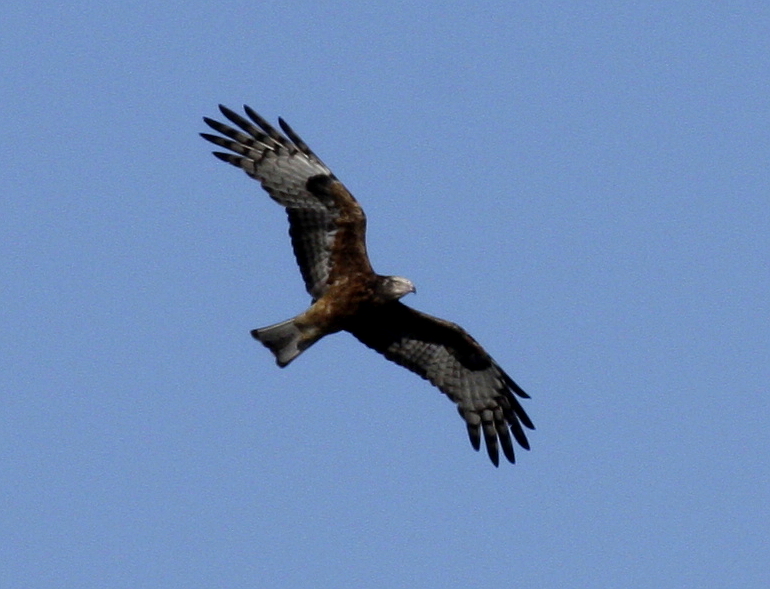
Black-breasted Kite
Hamirostra melanosternon
Order: Accipitriformes / Family: Accipitridae

Wikimedia Commons
About the Black-breasted Kite
The Black-breasted Kite, scientifically known as Hamirostra melanosternon, is a striking bird of prey native to Australia. Residing primarily in arid and semi-arid regions, it thrives in a variety of habitats including open woodlands, savannas, and scrublands. This raptor is recognized for its distinctive black breast and head which contrasts sharply with its otherwise pale body and wings, lending it a unique appearance among kites. The Black-breasted Kite plays a significant ecological role as a predator and scavenger. Its presence indicates a healthy ecosystem as it controls populations of smaller animals and insects while also cleaning up carrion. This species exhibits remarkable adaptability, often seen soaring effortlessly in the thermals of the Australian Outback. Its range extends across much of mainland Australia except for the densest tropical rainforests and the southernmost regions. Seasonally, the Black-breasted Kite may shift its range in response to prey availability and climatic conditions, moving closer to water bodies or into areas with higher prey densities during drier periods. The Black-breasted Kite's role extends beyond mere predation; it is a key indicator species for environmental changes. Its adaptability to varied landscapes makes it a resilient species, yet it is not immune to threats such as habitat destruction and climate change. During breeding season, which typically occurs from July to December, the kite becomes more territorial. Pairs will aggressively defend their nesting sites against intruders. This period is critical as it coincides with the end of the dry season and the onset of rains, ensuring an abundance of prey for raising young. The Black-breasted Kite is a master of survival, exhibiting behaviors that optimize its success in the harsh climates of the Australian interior. Its existence is a testament to the resilience and adaptability of raptor species in the face of natural and anthropogenic challenges.
The Black-breasted Kite belongs to the family Accipitridae, within the order Accipitriformes. These birds typically live typically 10-15 years..
How to Identify a Black-breasted Kite
The Black-breasted Kite is a medium-sized raptor, with adults measuring between 50 and 60 cm in length and boasting a wingspan of approximately 130 to 145 cm. Its plumage is characterized by a stark black head and breast contrasted with a pale, often creamy underbelly and wing linings. The back and upper wings are a muted brown, providing camouflage in its natural habitat. Juveniles display a more mottled appearance with less distinct coloration, having pale streaks on the breast and a more brownish hue overall. Sexual dimorphism is minimal, but females tend to be slightly larger than males. In flight, the Black-breasted Kite exhibits a buoyant, graceful flight pattern, often soaring on thermals with wings held in a slight dihedral. Its long, fingered wingtips and a moderately long tail aid in maneuverability. When perched, its posture is upright and alert, with a keen gaze often directed at the ground below as it scans for prey. Compared to similar species, such as the Whistling Kite, the Black-breasted Kite is easily distinguished by its darker head and breast. The Whistling Kite, in contrast, has a more uniform brown coloration and lacks the striking black chest. The Square-tailed Kite might also be confused with the Black-breasted Kite due to overlapping ranges, but the latter's distinct black markings and larger size help to differentiate them.
Having trouble telling birds apart? Upload a photo to our bird identification tool for an instant species match.
Black-breasted Kite Habitat and Range
Preferred Habitat
The Black-breasted Kite inhabits a variety of arid and semi-arid environments across Australia. It favors open woodlands, savannas, and scrublands, often found near watercourses or wetlands where prey is abundant. While it primarily occurs at low elevations, it can occasionally be seen in mountainous regions provided there is suitable open habitat available. Unlike some raptors, the Black-breasted Kite demonstrates a degree of tolerance for human-altered landscapes, sometimes venturing into agricultural areas or the outskirts of towns where food resources are available. Seasonal habitat shifts are common, with individuals moving to areas with greater prey availability, particularly during drier months. Despite its adaptability, the Black-breasted Kite is rarely found in dense forests or urban centers, preferring the open spaces that facilitate its hunting style.
Geographic Range
The Black-breasted Kite is endemic to Australia, with its range spanning much of the mainland. It is most prevalent in the northern and central regions, where arid and semi-arid habitats dominate. Its breeding range covers the vast expanse of the Australian Outback, with population concentrations in areas such as the Northern Territory and Queensland. During the breeding season, individuals may be found nesting in suitable habitats across this range. The Black-breasted Kite does not undertake long-distance migrations but may exhibit local movement patterns driven by food availability and climatic conditions. Outside the breeding season, it may be observed wandering into southern regions, though it typically avoids the cooler climates of Tasmania and the southernmost parts of Australia. Population densities vary across its range, with hotspots in areas where prey is abundant and habitat conditions are favorable.
Want to know which birds visit your area? Browse our backyard birds by location guides for region-specific species lists.
What Does the Black-breasted Kite Eat?
The Black-breasted Kite is an opportunistic feeder with a diet that includes both animal prey and carrion. Its primary food sources consist of small mammals, birds, reptiles, and large insects. It also scavenges carrion, including roadkill, which is particularly important during times when live prey is less accessible. Seasonal changes influence its diet, with a greater reliance on insects and small reptiles during the warmer months when these prey items are more active. The kite employs a variety of foraging techniques, including soaring at high altitudes to spot prey and sudden, swift dives to capture it on the ground. It is known for its ability to open eggs using its strong talons and beak, a skill that adds to its versatility as a predator. Typically, the Black-breasted Kite hunts during the day, taking advantage of thermals to conserve energy while searching for food.
Black-breasted Kite Behavior and Social Structure
The Black-breasted Kite exhibits a range of behaviors that reflect its adaptability and survival skills. It is predominantly solitary or found in pairs, especially during the breeding season when it becomes highly territorial. Courtship displays involve aerial acrobatics and mutual calling between mates, reinforcing pair bonds. While generally solitary, these kites may form loose flocks when conditions favor abundant food resources, such as during locust swarms or around carcasses. As a diurnal raptor, the Black-breasted Kite is most active during the day, with peak activity occurring in the early morning and late afternoon when temperatures are cooler. It exhibits a cautious approach to potential threats, often flying away to a safe distance when disturbed, yet it may be bold in defending its nest against perceived dangers. The kite's daily routine involves periods of soaring and scanning for prey interspersed with resting and preening sessions.
Black-breasted Kite Nesting and Reproduction
Nesting for the Black-breasted Kite begins with the construction of a large stick nest, often situated high in the canopy of a tall tree. Preferred nesting sites include isolated trees in open landscapes, providing a wide field of view for monitoring potential threats. The nest is lined with softer materials such as leaves and bark to provide comfort for the eggs and chicks. A typical clutch consists of one to three eggs, with an incubation period lasting approximately 35 days. Both parents share in the incubation duties, though the female takes a more prominent role. After hatching, the chicks remain in the nest for about six to eight weeks before fledging. During this time, both parents are actively involved in feeding and protecting the young. The Black-breasted Kite usually raises one brood per year, though favorable conditions may occasionally lead to a second.
Black-breasted Kite Sounds and Vocalizations
The Black-breasted Kite's vocalizations include a series of high-pitched whistles and calls, often heard during courtship or when defending territory. Its primary call is a sharp, clear whistle that cuts through the air, somewhat reminiscent of a referee's whistle. Alarm calls are harsher, consisting of repeated short notes that serve to warn off intruders. During the dawn chorus, its calls can be heard echoing across the landscape, contributing to the symphony of morning sounds. Compared to other raptors, the Black-breasted Kite is not particularly vocal outside of the breeding season or territorial disputes.
Interesting Facts About the Black-breasted Kite
- 1The Black-breasted Kite is known for its ability to open large bird eggs, a skill not commonly observed in other raptors.
- 2This kite's adaptability allows it to thrive in a range of environments, from coastal regions to the arid interior of Australia.
- 3Black-breasted Kites have been observed using tools, such as dropping stones on prey, displaying remarkable intelligence.
- 4Despite being primarily a hunter, the Black-breasted Kite will readily scavenge, making it an important part of the ecosystem.
- 5The kite's distinctive black breast and head are not only striking but also provide effective camouflage in the shadows of trees.
- 6During the breeding season, Black-breasted Kites perform spectacular aerial displays to attract mates and establish territories.
- 7Young Black-breasted Kites take several years to develop the adult plumage, gradually acquiring the iconic black markings.
Black-breasted Kite Conservation Status
The Black-breasted Kite is currently listed as Least Concern by the IUCN, with populations considered stable across its range. However, it faces threats from habitat destruction due to land clearing for agriculture and urban development. Additionally, climate change poses a long-term risk by altering prey availability and habitat conditions. Conservation efforts focus on preserving natural habitats and mitigating threats from human activities. Historically, the Black-breasted Kite has shown resilience to environmental changes, but ongoing monitoring and protection measures are essential to ensure its continued survival in the wild.
Other Accipitridae Species


Birds Similar to the Black-breasted Kite
These species are often confused with the Black-breasted Kite due to similar appearance or overlapping range.