
Black-capped Lory
Lorius lory
Order: Psittaciformes / Family: Psittacidae
Wikimedia Commons
About the Black-capped Lory
The Black-capped Lory, scientifically named Lorius lory, is a strikingly colorful parrot found predominantly in the humid lowland forests of New Guinea and surrounding islands. Characterized by its vibrant plumage of vivid red, black, and purple, this lory is a visual spectacle in its natural habitat. The bird’s significance extends beyond its beauty; it plays a critical role in seed dispersal and the pollination of native plants. Its strong, curved beak not only aids in processing food but also in accessing nectar, thus facilitating pollination. In addition to its ecological roles, the Black-capped Lory is a cultural icon in some indigenous communities, featuring prominently in local folklore and traditions. These lories inhabit primary and secondary forests, often thriving in areas with abundant flowering and fruiting trees. They are also found in mangroves, forest edges, and occasionally in coastal regions. The Black-capped Lory is a resident bird, remaining in its habitat year-round, although some seasonal movement occurs in response to food availability. During breeding seasons, typically from August to January, these birds become more conspicuous, displaying increased vocal activity and engaging in elaborate courtship behaviors. The Black-capped Lory is known for its gregarious and social nature, often forming tight-knit groups that traverse the forest canopy in search of food. These lories contribute significantly to the ecosystem's health and resilience by aiding in the regeneration of forested areas. The species' conservation status remains a concern due to habitat loss and the pet trade, although they are not currently classified as endangered. Efforts to conserve their habitat and regulate trade are crucial to ensure their survival.
The Black-capped Lory belongs to the family Psittacidae, within the order Psittaciformes. These birds typically live average 20-30 years with a max recorded of 35 years.
How to Identify a Black-capped Lory
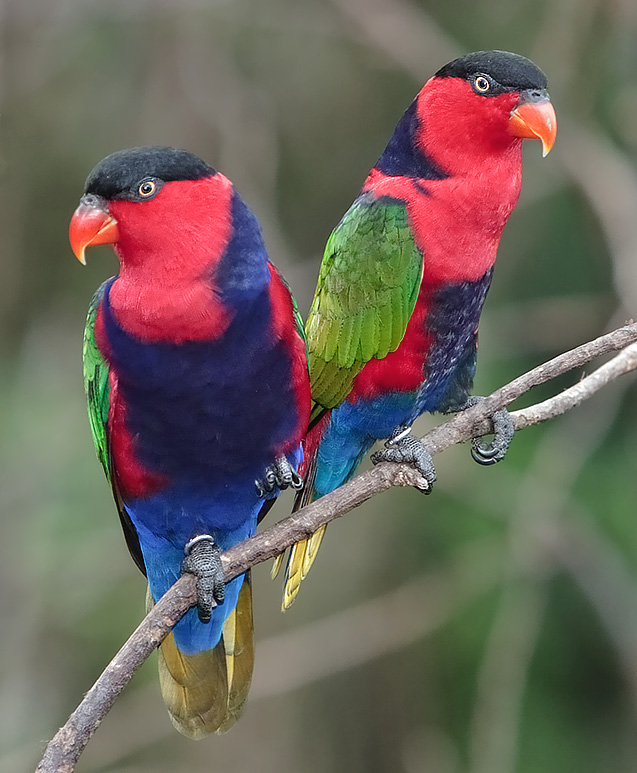
The adult Black-capped Lory is unmistakable with its vivid plumage. The head is capped with a glossy black, contrasting sharply with the bright red body. The wings and tail display a deep purple hue, with green tinges along the edges. Juveniles are similar but tend to have less pronounced colors and a shorter tail. Males and females are alike in plumage, making them difficult to distinguish visually. However, males are generally slightly larger with a more robust build. The Black-capped Lory is often confused with the closely related Duyvenbode's Lory, but the latter lacks the distinctive black cap and has a more yellowish body. In flight, the Black-capped Lory exhibits a rapid, undulating pattern, with wings appearing short and rounded. When perched, they typically adopt a horizontal posture, often seen socializing or foraging in pairs or small groups.
Having trouble telling birds apart? Upload a photo to our bird identification tool for an instant species match.
Black-capped Lory Habitat and Range
Preferred Habitat
The Black-capped Lory primarily inhabits the lowland tropical forests of New Guinea, favoring regions with dense vegetation and abundant food sources. It thrives in primary and secondary forests, as well as in mangroves and along forest edges. These lories can be found at elevations ranging from sea level up to 1,000 meters, although they are more common in the lower regions. They are adaptable and can occasionally be seen in more disturbed habitats, such as agricultural areas or near human settlements, especially where flowering trees are prevalent. Despite their adaptability, they are less frequently observed in urban areas.
Geographic Range
The Black-capped Lory's range is confined primarily to New Guinea and its surrounding islands, including the Bismarck Archipelago and the Solomon Islands. It is a resident species, with no significant migration patterns. However, they may show local movements in response to food availability, often traveling between islands or different forest patches. The population density of the Black-capped Lory is highest in the western and northern regions of New Guinea, where suitable habitat is more continuous.
Want to know which birds visit your area? Browse our backyard birds by location guides for region-specific species lists.
What Does the Black-capped Lory Eat?
The Black-capped Lory's diet is predominantly frugivorous, consisting mainly of fruits, berries, and flower nectar. They frequently forage in the forest canopy, using their strong, curved beaks to access difficult-to-reach food sources. This lory also consumes seeds and occasionally insects, supplementing its diet with protein. Seasonal changes in food availability influence their diet, with a preference for certain fruiting trees during peak seasons. Foraging typically occurs in the early morning and late afternoon, coinciding with the periods of increased bird activity in the forest.
Black-capped Lory Behavior and Social Structure
Black-capped Lories are highly social birds, often seen in small flocks of 10 to 20 individuals. They exhibit strong pair bonds, frequently observed grooming each other or engaging in synchronized flying displays. Territorial behavior is minimal, but they do defend feeding territories from intruders. During courtship, males perform elaborate displays, including bobbing, head movements, and vocalizations to attract females. These lories are diurnal, beginning their day with a burst of vocalizations at dawn before engaging in foraging activities. Their response to predators involves loud alarm calls and rapid dispersal into the dense canopy for cover. They are known for their playful nature, engaging in acrobatics and social interactions throughout the day.
Black-capped Lory Nesting and Reproduction
The Black-capped Lory nests in tree cavities, preferring large, mature trees that provide adequate protection and space. Nest sites are typically selected by the female, who also handles most of the incubation duties. The clutch size ranges from 2 to 3 eggs, with an incubation period of about 24 to 25 days. Both parents participate in feeding the chicks, which fledge after approximately 8 to 9 weeks. The fledglings remain dependent on their parents for several weeks post-fledging, learning essential survival skills. The species usually raises one brood per year, although a second brood is possible under favorable conditions.
Black-capped Lory Sounds and Vocalizations
The vocalizations of the Black-capped Lory are varied and distinctive, featuring a series of high-pitched, rapid whistles and chattering sounds. Their primary song includes rhythmic sequences that can be described as a melodic chatter, often heard throughout their territory. Alarm calls are sharper and more urgent, serving as a warning to nearby lories of potential threats. During the dawn chorus, these lories join other forest birds in a symphony of sounds, contributing to the vibrant acoustic landscape of their habitat.
Interesting Facts About the Black-capped Lory
- 1The Black-capped Lory can live up to 30 years in the wild, contributing to its role as a long-term resident of its habitat.
- 2These lories have specially adapted brush-tipped tongues for feeding on nectar, similar to hummingbirds.
- 3The Black-capped Lory is known to mimic sounds and voices, a trait that makes it popular in the pet trade.
- 4They are one of the few parrot species that participate in mutual grooming, strengthening social bonds.
- 5The vibrant colors of the Black-capped Lory's plumage help it to blend into the colorful flowers and fruits of its environment.
- 6Black-capped Lories have been observed using tools, such as sticks, to access food in hard-to-reach places.
- 7The species has a unique flight pattern, with rapid wingbeats interspersed with glides, allowing it to navigate dense forests efficiently.
Black-capped Lory Conservation Status
The Black-capped Lory is currently listed as of Least Concern by the IUCN, but the species faces threats from habitat destruction and the illegal pet trade. Deforestation for agriculture and logging has resulted in significant habitat loss, impacting population stability. Conservation efforts focus on habitat preservation and implementing regulations on wildlife trade. Historically, population numbers have fluctuated due to these pressures, emphasizing the need for ongoing protection measures.


