
Black-chinned Quailfinch
Ortygospiza gabonensis
Order: Passeriformes / Family: Estrildidae
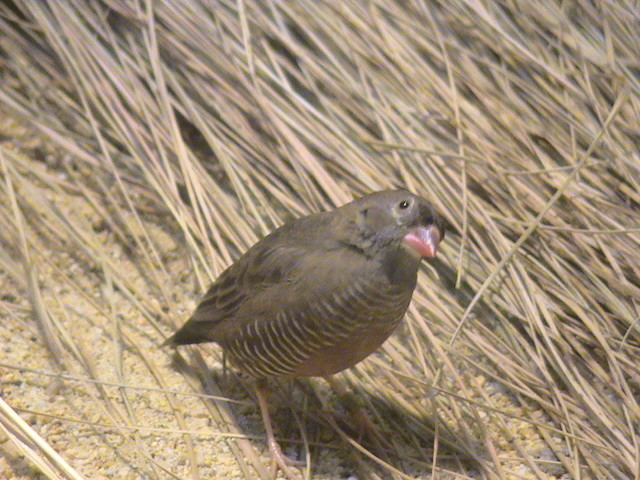
Wikimedia Commons
About the Black-chinned Quailfinch
The Black-chinned Quailfinch (Ortygospiza gabonensis) is a small bird belonging to the Estrildidae family, well-known for its distinctive black chin and throat which sharply contrasts with its otherwise brown and gray plumage. This species plays a significant ecological role in the grasslands and savannas of sub-Saharan Africa, where it participates in seed dispersal and insect control. Found primarily in countries like Gabon, Cameroon, and Nigeria, the Black-chinned Quailfinch prefers open habitats with abundant grass cover. These birds are a vital part of their ecosystem, contributing to the balance of insect populations and providing a food source for various predators. During the breeding season, which coincides with the rainy months, these finches become more territorial and display increased vocal activity. Outside of breeding times, they form loose flocks, often mixing with other small seed-eating birds. The seasonal abundance of seeds following rains influences the finch's breeding behaviors, as they require ample food for rearing their young. The Black-chinned Quailfinch's adaptability to different grassland environments illustrates its resilience, though it faces threats from habitat destruction and changes in land use.
The Black-chinned Quailfinch belongs to the family Estrildidae, within the order Passeriformes. These birds typically live 5-8 years, with some individuals reaching up to 10 years..
How to Identify a Black-chinned Quailfinch
Adult Black-chinned Quailfinches are small, measuring about 10 cm in length, with a short tail and a stout, conical bill perfect for seed consumption. The plumage is predominantly brown with fine streaks, providing excellent camouflage among the grasses. The key identifying feature is the black chin and throat, which stands out against the rest of the plumage. Males and females are similar in appearance, though females may have slightly duller markings. Juveniles lack the distinctive black chin and are generally more uniformly brown. When in flight, their short, rapid wingbeats and rounded wings are characteristic, and they often stay low to the ground. Perched, these birds exhibit an upright posture, often seen hopping through grass tufts. They can be confused with other small finches, like the African Firefinch, but the latter lacks the black chin and has more pronounced red hues.
Having trouble telling birds apart? Upload a photo to our bird identification tool for an instant species match.
Black-chinned Quailfinch Habitat and Range
Preferred Habitat
The Black-chinned Quailfinch inhabits open grasslands and savannas, often at elevations from sea level up to 2000 meters. These areas are characterized by scattered shrubs and a dense layer of grasses, providing both food and cover. They avoid dense forests and heavily urbanized regions, although they may venture into agricultural fields if conditions are suitable. Seasonal habitat shifts occur, with birds moving locally to exploit areas with optimal seed availability. During the dry season, they concentrate in areas that retain moisture longer, such as near rivers or in low-lying depressions.
Geographic Range
This species is widely distributed across sub-Saharan Africa, with breeding populations concentrated in countries like Gabon, Cameroon, Nigeria, and extending east to Uganda and Kenya. They do not undertake long migrations, but local movements are common, driven by the availability of food and water. In some regions, Black-chinned Quailfinches are considered common, particularly in well-preserved grassland habitats. However, their density may decrease in heavily farmed areas or where grasslands have been converted to other land uses.
Want to know which birds visit your area? Browse our backyard birds by location guides for region-specific species lists.
What Does the Black-chinned Quailfinch Eat?
The diet of the Black-chinned Quailfinch consists primarily of grass seeds, which they forage from the ground. They employ a methodical approach, using their strong bills to extract seeds from tough husks. Insects and other small invertebrates supplement their diet, especially during the breeding season when protein demands are higher. Their feeding schedule is flexible, often dictated by the availability of food resources, but they are most active during the cooler parts of the day, such as early morning and late afternoon. The size of their prey typically ranges from small seeds to medium-sized insects, which they hunt by carefully inspecting the ground or low vegetation.
Black-chinned Quailfinch Behavior and Social Structure
Black-chinned Quailfinches display a social structure that varies with the season. During the breeding season, pairs establish territories and become more solitary. Males perform courtship displays that include song and subtle aerial maneuvers to attract mates. Outside of breeding times, they form flocks, sometimes joining mixed-species groups, which offer protection against predators like raptors and snakes. Their daily activity pattern involves periods of foraging interspersed with rest and preening. When threatened, these finches rely on their cryptic plumage, staying motionless among the grasses, or they may take to swift, low flights to escape danger.
Black-chinned Quailfinch Nesting and Reproduction
The nesting habits of the Black-chinned Quailfinch involve constructing dome-shaped nests on or near the ground, typically hidden within dense grass tussocks. Nests are built from grasses and lined with feathers for insulation. A typical clutch consists of 3 to 5 eggs, with incubation lasting about 12 to 14 days. Both parents participate in feeding the chicks, which fledge approximately two weeks after hatching. The species may have up to two broods per year, depending on food availability and environmental conditions. Parental care continues post-fledging until the young are fully independent.
Black-chinned Quailfinch Sounds and Vocalizations
The Black-chinned Quailfinch's song is a series of high-pitched, melodious notes that vary in rhythm and intensity. Their calls include sharp 'chip' notes used for communication between flock members. Alarm calls are more rapid and higher in pitch, alerting others to the presence of predators. These finches participate in a dawn chorus, where the males' songs are most pronounced, serving to establish territory and attract mates. The quality of their song can be likened to a soft tinkling bell, subtle yet distinct against the backdrop of the savanna.
Interesting Facts About the Black-chinned Quailfinch
- 1The Black-chinned Quailfinch can consume up to 5% of its body weight in seeds daily, helping control seed populations.
- 2Their nests, although primarily made from grass, often incorporate feathers from other bird species for insulation.
- 3Despite their small size, Black-chinned Quailfinches can fly at speeds up to 40 km/h when evading predators.
- 4These finches have a unique foraging technique, using their bills to shake grass stems and dislodge seeds.
- 5During the breeding season, males sing up to 50% more frequently to establish dominance and attract females.
- 6The Black-chinned Quailfinch's call notes can be heard over distances of up to 100 meters in open grassland.
- 7They often form mixed-species flocks with other finches, enhancing their ability to detect and avoid predators.
Black-chinned Quailfinch Conservation Status
The Black-chinned Quailfinch is currently listed as Least Concern by the IUCN, with stable population trends across its range. However, habitat loss due to agricultural expansion and climate change poses ongoing threats. Conservation efforts focus on habitat preservation and sustainable land use practices. Historically, the species has shown resilience to moderate changes in its environment, but continued pressure could impact local populations, especially in areas experiencing rapid land conversion.
Other Estrildidae Species


Birds Similar to the Black-chinned Quailfinch
These species are often confused with the Black-chinned Quailfinch due to similar appearance or overlapping range.

