
Black Francolin
Francolinus francolinus
Order: Galliformes / Family: Phasianidae
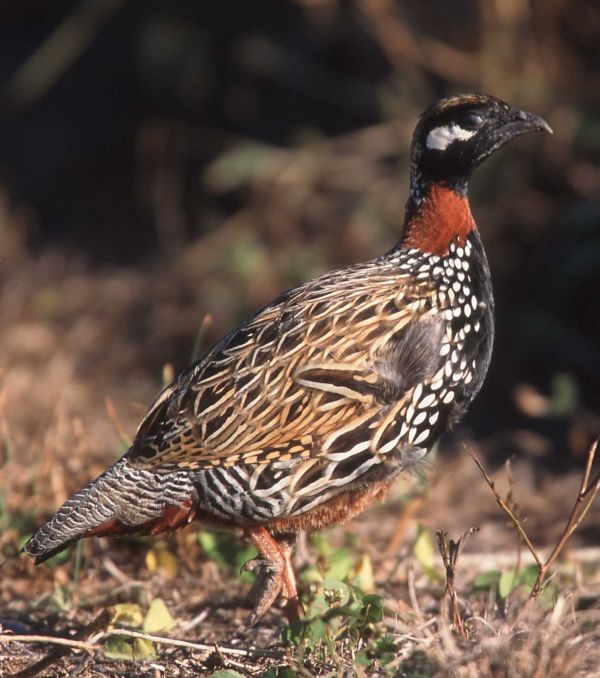
Wikimedia Commons
About the Black Francolin
The Black Francolin (Francolinus francolinus) is an elegant bird found primarily across the Indian subcontinent, the Middle East, and parts of Europe. As a member of the Phasianidae family, this species plays a significant role in its native ecosystems, often inhabiting grasslands, scrublands, and agricultural areas. Males boast striking black plumage adorned with intricate white spots, while females exhibit a more subdued brown coloration that provides excellent camouflage. Known for their adaptability, Black Francolins also occupy orchards and plantations, where they contribute to pest control by consuming insects.
In ecological terms, the Black Francolin functions as both predator and prey, influencing insect populations while also serving as a food source for larger raptors and mammals. Their presence in diverse habitats makes them an important study species for understanding ecological balance in both natural and modified landscapes. During the breeding season, which typically occurs from March to July, males engage in elaborate displays to attract females. These displays include vocal calls and physical posturing, demonstrating the bird's prominent role in local acoustic environments.
The Black Francolin is also notable for its seasonal behaviors, particularly in regions with marked wet and dry periods. During wetter months, their habitat range expands as they take advantage of increased food availability. Conversely, in drier seasons, they may concentrate around water sources. Despite facing habitat loss due to agricultural expansion and urbanization, the Black Francolin remains a species of least concern on the IUCN Red List, though local populations may experience fluctuations due to environmental pressures.
The Black Francolin belongs to the family Phasianidae, within the order Galliformes. These birds typically live average 5-8 years, with a maximum recorded of 10 years..
How to Identify a Black Francolin
The adult male Black Francolin is unmistakable, with its jet-black plumage speckled with white spots, a chestnut collar, and a striking white cheek patch. The female, meanwhile, wears a more cryptic brown plumage that aids in blending into her surroundings, a crucial feature for incubation and chick-rearing. Juveniles resemble females but can be distinguished by their paler tones and less defined markings.
When compared to similar species like the Grey Francolin, the Black Francolin is more robust and vividly colored. Its flight silhouette, characterized by short, rounded wings and a relatively short tail, allows for quick bursts of speed, essential for evading predators. Perching posture is often low to the ground, with birds frequently seen skulking through underbrush or taking brief flights across open areas. In flight, the rapid wingbeats interspersed with glides are distinctive, providing an additional identification cue.
Having trouble telling birds apart? Upload a photo to our bird identification tool for an instant species match.
Black Francolin Habitat and Range
Preferred Habitat
Black Francolins inhabit a variety of habitats including open grasslands, agricultural fields, and scrubby areas. They are often found at elevations ranging from sea level to about 1,500 meters. In areas like the Indian subcontinent's Punjab and Gujarat regions, they adapt well to agricultural landscapes, taking advantage of crop cover and irrigation. Seasonal shifts in habitat use are common, with birds moving to moister areas during dry spells to access water and food. While primarily rural, they occasionally venture into suburban areas where suitable cover and resources are available.
Geographic Range
The Black Francolin's range spans from the Indian subcontinent across the Middle East to parts of Europe, including Cyprus and Turkey. In India, they are prevalent in northern regions and are a common sight in the states of Haryana and Uttar Pradesh. They thrive in Pakistan's Punjab region and are also found in Iran and Iraq. This species does not undertake long migrations but may show local movements in response to seasonal changes, especially in arid areas where water availability dictates their distribution. Population densities are highest in regions with abundant cover and food resources.
Want to know which birds visit your area? Browse our backyard birds by location guides for region-specific species lists.
What Does the Black Francolin Eat?
The diet of the Black Francolin is omnivorous, consisting mainly of seeds, grains, and insects. During the breeding season, insects such as grasshoppers and beetles form a substantial part of their diet, providing the necessary protein for chick development. In agricultural areas, they consume a variety of crop seeds and are sometimes considered beneficial for controlling pest populations. Foraging typically occurs in the early morning and late afternoon, with birds using their strong legs to scratch the ground or sift through leaf litter. Prey size is generally small, allowing quick consumption to minimize exposure to predators.
Black Francolin Behavior and Social Structure
Black Francolins are generally solitary or found in pairs, though small family groups may be seen outside the breeding season. Males are territorial, especially during the breeding season, when they establish and defend territories through vocalizations and displays. Courtship involves the male performing a series of postures and calls to attract a mate, often accompanied by brief chases.
In response to predators, Black Francolins rely on their cryptic plumage and quick, low flights to escape danger. They are primarily ground-dwelling, preferring to stay hidden in dense vegetation. Daily activity peaks during cooler parts of the day, with birds resting in shaded areas during midday heat. Their alertness and quick response to threats are notable behavioral traits.
Black Francolin Nesting and Reproduction
Black Francolins nest on the ground, creating simple scrapes lined with grass and leaves. Preferred nesting sites are well-concealed within dense vegetation or among crops, providing protection from predators. The typical clutch size ranges from 6 to 12 eggs, with an incubation period of approximately 18 to 21 days. Both parents play a role in rearing the young, though the female primarily incubates the eggs. Chicks are precocial, leaving the nest shortly after hatching and relying on parental guidance for food and protection. Generally, Black Francolins may raise one to two broods per year, depending on environmental conditions.
Black Francolin Sounds and Vocalizations
The primary song of the Black Francolin is a loud, resonant call consisting of a series of sharp notes, often described as 'chee-kee, chee-kee, chee-kee'. This call is most frequently heard at dawn and dusk, serving as a territorial proclamation. Calls are clear and penetrating, carrying over long distances to assert presence and deter rivals. Alarm calls are sharp and abrupt, serving as a warning to nearby birds of potential threats. The dawn chorus is a particularly notable aspect of their vocal behavior, with males often competing vocally in the morning hours.
Interesting Facts About the Black Francolin
- 1The Black Francolin is known for its adaptability, thriving in agricultural landscapes where it helps control pest populations.
- 2Males have a distinctive call that can be heard over 1 kilometer away, making them easier to detect in dense vegetation.
- 3Unlike many birds, Black Francolins are more often heard than seen, thanks to their cryptic coloration and elusive behavior.
- 4In some cultures, the Black Francolin's call is considered a herald of good fortune and is often associated with the onset of rain.
- 5Despite being primarily ground-dwelling, Black Francolins are capable of rapid, powerful flights to escape predators.
- 6The species is a popular game bird in many regions, though hunting regulations vary widely across its range.
- 7A Black Francolin's home range can span several hectares, with males defending territories through vocal displays.
Black Francolin Conservation Status
Currently classified as a species of least concern by the IUCN, the Black Francolin faces threats primarily from habitat loss and hunting. Agricultural expansion and urban development reduce available habitat, while hunting pressure varies by region. Conservation efforts include habitat protection and local awareness campaigns. Despite these challenges, populations remain stable in many areas, though localized declines are possible. Historical data suggest fluctuations in population trends, often linked to changes in land use and environmental conditions.
Other Phasianidae Species


Birds Similar to the Black Francolin
These species are often confused with the Black Francolin due to similar appearance or overlapping range.