
Black-headed Trogon
Trogon melanocephalus
Order: Trogoniformes / Family: Trogonidae
Wikimedia Commons
About the Black-headed Trogon
The Black-headed Trogon (Trogon melanocephalus) is a captivating bird found primarily in the tropical and subtropical forests of Central America, particularly from southern Mexico through parts of Central America down to Costa Rica. These birds are an integral component of their ecosystems, serving as both predators and prey, thereby contributing to the ecological balance. The Black-headed Trogon is typically associated with lowland humid forests, but they can also be found in secondary growth and open woodland areas where they find ample food and nesting opportunities. This species is known for its vivid plumage, which plays a crucial role in its social interactions and mating displays. The Black-headed Trogon is a relatively sedentary bird, with most of its movements related to local food availability rather than long-distance migrations. In terms of behavior, these trogons are generally solitary or found in pairs, particularly during the breeding season. They engage in elaborate courtship displays that highlight their striking coloration, which helps maintain their social structure. Their presence in a given area often indicates a healthy, thriving forest ecosystem, as they rely on a variety of insects and fruits that flourish in such environments. By consuming a wide range of fruit, the Black-headed Trogon aids in seed dispersal, thus promoting forest regeneration and biodiversity. During the breeding season, which typically aligns with the rainy season, these birds are more vocal and visible, making them easier to observe and study. In contrast, they tend to be more secretive during the non-breeding season, blending into their surroundings and becoming less conspicuous. The Black-headed Trogon's adaptability to various forest habitats makes it an interesting subject for studies on avian adaptation and habitat utilization. With their vibrant colors and distinctive calls, these birds are not only a delight for birdwatchers but also an essential part of the natural heritage of Central America.
The Black-headed Trogon belongs to the family Trogonidae, within the order Trogoniformes. These birds typically live average 6-9 years with max recorded up to 12 years.
How to Identify a Black-headed Trogon
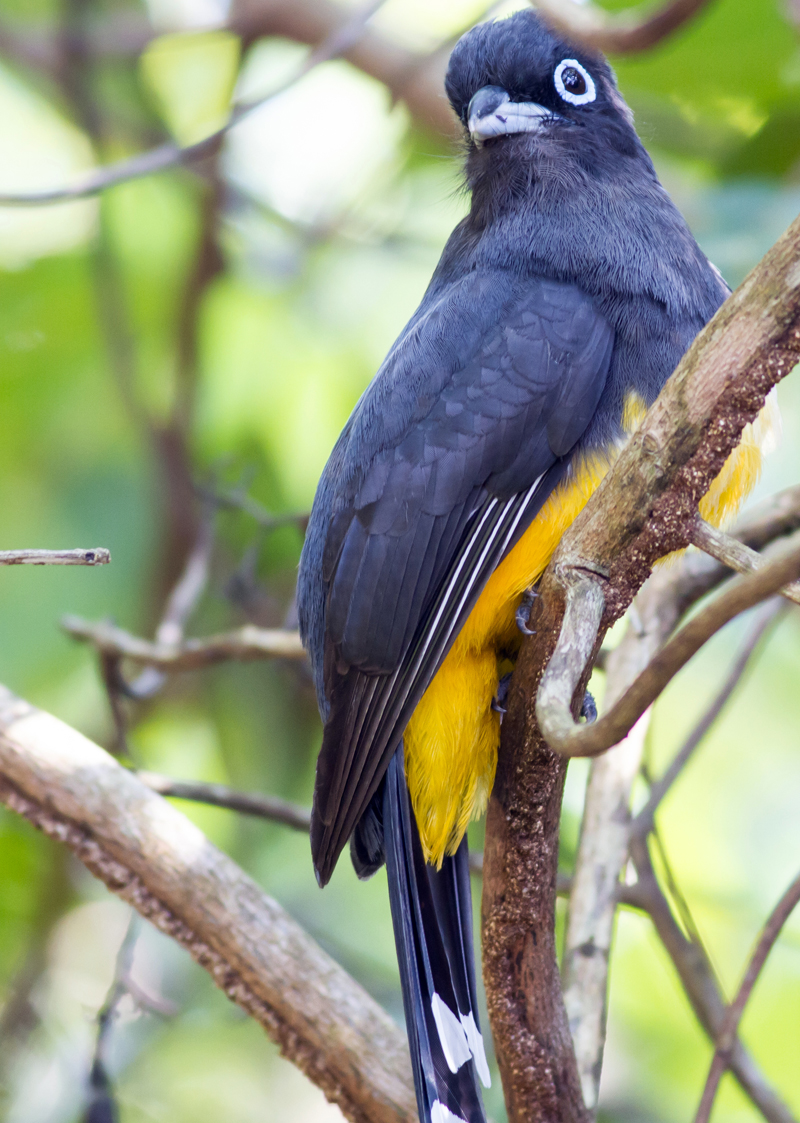
The Black-headed Trogon can be identified by its striking black head, which contrasts sharply with its brilliant yellow underparts. Adult males display a vivid blue-green iridescent back and wings, while females possess a slightly duller coloration with a brownish tinge on the back and wings. Both sexes have a distinctive white band across their upper breast, setting off the black head. The tail of the Black-headed Trogon is another key feature, with distinctive white tips that are visible in flight. Juveniles resemble adults but with more muted colors and less pronounced iridescence. These birds have a compact, medium-sized body with a short neck and long tail, making their silhouette quite recognizable. When perched, they often sit upright, motionless, and quiet, which can make them challenging to spot despite their vivid colors. In flight, their broad wings and long tail are noticeable, and their flight is typically direct and somewhat labored, showing intermittent flapping and gliding. Confusion with similar species like the Gartered Trogon can occur, but the Black-headed Trogon's uniform black head is a distinctive marker.
Having trouble telling birds apart? Upload a photo to our bird identification tool for an instant species match.
Black-headed Trogon Habitat and Range
Preferred Habitat
The Black-headed Trogon thrives in tropical and subtropical forests, predominantly lowland humid forests. They are often found in secondary growth forests and open woodland areas, which provide ample foraging opportunities. These birds prefer elevations ranging from sea level to about 1,200 meters. Seasonal shifts in habitat are minimal, though they may move within their range to exploit new food sources as they become available. In areas where forest edges meet agricultural land or urban areas, Black-headed Trogons can sometimes adapt to these modified habitats, provided there are sufficient trees and food sources.
Geographic Range
The Black-headed Trogon is primarily found in Central America, with a breeding range extending from southern Mexico through Belize, Guatemala, and parts of Honduras, to northern Costa Rica. It is a non-migratory species, which means it generally remains within its range year-round. Population densities are highest in regions where primary and secondary forests are abundant, providing a steady food supply and nesting sites. Their presence is more common in protected areas where habitat destruction has been minimized, highlighting the importance of conservation efforts in maintaining their populations.
Want to know which birds visit your area? Browse our backyard birds by location guides for region-specific species lists.
What Does the Black-headed Trogon Eat?
The Black-headed Trogon's diet primarily consists of fruits and insects, making it an omnivorous bird with a flexible diet. They feed on a variety of fruits, including those from the fig and berry families, which they pluck with precision while perched. Their insect diet includes beetles, caterpillars, and grasshoppers, which they catch in short flights from a perch. This foraging technique, known as sallying, involves quick, darting movements to capture prey. Seasonal changes in food availability influence their diet, with a higher reliance on fruits during times when insects are less abundant. The size of the prey they capture is generally small to medium, reflecting the bird's size and hunting style.
Black-headed Trogon Behavior and Social Structure
The Black-headed Trogon exhibits a relatively solitary lifestyle outside of the breeding season, with individuals or pairs often spotted quietly foraging. During the breeding season, these trogons become more vocal and visible, engaging in courtship displays that involve vocalizations and flight maneuvers to attract mates. Their calls, which are a series of soft coos or whistles, play a crucial role in territory establishment and mate attraction. These birds are territorial and will defend their chosen area from intruders, using vocalizations as a primary means of communication. When faced with potential threats, the Black-headed Trogon relies on its cryptic perch posture and stillness to avoid detection. Daily activity patterns include periods of foraging interspersed with rest, usually in the shade of dense foliage to avoid the midday heat.
Black-headed Trogon Nesting and Reproduction
The Black-headed Trogon typically nests in natural cavities, often utilizing old woodpecker holes in trees or termite nests. The availability of suitable nesting sites greatly influences their choice of habitat. They do not construct elaborate nests but rather rely on existing structures, which they may slightly modify if necessary. The clutch size generally consists of 2 to 3 eggs, which are incubated by both parents for about 17 to 19 days. After hatching, the young are altricial, requiring significant parental care. Both parents participate in feeding and tending to the chicks, which fledge approximately 24 to 26 days after hatching. The species typically raises one brood per year, although favorable conditions may allow for a second.
Black-headed Trogon Sounds and Vocalizations
The primary song of the Black-headed Trogon consists of a series of soft, repetitive coos or whistles that carry through the forest, often given in a slow, deliberate rhythm. These calls serve as both territorial markers and mate attractors. Alarm calls are sharper and more abrupt, signaling potential threats to conspecifics. During the dawn chorus, the Black-headed Trogon is more vocal, taking advantage of the cooler morning hours to communicate with neighbors and establish its presence. Their calls are reminiscent of a distant cuckoo, adding a distinctive element to the soundscape of their tropical habitats.
Interesting Facts About the Black-headed Trogon
- 1Despite their vibrant colors, Black-headed Trogons are surprisingly hard to spot due to their motionless perching behavior.
- 2Black-headed Trogons do not migrate, making them year-round residents of their tropical habitats.
- 3This species can be identified by its unique call, which is often likened to a distant cuckoo.
- 4They are part of the Trogonidae family, which includes some of the most colorful birds in the world.
- 5The Black-headed Trogon plays a vital role in seed dispersal, aiding in the regeneration of tropical forests.
- 6Their nesting habits often involve using old woodpecker holes, showcasing an interesting interspecies dependency.
- 7During the breeding season, their territorial calls can be heard echoing through the forest, signaling their presence.
Black-headed Trogon Conservation Status
The Black-headed Trogon is currently listed as Least Concern by the IUCN, with stable population trends in most of its range. However, habitat destruction due to deforestation and agricultural expansion poses a significant threat to its habitat. Conservation efforts focus on preserving large tracts of tropical forest, which are essential for the survival of this and other forest-dependent species. Historically, populations have fluctuated with changes in forest coverage, underscoring the importance of habitat protection in maintaining their numbers.


