Black-necked/Spectacled Weaver
Ploceus nigricollis
Order: Passeriformes / Family: Ploceidae
Wikimedia Commons
About the Black-necked/Spectacled Weaver
The Black-necked Weaver, Ploceus nigricollis, is a vibrant member of the Ploceidae family, noted for its striking appearance and fascinating behavior. This species thrives in a range of habitats across sub-Saharan Africa, from Guinea and Sierra Leone in the west to Uganda and Kenya in the east. Its adaptability allows it to inhabit both lowland forests and wooded savannas. The ecological significance of the Black-necked Weaver lies in its role as a seed disperser and pollinator, contributing to the health and diversity of its ecosystems. During the breeding season, these birds become even more conspicuous as males display their bright plumage and engage in elaborate nest-building activities to attract mates. Seasonal behaviors are marked by changes in flock dynamics; outside of the breeding season, Black-necked Weavers often form mixed-species flocks, facilitating cooperative foraging and increased vigilance against predators. This adaptability in behavior and habitat preference underscores their resilience in various environmental conditions. In addition to their ecological contributions, Black-necked Weavers are also culturally significant in certain regions, where their vibrant plumage and intricate nests hold symbolic meanings in local traditions. Furthermore, their presence in both rural and urban areas highlights their ability to coexist with human activities, making them an integral part of the avian biodiversity in many African landscapes.
The Black-necked/Spectacled Weaver belongs to the family Ploceidae, within the order Passeriformes. These birds typically live 5-10 years with a maximum recorded of 12 years.
How to Identify a Black-necked/Spectacled Weaver
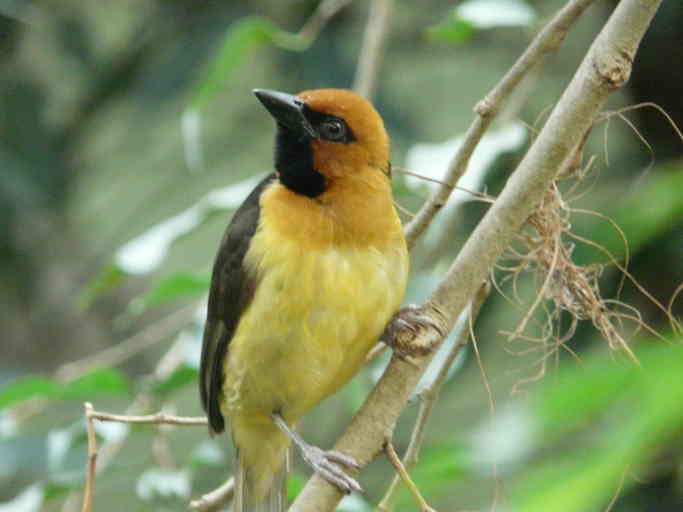
Identifying the Black-necked Weaver involves noting several key field marks. Adult males are especially striking, with a bright yellow body and a distinctive black head and neck. This contrast makes them easily recognizable among other weavers. Females and juveniles, however, display more subdued coloration, with olive-green upperparts and a yellowish underside, lacking the stark black markings of the males. In flight, the Black-necked Weaver's rounded wings and relatively short tail are noticeable. When perched, they typically exhibit an upright posture, often seen clinging to reeds or branches. Confusion with similar species, such as the Village Weaver, can occur, but the latter lacks the solid black head of the Black-necked Weaver. Observers should also pay attention to the bird's behavior and habitat, as these can further aid in accurate identification. Notably, the male's striking black and yellow plumage is a key differentiator during the breeding season when they are most active and visible.
Having trouble telling birds apart? Upload a photo to our bird identification tool for an instant species match.
Black-necked/Spectacled Weaver Habitat and Range
Preferred Habitat
The Black-necked Weaver inhabits a variety of environments, primarily in sub-Saharan Africa. These include moist lowland forests, wooded savannas, and edges of wetlands. In regions like the Congo Basin and East Africa's Great Rift Valley, they are commonly found in riparian woodlands. Elevation plays a role in their distribution, with these birds thriving from sea level up to 1,800 meters. Seasonal habitat shifts occur as they move to areas with abundant food resources during the rainy season. They adapt well to human-altered landscapes, residing in suburban gardens and agricultural fields, where they benefit from the diverse foraging opportunities. The Black-necked Weaver's presence in both rural and urban settings reflects their versatility and resilience.
Geographic Range
The range of the Black-necked Weaver extends across much of sub-Saharan Africa. Their breeding range includes countries such as Nigeria, Cameroon, and the Democratic Republic of Congo, where they are commonly found in suitable habitats. During the non-breeding season, these weavers may disperse more widely, though they are generally considered resident birds with limited migratory movements. Population density is higher in regions where forests and wetlands provide ample resources, such as the Albertine Rift and along major river systems like the Niger and Congo. In some areas, their presence overlaps with other weaver species, although the Black-necked Weaver maintains a distinct ecological niche.
Want to know which birds visit your area? Browse our backyard birds by location guides for region-specific species lists.
What Does the Black-necked/Spectacled Weaver Eat?
The diet of the Black-necked Weaver primarily consists of seeds, fruits, and insects. During the breeding season, their intake of protein-rich insects increases to support the nutritional demands of raising young. Their foraging technique involves gleaning from foliage and probing into crevices in search of insects and seeds. They exhibit a particular preference for feeding on grass seeds and the fruits of various wild plants. Seasonal diet changes are evident, with a greater reliance on insects during the wet season when these are more abundant. The Black-necked Weaver typically forages in small groups, which allows them to efficiently locate food while maintaining vigilance against predators.
Black-necked/Spectacled Weaver Behavior and Social Structure
Black-necked Weavers are social birds, often seen in flocks outside the breeding season. Their social structure is dynamic, with individuals joining mixed-species flocks to enhance foraging success and predator detection. During the breeding season, males become territorial, defending their chosen nesting sites vigorously. Courtship displays involve elaborate nest-building, with males weaving intricate structures to entice females. These displays are accompanied by vocalizations and posturing to demonstrate fitness. In response to predators, Black-necked Weavers exhibit alarm calls and engage in mobbing behavior to deter threats. Daily activity patterns show peaks in early morning and late afternoon, coinciding with optimal foraging times and lower temperatures.
Black-necked/Spectacled Weaver Nesting and Reproduction
Nesting for the Black-necked Weaver involves the construction of elaborate woven nests, typically suspended from tree branches or reeds near water. The nests are crafted using grass, leaves, and plant fibers, creating a spherical structure with a side entrance. Preferred nesting locations are in colonies, allowing for communal defense against predators. A typical clutch consists of two to three eggs, which are incubated primarily by the female for about 12-14 days. Both parents participate in feeding the young, which fledge around 18-21 days after hatching. The Black-necked Weaver may raise multiple broods per year if conditions permit, showcasing their reproductive adaptability.
Black-necked/Spectacled Weaver Sounds and Vocalizations
The primary song of the Black-necked Weaver is a series of melodious whistles, characterized by a rhythmic pattern and varying pitch. These songs serve both to attract mates and to establish territory. Call notes are sharp and distinctive, often used in communication between flock members. Alarm calls are louder and more urgent, serving as an effective deterrent to predators. During the dawn chorus, Black-necked Weavers are particularly vocal, their calls mingling with those of other bird species to create a vibrant soundscape. Their vocalizations, though complex, are an essential component of their social and territorial interactions.
Interesting Facts About the Black-necked/Spectacled Weaver
- 1The Black-necked Weaver can construct its intricate nest in as little as seven days, showcasing remarkable building skills.
- 2Despite their bright plumage, Black-necked Weavers can be quite elusive, often blending into the foliage of their preferred habitats.
- 3Black-necked Weavers are known to use spider silk in their nests, adding both strength and flexibility to the structure.
- 4These weavers are opportunistic, sometimes incorporating human-made materials like string and wire into their nests.
- 5During courtship, male Black-necked Weavers perform a 'hanging dance' from their nests, a display aimed at impressing potential mates.
- 6The species plays a role in pest control, as they consume large numbers of insects during breeding season.
- 7Black-necked Weavers have been observed engaging in cooperative breeding, with multiple adults helping to raise a single brood.
Black-necked/Spectacled Weaver Conservation Status
Currently, the IUCN lists the Black-necked Weaver as a species of Least Concern, with stable population trends across most of its range. Primary threats include habitat loss due to deforestation and wetland drainage. However, their adaptability to altered landscapes has mitigated some of these impacts. Conservation efforts focus on preserving crucial habitats and promoting sustainable land-use practices. Historically, population changes have been minimal, attributed to their resilience and broad distribution. Continued monitoring is essential to ensure their populations remain robust in the face of environmental changes.