
Black-streaked Scimitar-Babbler
Megapomatorhinus gravivox
Order: Passeriformes / Family: Timaliidae
Wikimedia Commons
About the Black-streaked Scimitar-Babbler
The Black-streaked Scimitar-Babbler (Megapomatorhinus gravivox) is a captivating bird belonging to the Timaliidae family, known for its distinctive curved bill and melodious vocalizations. This bird primarily inhabits the subtropical and tropical forests of Asia, with significant populations in regions such as southern China, northern Thailand, and parts of Myanmar. As a member of the passerine order, it plays a crucial role in its ecosystem, both as a predator of insects and as prey for larger avian species. The bird's striking appearance and engaging behaviors make it a favorite among birdwatchers and ornithologists alike. The ecological role of the Black-streaked Scimitar-Babbler is multifaceted. It helps control insect populations, promoting forest health, while its seeds dispersal habits contribute to the propagation of various plant species. This bird's presence is often an indicator of a balanced ecosystem, as it requires healthy forested environments to thrive. These birds are quite active throughout the year, but their behaviors and visibility can vary with the seasons. During the breeding season, which generally runs from late spring to early summer, the Black-streaked Scimitar-Babbler becomes more vocal and easier to spot. Its vocalizations are not only a tool for mating but also a mechanism for establishing territory. Outside the breeding season, these birds tend to be more elusive, often retreating deeper into the forest. In winter, when food is scarcer, they may forage over larger areas. The Black-streaked Scimitar-Babbler holds cultural significance in several regions, often featured in local folklore and traditions. Its distinctive call is sometimes used to predict weather changes or signal the start of planting seasons. This bird's adaptability to various forest types, from dense primary forests to secondary growth and bamboo thickets, highlights its resilience, though it remains sensitive to habitat destruction. Conservation efforts are crucial to preserving the diverse forest environments on which the Black-streaked Scimitar-Babbler depends.
The Black-streaked Scimitar-Babbler belongs to the family Timaliidae, within the order Passeriformes. These birds typically live average 5-7 years, with a maximum recorded of 8 years..
How to Identify a Black-streaked Scimitar-Babbler
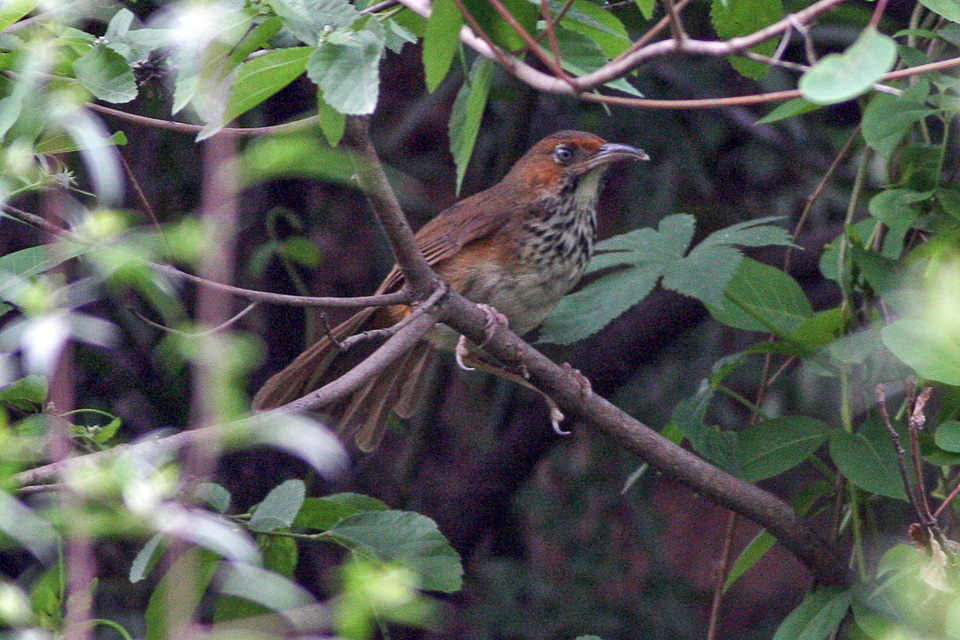
The Black-streaked Scimitar-Babbler is a medium-sized bird, measuring around 24 centimeters in length. Its most notable feature is its long, curved bill, which it uses skillfully to forage for insects and seeds. The plumage is primarily brown with distinct black streaks running along its back and flanks, providing excellent camouflage in its forest habitat. The face is adorned with white and black markings, with a prominent white supercilium contrasting against a darker crown. Juvenile Black-streaked Scimitar-Babblers exhibit a more subdued color palette compared to adults, with less pronounced streaking and a generally duller appearance. Males and females are similar in appearance, which can make field identification challenging without careful observation of behavior or vocalizations. The bird's flight is typically short and direct, often moving from one dense thicket to another, while its perching posture is upright, allowing it to scan for food and predators effectively. Confusion with other scimitar-babbler species can occur, particularly with those sharing overlapping ranges. However, the specific combination of black streaks and facial markings helps distinguish it from similar species like the White-browed Scimitar-Babbler, which lacks the distinct streaked pattern.
Having trouble telling birds apart? Upload a photo to our bird identification tool for an instant species match.
Black-streaked Scimitar-Babbler Habitat and Range
Preferred Habitat
The Black-streaked Scimitar-Babbler inhabits subtropical and tropical forests, favoring dense undergrowth and bamboo thickets. These birds are most commonly found at elevations ranging from 500 to 2500 meters, thriving in both primary and secondary forest environments. In regions such as southern China and northern Thailand, they are often seen in broadleaf evergreen forests where the dense foliage provides ample cover and foraging opportunities. During certain seasons, particularly when food is scarce, they may venture into adjacent habitats, including degraded forests and plantations, although their presence in urban areas is rare. The bird's adaptability to different forest types highlights its resilience, though it remains vulnerable to habitat destruction and deforestation.
Geographic Range
The Black-streaked Scimitar-Babbler's range spans several countries in Southeast Asia. Its breeding range includes southern China, northern Thailand, and parts of Myanmar, where these birds are commonly found in suitable forest habitats. The species is largely sedentary, with minimal migratory movement, although some populations may disperse over short distances in search of food, particularly in response to seasonal changes. The bird's core population is concentrated in mountainous regions where dense forests provide ideal conditions for breeding and foraging. Within these areas, they can be locally abundant, with population density hotspots occurring in regions with extensive forest cover and minimal human disturbance.
Want to know which birds visit your area? Browse our backyard birds by location guides for region-specific species lists.
What Does the Black-streaked Scimitar-Babbler Eat?
The Black-streaked Scimitar-Babbler's diet primarily consists of insects, which it skillfully extracts from the forest floor and foliage using its curved bill. Common prey items include beetles, ants, and caterpillars. During the breeding season, the bird's diet expands to include a variety of seeds and fruits, providing additional nutrients essential for raising young. The bird displays a methodical foraging technique, often probing leaf litter and undergrowth with its specialized bill. Prey size generally varies, although the bird typically focuses on small to medium-sized insects. This species maintains a flexible feeding schedule, actively foraging throughout the day, with peak activity in the early morning and late afternoon.
Black-streaked Scimitar-Babbler Behavior and Social Structure
The Black-streaked Scimitar-Babbler exhibits complex social and territorial behavior. These birds often form small, loose flocks, particularly outside the breeding season, offering protection against predators through increased vigilance. Within these groups, they maintain a strict social hierarchy, often led by a dominant pair. Territorial disputes are common during the breeding season, with males engaging in vocal displays to assert dominance and attract mates. Courtship involves elaborate displays, including synchronized movements and mutual preening, which strengthen pair bonds. The bird's response to predators is typically cautious, using its vocal alarm calls to alert fellow flock members. Daily activity patterns revolve around foraging, interspersed with periods of rest and social interaction.
Black-streaked Scimitar-Babbler Nesting and Reproduction
The Black-streaked Scimitar-Babbler constructs cup-shaped nests, often hidden within dense undergrowth or bamboo thickets. Nest materials include twigs, leaves, and moss, providing camouflage and insulation. Preferred nest sites are typically low to the ground, within 1 to 3 meters, ensuring easy access and concealment. A typical clutch consists of 2 to 4 eggs, which the female incubates for approximately 14 days. Both parents participate in feeding and caring for the chicks, which fledge after about 12 to 15 days. The species is known to produce one to two broods per year, depending on environmental conditions and food availability.
Black-streaked Scimitar-Babbler Sounds and Vocalizations
The primary song of the Black-streaked Scimitar-Babbler is a series of melodious, flute-like notes that rise and fall in pitch, often delivered in a slow, deliberate rhythm. These vocalizations serve multiple purposes, from attracting mates to delineating territory. Call notes are typically short and sharp, used for communication among flock members. Alarm calls, in contrast, are loud and urgent, designed to warn of potential predators. During the dawn chorus, the bird's song is particularly prominent, contributing to the rich acoustic tapestry of the forest environment.
Interesting Facts About the Black-streaked Scimitar-Babbler
- 1The Black-streaked Scimitar-Babbler's curved bill is perfectly adapted for probing into crevices for insects.
- 2These birds are known for their melodious calls, often described as flute-like, resonating through the forest.
- 3Despite their name, Black-streaked Scimitar-Babblers can blend seamlessly into their forest habitats due to their brown plumage.
- 4The species is largely sedentary, with minimal migration, preferring to remain within established territories.
- 5Black-streaked Scimitar-Babblers often form small flocks, which helps them forage more efficiently and avoid predators.
- 6Nests of these birds are expertly concealed within dense bamboo thickets, offering protection from predators.
- 7The bird's presence in a forest is often an indicator of ecological health, reflecting rich biodiversity and balanced ecosystems.
Black-streaked Scimitar-Babbler Conservation Status
The IUCN currently lists the Black-streaked Scimitar-Babbler as a species of Least Concern, with stable population trends. However, habitat destruction due to logging and agricultural expansion poses significant threats. Conservation efforts focus on protecting forest habitats and promoting sustainable land-use practices. Historically, the species has maintained stable populations, but continued habitat loss could challenge this stability. Local conservation initiatives aim to preserve biodiversity hotspots, ensuring the long-term survival of this and other forest-dependent species.


