
Black-tailed Nativehen
Gallinula ventralis
Order: Gruiformes / Family: Rallidae
Wikimedia Commons
About the Black-tailed Nativehen
The Black-tailed Nativehen, Gallinula ventralis, is a medium-sized bird endemic to Australia, renowned for its adaptability to the country's unpredictable climate and water availability. This bird thrives in various wetland habitats, including both permanent and ephemeral water bodies. Its strong association with water is evident in its preference for regions with abundant aquatic vegetation, providing both food and cover. Despite being a waterbird, it is not strictly aquatic and can often be seen foraging on land near these wet areas. The Black-tailed Nativehen's presence is significant in maintaining the ecological balance of its habitats. By feeding on a variety of plant materials and invertebrates, it helps control populations of these organisms, thus playing a crucial role in nutrient cycling within these ecosystems. Its ability to move quickly and efficiently through dense vegetation makes it an excellent seed disperser, contributing to plant diversity and propagation. The bird exhibits intriguing seasonal behaviors, dictated largely by rainfall patterns. During the wet season, when water bodies swell, the Black-tailed Nativehen breeds prolifically, exploiting the abundance of resources and habitat. In drier times, it may travel significant distances in search of suitable conditions, reflecting its resilience and adaptability. The species is a fascinating subject for ornithologists and birdwatchers alike, offering insights into the dynamics of wetland environments and the strategies birds employ to survive and thrive. Its interactions with other species, including both competitors and predators, further enrich its ecological narrative.
The Black-tailed Nativehen belongs to the family Rallidae, within the order Gruiformes. These birds typically live typically 4-5 years, with some living up to 8 years..
How to Identify a Black-tailed Nativehen
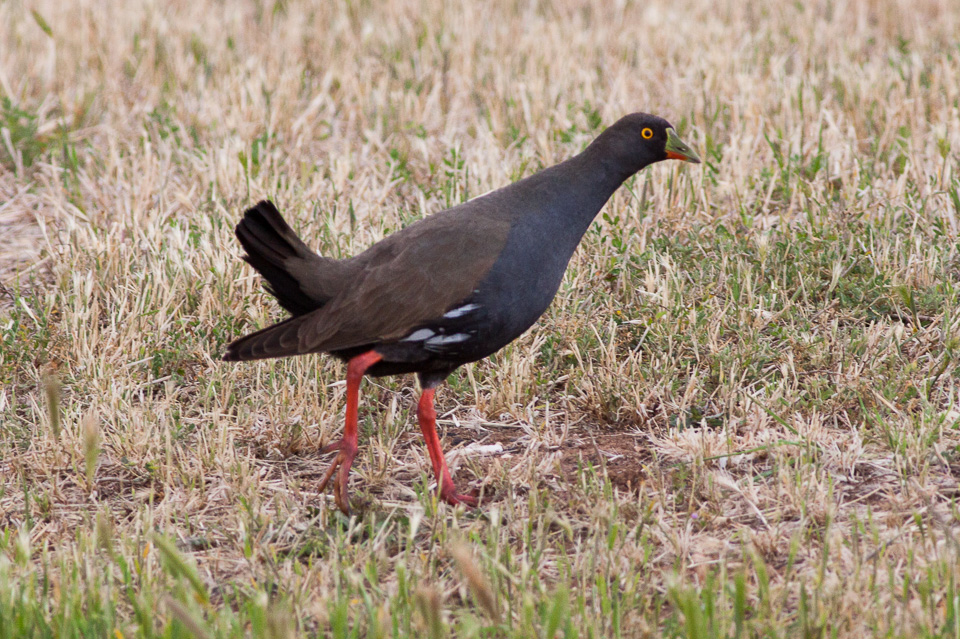
The Black-tailed Nativehen is characterized by its distinct plumage and morphology. Adults display a predominantly dark olive-brown body with a striking black tail that is often flicked upwards, revealing white undertail coverts. The legs are long and greenish-yellow, adapted for wading and navigating through aquatic vegetation. Juveniles resemble adults but are generally duller with a more muted coloration and less defined tail markings. Males and females are similar in appearance, making sex differentiation in the field challenging. However, males tend to be slightly larger. When compared to similar species, the Black-tailed Nativehen can be distinguished by its unique tail movement and the absence of the more vibrant colors seen in species like the Purple Swamphen. In flight, this bird displays a rapid, fluttering wingbeat, with legs trailing behind and the tail conspicuously flicked. Its perching behavior is often on the ground or low vegetation, where it remains alert and ready to retreat into dense cover if threatened.
Having trouble telling birds apart? Upload a photo to our bird identification tool for an instant species match.
Black-tailed Nativehen Habitat and Range
Preferred Habitat
The Black-tailed Nativehen is primarily associated with wetland habitats, including freshwater marshes, swamps, and floodplains. It thrives in areas with dense aquatic vegetation, which provides both food and protection. In Australia, notable habitats include the Murray-Darling Basin and the wetlands of northern Queensland. The bird's presence is influenced by water availability, leading to seasonal habitat shifts. During dry periods, it may move towards more reliable water sources, such as permanent lakes or rivers. While primarily a rural species, the Black-tailed Nativehen can occasionally be found in urban parks with suitable wetland conditions. Its adaptability to fluctuating water levels and diverse wetland types underscores its resilience and ecological importance.
Geographic Range
The Black-tailed Nativehen is endemic to Australia, with its range covering much of the continent's interior and eastern regions. It breeds mainly in the southeast, particularly in areas like the Murray-Darling Basin, where conditions are favorable. During non-breeding seasons, the bird can be found in northern Queensland and even as far west as Western Australia, depending on rainfall patterns. The species is known for its nomadic behavior, with populations moving extensively in response to changes in habitat suitability and water availability. Migration corridors are not well defined, as movements are irregular and driven by environmental factors rather than fixed seasonal patterns. Population density is highest in regions with consistent water sources, but the bird's ability to exploit transient wetlands allows it to colonize a wide range.
Want to know which birds visit your area? Browse our backyard birds by location guides for region-specific species lists.
What Does the Black-tailed Nativehen Eat?
The diet of the Black-tailed Nativehen is diverse, incorporating both plant and animal matter. Primary food sources include seeds, aquatic plants, and insects. During the wet season, the bird feeds extensively on the seeds of sedges and grasses, taking advantage of the abundance provided by flooding. It also preys on small invertebrates, such as snails and insects, which thrive in moist environments. Foraging techniques include probing in mud and shallow water, as well as scavenging on land near water bodies. The bird's diet shifts seasonally, with a greater emphasis on plant matter during the dry season when animal prey is less abundant. This opportunistic feeding strategy allows the Black-tailed Nativehen to survive in fluctuating conditions, showcasing its adaptability.
Black-tailed Nativehen Behavior and Social Structure
The Black-tailed Nativehen is a gregarious species, often forming large flocks outside the breeding season. These flocks can number in the hundreds, providing safety in numbers against predators. Socially active, the birds engage in mutual preening and vocal interactions, strengthening group cohesion. Territorial behavior is primarily exhibited during the breeding season when pairs defend nesting sites vigorously. Courtship displays include synchronized tail flicking and vocal duets between mates. The bird's response to predators is quick and coordinated, involving alarm calls and retreat into dense vegetation or water. Daily activity patterns revolve around foraging, with peak activity occurring in the early morning and late afternoon. Resting and maintenance behaviors, such as preening, occur during the hotter parts of the day when activity is reduced.
Black-tailed Nativehen Nesting and Reproduction
The Black-tailed Nativehen constructs nests in dense vegetation, usually near water. The nest is a simple platform made of reeds and grasses, providing concealment and support. Preferred nesting sites include reeds, shrubs, and low trees close to water. Clutch size ranges from 5 to 7 eggs, with both parents sharing incubation duties over a period of about 20-25 days. Once hatched, the chicks are precocial and leave the nest soon after, although they remain under parental care. Fledging occurs within 6-8 weeks, depending on food availability and environmental conditions. The species typically raises one brood per year, although favorable conditions may result in additional broods.
Black-tailed Nativehen Sounds and Vocalizations
The Black-tailed Nativehen's vocalizations include a variety of calls and sounds, each serving different purposes. The primary song is a series of sharp, rhythmic clucks that can carry over long distances, often described as resembling the sound of stones clacking together. These calls are used to maintain contact between flock members and during courtship. Alarm calls are higher-pitched and more frantic, alerting others to potential threats. The bird participates in a dawn chorus, particularly during the breeding season, with both sexes contributing to the vocal display. Compared to familiar sounds, its calls bear a resemblance to the clucking of domestic hens, albeit sharper and more distinct.
Interesting Facts About the Black-tailed Nativehen
- 1The Black-tailed Nativehen can cover impressive distances, sometimes traveling hundreds of kilometers in search of suitable habitat.
- 2Despite being flight-capable, the Black-tailed Nativehen often relies on its strong legs for rapid terrestrial movement.
- 3During breeding season, a pair of Black-tailed Nativehens may defend a territory as large as 1 hectare from intruders.
- 4The species exhibits a unique tail flicking behavior, often used in social interactions and as a display to potential mates.
- 5The Black-tailed Nativehen is known for its nomadic lifestyle, with populations appearing and disappearing unpredictably based on water availability.
- 6Juvenile Black-tailed Nativehens are capable of independent foraging within days of hatching, showcasing their precocial nature.
- 7This species is one of the few rails that can be found in large, cohesive flocks, sometimes numbering over 1,000 individuals.
Black-tailed Nativehen Conservation Status
The IUCN currently lists the Black-tailed Nativehen as a species of Least Concern, reflecting its widespread distribution and stable population. However, it faces threats from habitat loss due to wetland drainage and agricultural expansion. Climate change, impacting rainfall patterns and water availability, poses a long-term risk. Conservation efforts focus on protecting essential wetland habitats and understanding the species' movement patterns to better predict and mitigate impacts of environmental changes. Historically, populations have fluctuated with climatic conditions, highlighting the importance of preserving natural water regimes and wetland ecosystems.
Other Rallidae Species


Birds Similar to the Black-tailed Nativehen
These species are often confused with the Black-tailed Nativehen due to similar appearance or overlapping range.
