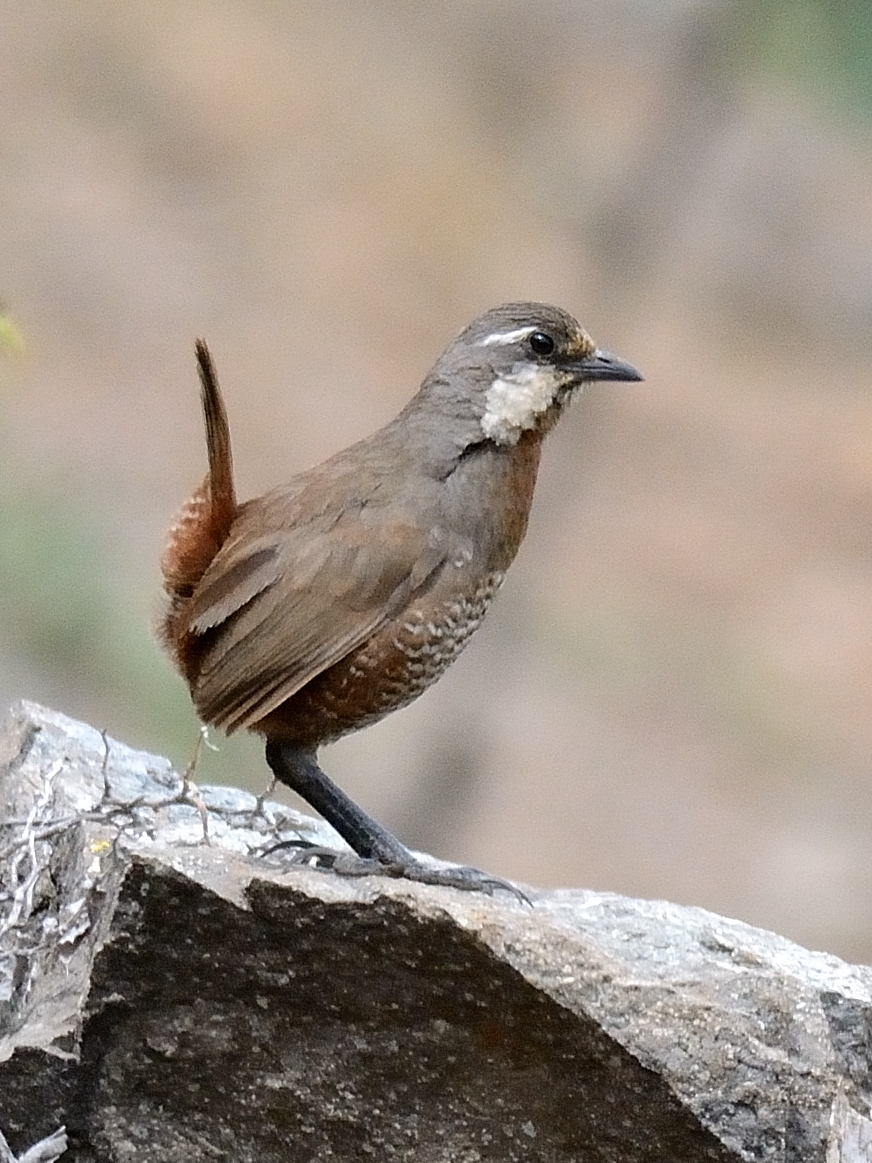
Black-throated Huet-huet
Pteroptochos tarnii
Order: Passeriformes / Family: Rhinocryptidae

Wikimedia Commons
About the Black-throated Huet-huet
The Black-throated Huet-huet (Pteroptochos tarnii) is a captivating bird, belonging to the Rhinocryptidae family, known for its elusive nature and strong presence in the temperate rainforests of southern South America. This species is primarily found in the dense, often impenetrable forests of Chile and Argentina, particularly thriving in the Valdivian temperate rainforests. These forests, rich with understory vegetation and fallen logs, provide ideal conditions for the Huet-huet's terrestrial lifestyle. The bird plays a significant role in these ecosystems, acting as both predator and prey, contributing to the intricate web of forest life. Its foraging habits help control insect populations and its diet of small invertebrates, seeds, and fruit allows it to disperse seeds, supporting forest regeneration. During the breeding season, which occurs in the Southern Hemisphere spring and summer, the Black-throated Huet-huet becomes more vocal and territorial, actively defending its territory with a series of loud, resonant calls. The bird's ability to remain hidden despite its vocal nature is a testament to its adaptability and the dense habitats it prefers. While not migratory, the Black-throated Huet-huet may exhibit some altitudinal movement, ranging from lowland forests to montane regions depending on seasonal food availability. Its ecological importance and unique behaviors make it a subject of interest not only to birders but also to conservationists aiming to preserve its forest habitats. The presence of the Black-throated Huet-huet serves as an indicator of healthy forest ecosystems, underscoring the need for robust conservation strategies in its range.
The Black-throated Huet-huet belongs to the family Rhinocryptidae, within the order Passeriformes. These birds typically live average 8 years, max recorded 12 years.
How to Identify a Black-throated Huet-huet
The Black-throated Huet-huet is a medium-sized bird, easily identifiable by its striking black throat contrasted against a reddish-brown body. Adult plumage is characterized by the dark, almost velvety blackness of the throat and upper chest, which sharply contrasts with the lighter, rust-colored belly and flanks. The wings and tail also display a rich brown hue, blending seamlessly with the forest floor. Juveniles lack the intensity of the adult's black throat, exhibiting a more muted brown coloration overall. Both males and females share similar plumage, making them difficult to differentiate in the field. However, males may appear slightly larger, though this is subtle. When observing the bird in its natural habitat, note its unique perching posture where it often sits low to the ground. Unlike many passerines, the Black-throated Huet-huet rarely takes to the air, preferring to run through the underbrush with agility. This terrestrial habit, combined with its distinctive vocalizations, distinguishes it from similar species like the Chucao Tapaculo, which shares parts of its range but exhibits different coloration and vocal patterns.
Having trouble telling birds apart? Upload a photo to our bird identification tool for an instant species match.
Black-throated Huet-huet Habitat and Range
Preferred Habitat
The Black-throated Huet-huet primarily inhabits the temperate rainforests of southern Chile and Argentina. These forests, characterized by high humidity and dense undergrowth, provide the perfect backdrop for its secretive lifestyle. Within these ecosystems, the bird prefers areas rich in fallen logs and thick leaf litter, which offer ample foraging opportunities. The elevation range of the Black-throated Huet-huet extends from sea level to approximately 1,500 meters, allowing it to occupy both lowland and montane forests. Seasonal habitat shifts are minimal, as the bird remains largely sedentary throughout the year. Urban presence is rare, as the Black-throated Huet-huet avoids areas with significant human disturbance, favoring remote forested regions far from urban development. Conservation of these habitats is crucial, given the bird's reliance on the dense forest cover for survival.
Geographic Range
The Black-throated Huet-huet is endemic to southern South America, with its range primarily confined to Chile and Argentina. In Chile, it is found from the Bio-Bio region southward to the Aysén region, while in Argentina, it inhabits areas from Neuquén to Chubut. The bird's distribution is closely tied to the presence of temperate rainforests, particularly the Valdivian and Magellanic forest types. Unlike many passerines, the Black-throated Huet-huet does not migrate, maintaining a year-round presence within its range. Population densities are highest in pristine forest habitats where human impact has been minimal. As a non-migratory species, conservation efforts focus on safeguarding these critical habitats to ensure the bird's continued survival in its native range.
Want to know which birds visit your area? Browse our backyard birds by location guides for region-specific species lists.
What Does the Black-throated Huet-huet Eat?
The diet of the Black-throated Huet-huet is diverse, reflecting its omnivorous feeding habits. Primarily, it consumes a variety of invertebrates, including insects, spiders, and small crustaceans found within the forest floor's leaf litter. During the breeding season, the bird's diet shifts slightly to include more protein-rich insects, vital for chick development. Seeds and fruits also form a substantial part of its diet, with the bird often seen foraging near fruiting shrubs and trees. The Huet-huet employs a foraging technique characterized by scratching and probing through the leaf litter, using its sturdy bill to uncover hidden prey. This ground-foraging behavior is highly effective, allowing it to exploit a wide range of food resources. Feeding typically occurs during the cooler parts of the day, primarily in the morning and late afternoon, when the forest is most active.
Black-throated Huet-huet Behavior and Social Structure
The Black-throated Huet-huet exhibits a complex array of behaviors that reflect its adaptation to life in dense forest environments. As a largely solitary bird outside of the breeding season, it maintains a strong territorial presence, using its loud, far-carrying calls to assert dominance over its chosen area. During courtship, pairs engage in mutual calling displays, strengthening pair bonds through vocal interactions. The bird's response to predators is swift and calculated, often retreating into dense underbrush where it remains motionless and silent, an effective strategy against avian and terrestrial threats. Daily activity patterns are primarily diurnal, with peak activity occurring in the early morning and late afternoon. During these times, the bird forages actively, capitalizing on the abundance of insects and other prey stirred by the cooler temperatures.
Black-throated Huet-huet Nesting and Reproduction
The Black-throated Huet-huet constructs its nest on or near the ground, typically hidden within dense vegetation or among fallen logs. The nest is a dome-shaped structure made from twigs, leaves, and moss, providing excellent camouflage. The clutch size usually consists of 2 to 3 eggs, which both parents incubate for about 18 to 20 days. Once hatched, the chicks remain in the nest for an additional 16 to 18 days before fledging. Parental care continues post-fledging, with both parents involved in feeding and protecting the young. The species generally raises one brood per year, although favorable conditions may lead to a second brood in some cases. The choice of nesting site and materials reflects the bird's adaptation to its forested environment, emphasizing the need for undisturbed habitats to support its reproductive success.
Black-throated Huet-huet Sounds and Vocalizations
The Black-throated Huet-huet is renowned for its distinctive vocalizations, which play a crucial role in its territorial and social behaviors. Its primary song is a series of deep, resonant notes delivered in a steady rhythm, often echoing through the forest. This song serves both to attract mates and to establish territory boundaries. In addition to its primary song, the bird emits a variety of call notes, including sharp, staccato alarms used to warn of potential threats. During the dawn chorus, the Huet-huet's calls are a prominent feature, contributing to the rich soundscape of its forest home. The quality of its calls is often compared to a series of hollow, drum-like beats, distinctive and easily recognizable to those familiar with the species.
Interesting Facts About the Black-throated Huet-huet
- 1The Black-throated Huet-huet belongs to the Rhinocryptidae family, known for their secretive nature and ground-dwelling habits.
- 2This bird's name, Huet-huet, mimics its unique call, which echoes like a rhythmic drum through the forest.
- 3The Black-throated Huet-huet is rarely seen in flight, as it prefers to run swiftly through the underbrush.
- 4Its diet includes a wide range of insects and invertebrates, which it skillfully uncovers with its strong bill.
- 5Breeding pairs of Black-throated Huet-huets engage in complex vocal duets to strengthen their pair bonds.
- 6The Valdivian temperate rainforest, home to the Huet-huet, is one of the world's few temperate rainforests.
- 7Both male and female Huet-huets share parenting duties, from incubation to feeding their young.
Black-throated Huet-huet Conservation Status
The Black-throated Huet-huet is currently classified as Least Concern by the IUCN, indicating a stable population trend. However, ongoing threats to its habitat, primarily from logging and forest conversion for agriculture, pose significant challenges to its long-term survival. Conservation efforts focus on protecting the Valdivian temperate rainforest, a critical habitat for the species. Initiatives include establishing protected areas and promoting sustainable forestry practices. Historically, the population has remained stable, but continued vigilance is necessary to counteract potential habitat loss. Collaborative efforts between conservation organizations and local communities are key to ensuring the preservation of this unique bird and its forest habitat.
Other Rhinocryptidae Species


Birds Similar to the Black-throated Huet-huet
These species are often confused with the Black-throated Huet-huet due to similar appearance or overlapping range.