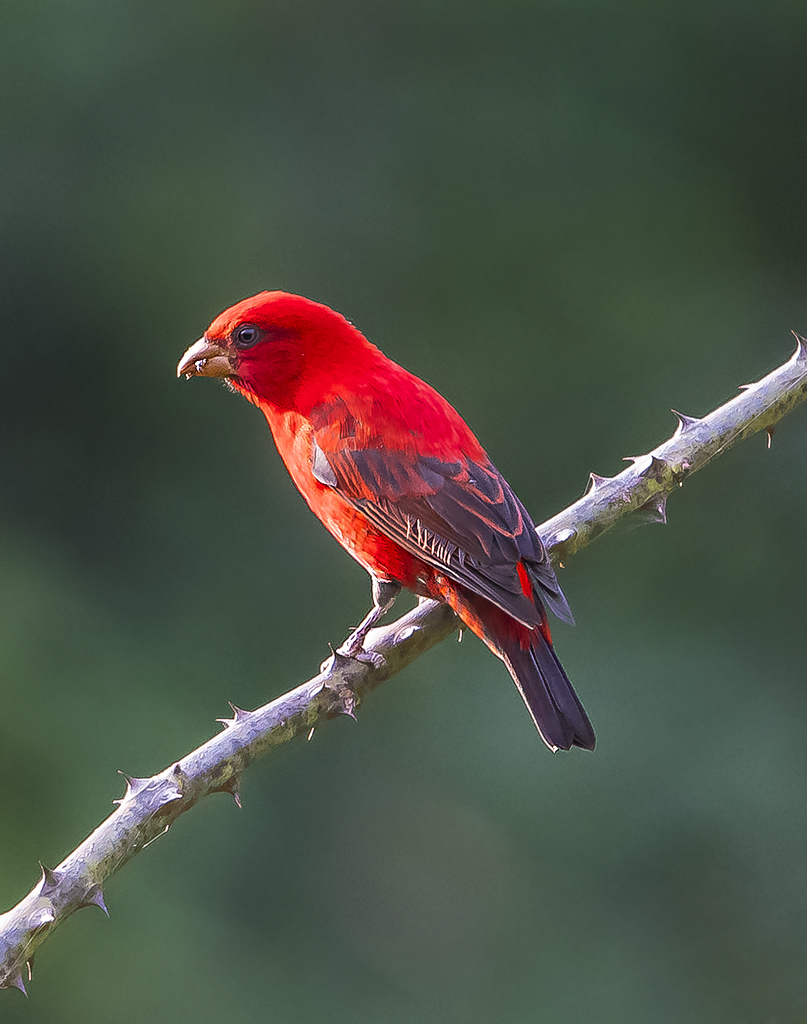
Blanford's Rosefinch
Agraphospiza rubescens
Order: Passeriformes / Family: Fringillidae

Wikimedia Commons
About the Blanford's Rosefinch
Blanford's Rosefinch (Agraphospiza rubescens) is a striking member of the Fringillidae family, notable for its distinctive rosy-red plumage that makes it a favorite among bird watchers trekking through the Himalayan ranges. This species inhabits regions primarily in the eastern Himalayas, extending through Bhutan, parts of India, and Nepal, and reaching into southern Tibet. In these mountainous regions, the bird plays an essential ecological role as both a seed disperser and an insectivore, contributing to the health of forest ecosystems. Blanford's Rosefinch thrives in subalpine coniferous forests and mixed woodlands, often seen flitting among the branches at altitudes ranging from 3,000 to 4,500 meters. During the colder months, some populations may descend to slightly lower elevations in search of food, making them more accessible to birders in the foothills. Despite undergoing seasonal movements, they do not engage in long-distance migrations. This rosefinch is an indicator of a healthy montane ecosystem, with its presence often signaling a rich biodiversity. Blanford's Rosefinch engages in a variety of behaviors that reflect its adaptability to the rugged terrain of its habitat. During the breeding season, males are particularly vocal, singing to establish territories and attract mates. Their song, a series of melodious trills, echoes through the forest, reverberating off steep cliffs and dense foliage. The species is not only a delight for bird enthusiasts but also serves as a critical subject for ornithologists studying high-altitude avifauna. As climate change continues to alter habitats, understanding the dynamics of species like Blanford's Rosefinch becomes increasingly important for conservation efforts.
The Blanford's Rosefinch belongs to the family Fringillidae, within the order Passeriformes. These birds typically live average 3-5 years, with max recorded up to 7 years..
How to Identify a Blanford's Rosefinch
Adult Blanford's Rosefinch males exhibit a vibrant rosy-red coloration on their head and upperparts, which transitions to a more subdued pinkish tone on the underparts. Females, in contrast, display a more muted brownish-olive plumage with subtle hints of pink, providing camouflage in their forest habitats. Juveniles resemble females but often appear even duller, with a streaky appearance. Both sexes possess a stout, conical bill ideal for seed consumption, a characteristic trait of finches. In flight, Blanford's Rosefinch presents a compact silhouette, with relatively short, rounded wings and a notched tail, features that aid in maneuverability through dense foliage. When perched, they often adopt an upright posture, alert and ready to dart into the safety of the canopy at any sign of danger. While the rosy plumage of males makes them difficult to confuse with other species, females could potentially be mistaken for other brown finches. However, the combination of their habitat preference and subtle plumage variations usually aids in correct identification. The bird's distinctive flight call, a sharp 'tsip,' coupled with its preference for high-altitude regions, further assists in distinguishing it from similar species.
Having trouble telling birds apart? Upload a photo to our bird identification tool for an instant species match.
Blanford's Rosefinch Habitat and Range
Preferred Habitat
Blanford's Rosefinch predominantly inhabits subalpine and alpine forests, favoring areas with dense coniferous trees like fir and spruce. These forests, often interspersed with rhododendron shrubs, provide both food resources and nesting sites. The species is typically found at elevations ranging from 3,000 to 4,500 meters, though it may venture lower during winter. In addition to coniferous habitats, Blanford's Rosefinch can occasionally be spotted in mixed woodlands where deciduous trees are present. Despite its preference for remote, high-altitude areas, it tends to avoid human-altered landscapes such as urban environments. Seasonal habitat shifts are primarily driven by the availability of food rather than temperature, as the species is well-adapted to cold conditions.
Geographic Range
The range of Blanford's Rosefinch spans the eastern Himalayas, encompassing countries such as Bhutan, northeastern India, Nepal, and southern Tibet. Within these regions, the bird resides in montane forests, with population densities peaking in areas that offer abundant food and suitable nesting sites. Although not migratory in the traditional sense, some populations exhibit altitudinal movements in response to seasonal variations in food availability. During breeding, they inhabit higher elevations, descending to lower altitudes as snow cover increases. The species' distribution across these territories is patchy, correlating with the presence of its preferred habitat. Notably, the rosefinch is absent from the western Himalayas, where climatic and ecological conditions differ significantly.
Want to know which birds visit your area? Browse our backyard birds by location guides for region-specific species lists.
What Does the Blanford's Rosefinch Eat?
The diet of Blanford's Rosefinch primarily consists of seeds, which it deftly extracts using its strong, conical bill. In summer, the bird supplements its diet with insects, providing a crucial source of protein during the breeding season. Commonly consumed seeds include those from coniferous trees like pine and fir, as well as various herbaceous plants. The rosefinch employs a foraging technique that involves hopping along branches and the forest floor, picking seeds directly from cones or the ground. During winter, when insects are scarce, the bird relies heavily on seeds, sometimes venturing to lower elevations to find sufficient food. This adaptability in diet allows Blanford's Rosefinch to thrive in its harsh montane environment.
Blanford's Rosefinch Behavior and Social Structure
Blanford's Rosefinch exhibits a range of behaviors that reflect its adaptation to high-altitude life. The species is generally observed alone or in pairs during the breeding season but may form small flocks in the non-breeding months. These flocks, often comprising family groups, provide safety in numbers when foraging in more open areas. Territorial behavior is pronounced in males, who sing vigorously from elevated perches to establish dominance and attract mates. Courtship involves males performing flights and displaying their vibrant plumage to potential mates. In response to predators, Blanford's Rosefinch relies on its cryptic coloration and quick, agile flight to evade danger. Daily activity patterns show peaks in morning and late afternoon when the bird is most actively foraging.
Blanford's Rosefinch Nesting and Reproduction
The nesting habits of Blanford's Rosefinch involve the construction of cup-shaped nests, often hidden in the dense foliage of coniferous trees or shrubs. These nests, built by the female, utilize materials such as twigs, grasses, and moss, providing camouflage and protection from the elements. Typically, the bird lays a clutch of three to four eggs, with the female solely responsible for incubation over a period of 12 to 14 days. Once hatched, both parents participate in feeding the chicks, which fledge approximately two weeks after hatching. Blanford's Rosefinch may raise one or two broods per year, depending on environmental conditions and food availability.
Blanford's Rosefinch Sounds and Vocalizations
The song of Blanford's Rosefinch is a melodious series of trills and whistles, often described as a sweet, warbling tune that resonates through its mountainous habitat. This song serves not only to establish territory but also to attract mates during the breeding season. In addition to its primary song, the rosefinch emits call notes that are short and sharp, typically a 'tsip' or 'chit' sound used for communication and alerts. Alarm calls differ slightly, being more rapid and staccato, signaling the presence of predators. During the dawn chorus, males are particularly vocal, contributing to the symphony of sounds that heralds the start of the day.
Interesting Facts About the Blanford's Rosefinch
- 1Blanford's Rosefinch is named after William Thomas Blanford, a British geologist and naturalist who made significant contributions to the study of Asian fauna.
- 2These birds are known to endure harsh weather conditions, often staying in regions where temperatures plummet below freezing.
- 3Unlike many finch species, Blanford's Rosefinch does not typically visit human feeders, preferring its natural high-altitude habitats.
- 4Their vibrant plumage is due to carotenoid pigments, which are also responsible for the coloration seen in many other bird species.
- 5Blanford's Rosefinch plays a crucial role in seed dispersal, aiding in the regeneration of forested areas they inhabit.
- 6Their preferred nesting sites are often located on steep, inaccessible slopes, providing protection from predators.
- 7Despite their remote habitats, these rosefinches are surprisingly vocal, their songs carrying great distances in the thin mountain air.
Blanford's Rosefinch Conservation Status
Blanford's Rosefinch currently holds a status of Least Concern according to the IUCN Red List, with population trends considered stable. Despite this, the bird faces threats from habitat loss due to deforestation and climate change, which could alter its high-altitude habitats. Conservation efforts in regions like the Himalayas focus on preserving forest ecosystems and mitigating the impacts of climate change. Historically, the population of Blanford's Rosefinch has remained relatively stable, benefiting from its remote and inaccessible habitat that has shielded it from the more severe impacts of human activity encountered by other species.
Other Fringillidae Species


Birds Similar to the Blanford's Rosefinch
These species are often confused with the Blanford's Rosefinch due to similar appearance or overlapping range.