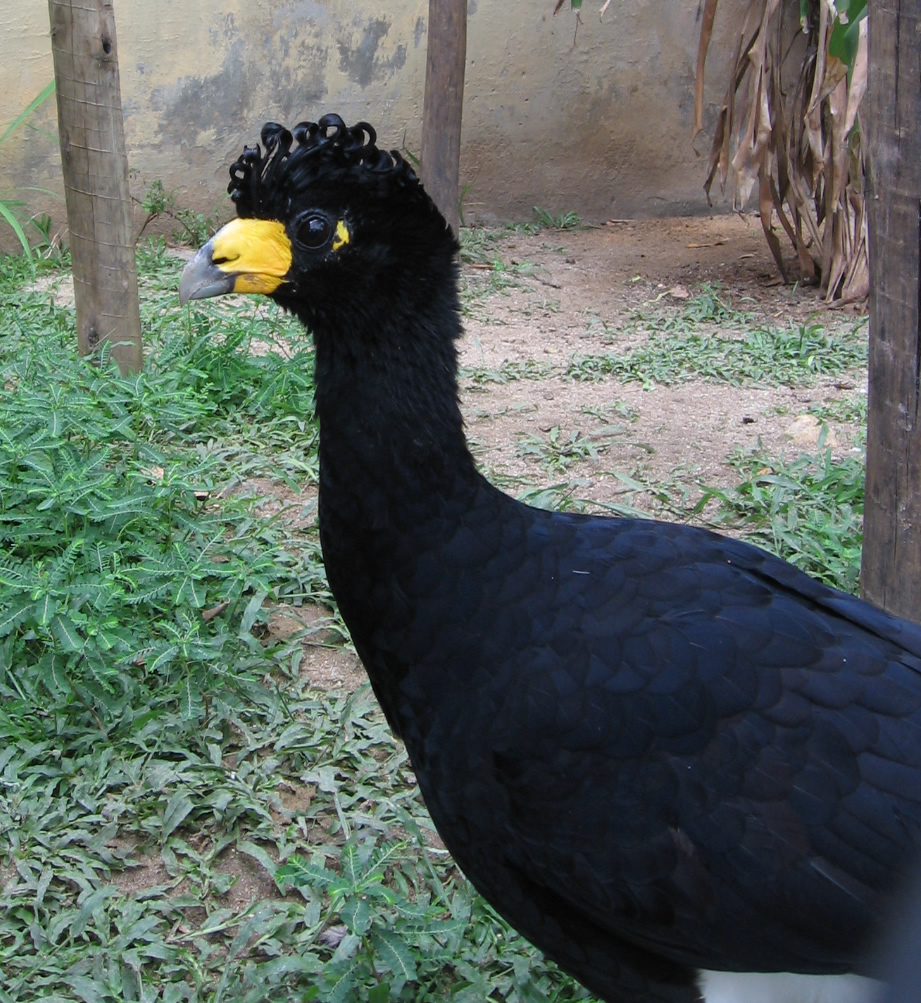
Blue-billed Curassow
Crax alberti
Order: Galliformes / Family: Cracidae

Wikimedia Commons
About the Blue-billed Curassow
The Blue-billed Curassow (Crax alberti) is a striking bird endemic to the humid lowland forests of northern Colombia. This species is a member of the Cracidae family, known for its large, robust body and distinctively vibrant blue bill. It is listed as Critically Endangered by the IUCN, primarily due to habitat loss and hunting pressures. The Blue-billed Curassow occupies a unique ecological niche within its environment, playing a significant role in seed dispersal and forest regeneration. Its diet, largely composed of fruits, seeds, and small invertebrates, facilitates the spread of various plant species across its range. The bird's presence is often an indicator of healthy, undisturbed forest ecosystems. The Blue-billed Curassow's distribution is limited to a few fragmented areas within the Magdalena River Valley and the foothills of the Sierra Nevada de Santa Marta. Here, the lush tropical forests provide ample food resources and shelter. The species exhibits seasonal behaviors tied to food availability, often seen foraging on the forest floor during the rainy season when fruits are more abundant. Despite its critical status, conservation efforts, including habitat restoration and protection, aim to stabilize and eventually increase its population. The Blue-billed Curassow is a key species for understanding the complex dynamics of tropical forest ecosystems. It interacts with other wildlife and contributes to maintaining biodiversity. Its conservation is not only vital for the species itself but also for the broader health of the forests it inhabits. Efforts to protect the Blue-billed Curassow involve local communities, raising awareness of its ecological significance and promoting sustainable land use practices.
The Blue-billed Curassow belongs to the family Cracidae, within the order Galliformes. These birds typically live typically 15-20 years in the wild, with individuals in captivity living longer..
How to Identify a Blue-billed Curassow
Adult Blue-billed Curassows are easily recognized by their glossy black plumage contrasted with a striking white vent and underbelly. The most distinguishing feature is their bright blue bill, which stands out against their dark feathers. Males typically have a more pronounced casque, a bony ridge on top of the bill, compared to females. Juveniles bear a similar dark plumage but lack the vibrant bill coloration, appearing more muted with a duller bill. In flight, the Blue-billed Curassow presents a broad-winged silhouette, with its powerful wingbeats and long tail aiding in maneuverability through dense forests. Perched, it maintains an upright posture, often on lower branches or the forest floor, where it forages. While the Blue-billed Curassow might be confused with other curassow species, its unique blue bill and specific range help differentiate it. Similar species lack the distinct blue bill and may exhibit variations in tail and body coloration. The bird's vocalizations, often a series of deep, resonant calls, also assist in identification among the dense canopy.
Having trouble telling birds apart? Upload a photo to our bird identification tool for an instant species match.
Blue-billed Curassow Habitat and Range
Preferred Habitat
The Blue-billed Curassow inhabits tropical and subtropical moist lowland forests, particularly favoring areas with dense understory vegetation. It thrives in elevations ranging from sea level up to 1,200 meters, although it is most commonly found in the lower elevations of the Magdalena River Valley. These forests provide the necessary cover and abundant food resources that the curassow relies on. Seasonal changes influence its habitat use, with the bird often moving to areas with higher fruit availability during the rainy season. Unlike some other bird species, the Blue-billed Curassow rarely ventures into urban areas, preferring the undisturbed, remote parts of the forest where human activity is minimal. Efforts to protect and restore these habitats are crucial for its survival, as forest fragmentation poses a significant threat.
Geographic Range
The Blue-billed Curassow's range is confined to northern Colombia, specifically within the Magdalena River Valley and the Sierra Nevada de Santa Marta foothills. Historically, its range was more extensive, but deforestation and hunting have led to a significant contraction. Breeding occurs predominantly within this limited range, where the climate and habitat conditions are ideal. The curassow is largely non-migratory, staying within the same general area year-round. However, minor movements may occur in response to seasonal food availability. Population density hotspots are primarily found in protected reserves and national parks where conservation efforts are in place. Despite its restricted range, ongoing habitat loss remains a critical threat to its continued existence.
Want to know which birds visit your area? Browse our backyard birds by location guides for region-specific species lists.
What Does the Blue-billed Curassow Eat?
The Blue-billed Curassow primarily consumes a diet of fruits and seeds, making it an important seed disperser within its ecosystem. It forages on the forest floor, using its powerful bill to crack open hard-shelled fruits and dig for seeds. Seasonal variations in fruit availability lead to shifts in diet, with an increased intake of insects and small invertebrates during periods when fruits are scarce. Foraging typically occurs during the early morning and late afternoon when the forest is cooler and quieter. The bird's diet plays a crucial role in the maintenance and regeneration of forest flora, as it aids in the propagation of various plant species by dispersing their seeds throughout its habitat.
Blue-billed Curassow Behavior and Social Structure
The Blue-billed Curassow exhibits a generally solitary or paired lifestyle, although small family groups are occasionally observed. Males are territorial, often seen displaying aggressive behaviors to defend their area. Courtship involves elaborate displays, including calls and physical posturing to attract females. During the breeding season, males engage in territorial displays to ward off rivals, using vocalizations and physical displays. The curassow's response to predators involves a mix of stealth and flight, with the bird using dense vegetation for cover. Daily activity patterns include foraging and resting during the cooler parts of the day to avoid the midday heat. Its behavior emphasizes the importance of maintaining undisturbed habitats for its survival.
Blue-billed Curassow Nesting and Reproduction
The Blue-billed Curassow constructs its nests in trees, using materials like twigs, leaves, and other forest debris. Nests are typically located several meters above the ground, providing protection from ground-dwelling predators. The female lays a clutch of 2 to 3 eggs, which she incubates for approximately 28 to 32 days. During this period, the male plays a supportive role, guarding the nesting area and providing food. Once hatched, the chicks remain in the nest for a few weeks before fledging. Parental care continues for several months, with both parents involved in feeding and protecting the young. Typically, the Blue-billed Curassow produces one brood per year, although under favorable conditions, a second may occur.
Blue-billed Curassow Sounds and Vocalizations
The primary song of the Blue-billed Curassow consists of a series of deep, resonant booming notes, often described as drum-like in quality. These calls serve as territorial markers and are most frequently heard during the early morning hours. The bird also emits various call notes, including softer clucks and whistles used in communication between mates and family groups. Alarm calls are sharper and more abrupt, alerting others to potential danger. The curassow's vocalizations are distinctive and help in locating the bird within the dense forest canopy.
Interesting Facts About the Blue-billed Curassow
- 1The Blue-billed Curassow's diet of fruits helps in the propagation of over 50 different plant species in its habitat.
- 2Despite its large size, the Blue-billed Curassow can navigate through dense forest understory with remarkable agility.
- 3Males and females of the species are monogamous, often forming lifelong pair bonds.
- 4The bird's booming call can be heard up to a kilometer away, serving as a powerful territorial signal.
- 5Blue-billed Curassows have been recorded living up to 15 years in the wild under optimal conditions.
- 6The species plays a crucial role in maintaining the ecological balance of its natural habitat through seed dispersal.
- 7Blue-billed Curassows were first described scientifically in 1852, highlighting their longstanding presence in ornithological studies.
Blue-billed Curassow Conservation Status
The Blue-billed Curassow is classified as Critically Endangered by the IUCN, with its population trend showing a significant decline. Primary threats include habitat destruction due to deforestation for agriculture and illegal hunting. Conservation efforts focus on habitat protection and restoration, with several reserves established to safeguard remaining populations. Local and international organizations work to raise awareness and promote sustainable practices. Historical data indicate a once broader distribution, highlighting the urgent need for conservation measures to prevent further decline.
Other Cracidae Species


Birds Similar to the Blue-billed Curassow
These species are often confused with the Blue-billed Curassow due to similar appearance or overlapping range.