
Blue Eared-Pheasant
Crossoptilon auritum
Order: Galliformes / Family: Phasianidae
Wikimedia Commons
About the Blue Eared-Pheasant
The Blue Eared-Pheasant, Crossoptilon auritum, is a captivating bird species native to the montane regions of China, primarily inhabiting the provinces of Sichuan, Gansu, and Qinghai. This pheasant plays a significant ecological role within its habitat by participating in seed dispersal and controlling insect populations. The Blue Eared-Pheasant thrives in temperate forests, often found at elevations ranging from 2,000 to 4,500 meters. Its preferred environment includes mixed forests dominated by coniferous and deciduous trees, which provide ample cover and food resources.
Ecologically, the Blue Eared-Pheasant contributes to the health of its ecosystem by aiding in the breakdown of nutrient-rich leaf litter through its foraging activities. Its presence also supports a diverse range of predators, including mammals and birds of prey, which rely on it as a food source. During the breeding season, which spans from April to August, these pheasants engage in elaborate courtship displays that highlight their iridescent plumage.
The Blue Eared-Pheasant exhibits seasonal behaviors, particularly in response to harsh winter conditions. In the colder months, these birds descend to lower elevations, where food availability is higher and snow cover is less prohibitive. Their seasonal movements influence the floral composition of their habitats, as their foraging habits aid in seed dispersal and germination. Overall, the Blue Eared-Pheasant is a vital component of its ecosystem, showcasing the interconnectedness of species within China's mountainous regions.
The Blue Eared-Pheasant belongs to the family Phasianidae, within the order Galliformes. These birds typically live average 10-15 years, with some individuals reaching up to 20 years..
How to Identify a Blue Eared-Pheasant
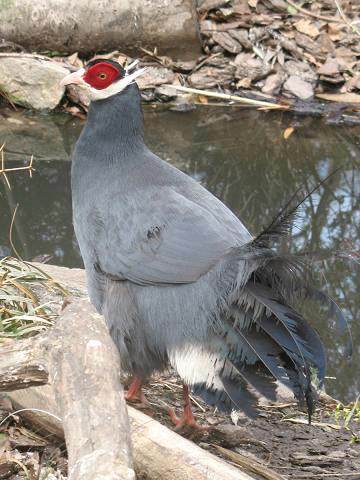
The Blue Eared-Pheasant, with its striking blue plumage, stands out among the pheasant family. Adult birds are easily recognizable by their deep iridescent blue feathers, contrasting sharply with their white ear tufts and tail tips. The pheasant's bill is a pale yellow, and its legs are a distinctive red, adding to its vibrant appearance. Males and females are similar in plumage, though males tend to be slightly larger.
Juvenile Blue Eared-Pheasants exhibit a duller coloration, with more muted blues and grays, gradually acquiring the vivid adult plumage as they mature. This transformation makes them less conspicuous to predators during their vulnerable early months. In the field, distinguishing the Blue Eared-Pheasant from similar species is straightforward due to its unique combination of blue coloration and white ear tufts.
In flight, the Blue Eared-Pheasant displays a distinctive silhouette characterized by broad, rounded wings and a long tail. When perching, they often maintain an upright posture, which, along with their distinctive coloration, makes them relatively easy to identify even from a distance.
Having trouble telling birds apart? Upload a photo to our bird identification tool for an instant species match.
Blue Eared-Pheasant Habitat and Range
Preferred Habitat
Blue Eared-Pheasants inhabit temperate montane forests, where they thrive in mixed coniferous and deciduous woodlands. These habitats provide the dense understory and varied diet they require. Typically found at elevations between 2,000 and 4,500 meters, they prefer cool, moist environments where snow cover is sparse enough to allow for foraging.
During winter, Blue Eared-Pheasants may descend to lower elevations, seeking areas with less snow and more accessible food sources. Unlike many other pheasant species, they rarely venture into urban areas, maintaining a strong preference for the solitude and cover of the forest. Such habitat specificity highlights their adaptation to the rugged terrain of China's mountainous regions.
Geographic Range
The range of the Blue Eared-Pheasant is primarily restricted to central and western China, with core populations in the provinces of Sichuan, Gansu, and Qinghai. These birds occupy a well-defined range within the high-altitude forests of the Tibetan Plateau and its surrounding regions.
During the breeding season, they remain within these montane forests, while in winter, they may migrate to lower altitudinal zones to escape the harshest weather conditions. Although not migratory in the traditional sense, these seasonal movements are vital for their survival and reproduction. The Blue Eared-Pheasant does not typically extend beyond China, making it a species of particular interest to those studying the biodiversity of this region.
Want to know which birds visit your area? Browse our backyard birds by location guides for region-specific species lists.
What Does the Blue Eared-Pheasant Eat?
The Blue Eared-Pheasant has an omnivorous diet that changes with the seasons. Primarily, it feeds on a variety of plant materials, including seeds, roots, and berries, which constitute the bulk of its diet. In the spring and summer, the pheasant's diet expands to include insects and other invertebrates, which provide essential protein during the breeding season.
Foraging typically occurs on the forest floor, where these birds use their strong legs to scratch through leaf litter and soil to uncover food. They also consume small mammals and reptiles when available, though these are less common in their diet. The Blue Eared-Pheasant is primarily diurnal, feeding throughout the day with peak activity in the morning and late afternoon.
Blue Eared-Pheasant Behavior and Social Structure
Blue Eared-Pheasants exhibit a complex social structure, often forming small family groups outside the breeding season. These groups cooperate in foraging and offer protection against predators. During the breeding season, males engage in conspicuous courtship displays, including calls and physical posturing, to attract females.
Territorial behavior is evident during this time, with males defending their chosen area aggressively. The Blue Eared-Pheasant is generally a ground-dwelling bird, though it roosts in trees at night to avoid predators such as foxes and birds of prey. They communicate using a range of vocalizations and are known for their distinctive calls, which can carry over long distances in their dense forest habitat.
Blue Eared-Pheasant Nesting and Reproduction
The Blue Eared-Pheasant builds its nests on the ground, typically concealed under dense vegetation or among rocks to protect from predators. Nest construction involves creating a shallow depression lined with leaves, grass, and feathers. Clutch sizes generally range from 6 to 12 eggs, which the female incubates for about 24 to 28 days.
Both parents participate in rearing the chicks, which fledge approximately 10 to 14 days after hatching. The young remain with their parents for several months, learning essential survival skills. The species commonly raises one brood per year, though favorable conditions may lead to a second brood.
Blue Eared-Pheasant Sounds and Vocalizations
The Blue Eared-Pheasant produces a variety of vocalizations, including a primary song characterized by short, rhythmic calls. These calls have a clear, ringing quality, often described as a series of 'kro-kro' notes. During the breeding season, males emit a loud, resonant call to establish territory and attract mates.
Alarm calls are sharp and abrupt, alerting other pheasants to potential threats. These birds also participate in dawn choruses, where their calls blend with the sounds of other forest inhabitants, creating a vibrant auditory landscape. The sounds of the Blue Eared-Pheasant are a distinctive feature of the mountainous forests they inhabit.
Interesting Facts About the Blue Eared-Pheasant
- 1The Blue Eared-Pheasant can live for over 15 years in the wild, making it one of the longer-lived pheasant species.
- 2Their strong legs allow them to dig through snow up to 30 centimeters deep to find food during winter.
- 3Despite their vibrant appearance, Blue Eared-Pheasants are highly adept at blending into their forest environment.
- 4They are capable of short bursts of flight, but primarily rely on their swift legs to escape predators.
- 5The white ear tufts of the Blue Eared-Pheasant serve as a key visual signal during social interactions.
- 6During courtship, males perform a display that includes spreading their wings and fanning their tail.
- 7The Blue Eared-Pheasant's call can be heard up to a kilometer away, cutting through the dense forest cover.
Blue Eared-Pheasant Conservation Status
According to the IUCN, the Blue Eared-Pheasant is currently listed as Least Concern, with a stable population trend. However, habitat loss due to deforestation and agricultural expansion poses ongoing threats. Conservation efforts focus on habitat preservation and mitigating human-wildlife conflict. Historically, the population has fluctuated in response to these pressures, but recent conservation measures, including protected areas and reforestation projects, have helped stabilize numbers. Continued monitoring and habitat conservation will be crucial to ensure the long-term survival of this species.


