
Blue Lorikeet
Vini peruviana
Order: Psittaciformes / Family: Psittacidae
Wikimedia Commons
About the Blue Lorikeet
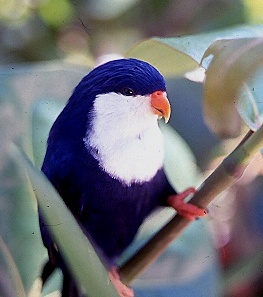
The Blue Lorikeet, scientifically named Vini peruviana, is a captivating member of the parrot family, distinguished by its striking blue plumage and vivid red beak. Native to the islands of the South Pacific, this bird is predominantly found in the low-lying areas of French Polynesia, particularly in the Society and Tuamotu archipelagos. Its presence is also noted on the relatively isolated island of Rimatara, where it plays a crucial role in local ecosystems. The Blue Lorikeet is a significant pollinator within its habitat. By feeding on nectar, it facilitates the cross-pollination of various flowering plants, contributing to the biodiversity of these island ecosystems. This role is especially vital given the limited land area and isolated nature of its habitat, where each species plays an integral part in maintaining ecological balance. The Blue Lorikeet adapts to a variety of environments, ranging from native forests to coconut plantations and gardens. It exhibits notable seasonal behaviors, often moving in response to food availability. During the breeding season, which typically aligns with the wet months, these birds become more territorial, showcasing elaborate displays and vocalizations to defend their nesting sites. This seasonality in behavior underscores the interconnectedness between the Blue Lorikeet and its environment, as it responds dynamically to changes in resource availability. The Blue Lorikeet's vibrant presence and ecological role highlight its importance within its native range, where it continues to captivate observers and contribute to the health of its ecosystem.
The Blue Lorikeet belongs to the family Psittacidae, within the order Psittaciformes. These birds typically live typically 10-15 years, with some living up to 20 years in captivity..
How to Identify a Blue Lorikeet
The Blue Lorikeet is an unmistakable bird due to its striking color patterns. Adults exhibit a deep cobalt blue plumage covering most of their body, contrasted by a bright red beak and a small patch of white feathers on their chest, which can vary slightly in size and intensity. Juvenile Blue Lorikeets are generally similar in appearance to adults but may display duller hues or a slightly less defined white chest patch, which becomes more pronounced as they mature. Male and female Blue Lorikeets do not exhibit significant sexual dimorphism, making them visually indistinguishable in the field. This lack of dimorphism requires careful observation of their behavior rather than physical characteristics to determine gender. In flight, the Blue Lorikeet reveals a streamlined silhouette characterized by its swift and agile movements. Its wings appear short and rounded, allowing for quick maneuvers among the dense foliage of its island habitats. When perched, the Blue Lorikeet maintains a distinctive upright posture, often engaging in acrobatic movements as it navigates branches in search of food. While the Blue Lorikeet's vivid blue plumage is distinctive, observers may confuse it with other lorikeet species in the region that share similar habitats, such as the Ultramarine Lorikeet. However, the Blue Lorikeet's specific combination of blue, red, and white, along with its unique vocalizations, aid in accurate identification.
Having trouble telling birds apart? Upload a photo to our bird identification tool for an instant species match.
Blue Lorikeet Habitat and Range
Preferred Habitat
The Blue Lorikeet predominantly inhabits tropical forest environments, thriving in both primary and secondary forests. It shows a marked preference for coastal and lowland areas, where it finds an abundance of flowering plants and fruiting trees. These birds are often observed in coconut plantations and gardens, where human-altered landscapes provide additional food sources. The Blue Lorikeet is typically found at elevations ranging from sea level to approximately 300 meters, although it occasionally ventures to higher altitudes when searching for food. Seasonal habitat shifts are common, with movements largely driven by the availability of flowering plants and fruiting trees. During periods of food scarcity, the Blue Lorikeet may temporarily inhabit less optimal areas, such as degraded forest patches or urban fringes. While the Blue Lorikeet is primarily associated with rural environments, it can adapt to urban settings, particularly in regions where natural habitats are diminished. In these areas, gardens and parks with flowering plants serve as vital resources, allowing the Blue Lorikeet to thrive in otherwise modified landscapes.
Geographic Range
The Blue Lorikeet's range is primarily confined to the South Pacific islands, with its core populations located in French Polynesia. It is most commonly found in the Society Islands and the Tuamotu Archipelago, where these birds are resident year-round. The island of Rimatara holds a significant population, serving as a crucial stronghold for the species. Unlike many other bird species, the Blue Lorikeet does not engage in long-distance migrations. Instead, it exhibits localized movements, often shifting between islands within its range in response to food availability. These movements are not extensive and are typically limited to short distances, often within a single archipelago. Population density hotspots exist on certain islands, such as Rimatara, where conservation efforts have helped stabilize numbers. In contrast, the Blue Lorikeet faces challenges on other islands due to habitat loss and competition with introduced species. Despite these challenges, the species' ability to adapt to a range of habitats has facilitated its persistence in several areas.
Want to know which birds visit your area? Browse our backyard birds by location guides for region-specific species lists.
What Does the Blue Lorikeet Eat?
The Blue Lorikeet's diet primarily consists of nectar, which it extracts from a variety of flowering plants. This diet is supplemented by pollen and soft fruits, providing essential nutrients that support its active lifestyle. The Blue Lorikeet's specialized brush-tipped tongue allows it to efficiently gather nectar while feeding on flowers. During the wet season, when flowers are abundant, the Blue Lorikeet’s diet is heavily nectar-based. In contrast, during drier periods, these birds rely more on available fruits and occasionally consume small insects to meet their nutritional needs. Foraging typically occurs in the early morning and late afternoon, when the temperatures are cooler and flowers are most productive. The Blue Lorikeet exhibits a highly social foraging behavior, often seen in small flocks moving systematically through flowering trees. This cooperative foraging strategy increases feeding efficiency and helps locate food sources more effectively. The Blue Lorikeet's reliance on nectar ties its feeding schedule closely to the flowering cycles of native and introduced plants, making it a critical pollinator in its ecosystem.
Blue Lorikeet Behavior and Social Structure
The Blue Lorikeet is a highly social and active bird, frequently observed in flocks that range from small family groups to larger aggregations. These flocks facilitate efficient foraging and provide protection against predators. The species exhibits strong territorial behavior during the breeding season, with pairs vigorously defending nesting sites and surrounding feeding areas from intruders. Courtship displays are elaborate and involve synchronized flying maneuvers, vocalizations, and mutual preening. These displays strengthen pair bonds and ensure successful breeding. The Blue Lorikeet is diurnal, with activity patterns closely tied to the availability of food. Early morning and late afternoon mark peak activity periods, as the birds venture out in search of nectar and fruits. During the hotter midday hours, they often rest in shaded areas, reducing energy expenditure. While generally tolerant of human presence, the Blue Lorikeet may react to potential threats with alarm calls and rapid evasive flights. This response helps alert other flock members to danger and ensures the group's safety.
Blue Lorikeet Nesting and Reproduction
The Blue Lorikeet typically nests in tree cavities, utilizing natural hollows or abandoned nests of other birds. The species shows a preference for cavity sites located in tall trees, which provide protection from predators and environmental elements. Nesting materials are minimal since the cavity itself provides the necessary structure. The Blue Lorikeet lays a clutch of two to three eggs, which the female incubates for approximately 25 days. During this period, the male plays a supportive role, providing food and defending the nest site. Once hatched, the chicks remain in the nest for six to eight weeks, during which both parents share feeding duties. The young birds fledge around eight weeks of age, but they often remain with their parents for an additional four to six weeks, learning vital survival skills. The Blue Lorikeet typically raises one brood per year, although favorable conditions may occasionally allow for a second brood.
Blue Lorikeet Sounds and Vocalizations
The Blue Lorikeet's vocalizations are characterized by a series of high-pitched, melodic calls that vary in rhythm and intensity. These calls serve multiple purposes, from maintaining contact with flock members to signaling alarm in response to threats. The primary song consists of rapid, trilling notes that can be heard during courtship displays and territorial disputes. In addition to their more melodic sounds, Blue Lorikeets produce sharp, piercing alarm calls when disturbed or threatened. This call pattern helps alert other birds to potential danger. During the dawn chorus, the Blue Lorikeet's calls blend with those of other island species, creating a vibrant soundscape that marks the beginning of the day's activities.
Interesting Facts About the Blue Lorikeet
- 1The Blue Lorikeet has a specialized brush-tipped tongue designed for efficient nectar extraction.
- 2Despite their vibrant appearance, Blue Lorikeets are surprisingly agile and can navigate through dense foliage with ease.
- 3Blue Lorikeets play a crucial role as pollinators, aiding the reproduction of many plant species on their island habitats.
- 4Their population on Rimatara is one of the most stable, thanks to effective conservation measures such as predator control.
- 5Blue Lorikeets are known for their acrobatic feeding behavior, often hanging upside down to access flowers.
Blue Lorikeet Conservation Status
The IUCN currently classifies the Blue Lorikeet as Vulnerable, with population trends showing signs of stability in some areas due to targeted conservation efforts. Primary threats to the species include habitat destruction, competition with introduced species, and predation by invasive mammals such as rats and cats. Conservation initiatives focus on habitat preservation, eradication of invasive species, and captive breeding programs aimed at bolstering wild populations. Historical data indicates a decline in population due to these threats, but recent efforts have stabilized numbers, particularly on islands like Rimatara where protective measures are in place.


