Blue Mountain Vireo
Vireo osburni
Order: Passeriformes / Family: Vireonidae

Wikimedia Commons
About the Blue Mountain Vireo
The Blue Mountain Vireo, known scientifically as Vireo osburni, is a unique bird species endemic to Jamaica, where it predominantly occupies the lush, montane forests of the Blue Mountains. This bird is a member of the Vireonidae family and is a striking example of avian adaptation to specific ecological niches. Its presence is significant not only due to its restricted range but also because it plays a crucial role in the ecosystem as both a predator and prey.
The Blue Mountain Vireo is crucial for maintaining the ecological balance within its habitat. By feeding on insects, it helps control pest populations, thus aiding in the health of the forest. Additionally, as a prey species for larger birds and animals, it provides a vital link in the food chain. This bird's preference for high-altitude forests, specifically those above 1,000 meters, underscores its adaptation to cooler, moist environments, which are often shrouded in mist and offer dense canopy coverage.
The vireo's ecological role extends beyond just pest control. During the breeding season, its territorial calls and songs contribute to the soundscape of the Jamaican montane forests, enriching the biodiversity and promoting healthy competition among avian species. In the non-breeding season, the Blue Mountain Vireo remains within its highland home, adapting to the slight seasonal variations in climate and prey availability. This year-round residency highlights its specialization and the critical need to preserve its habitat.
The Blue Mountain Vireo belongs to the family Vireonidae, within the order Passeriformes. These birds typically live average 4 years, with a maximum recorded of 7 years..
How to Identify a Blue Mountain Vireo
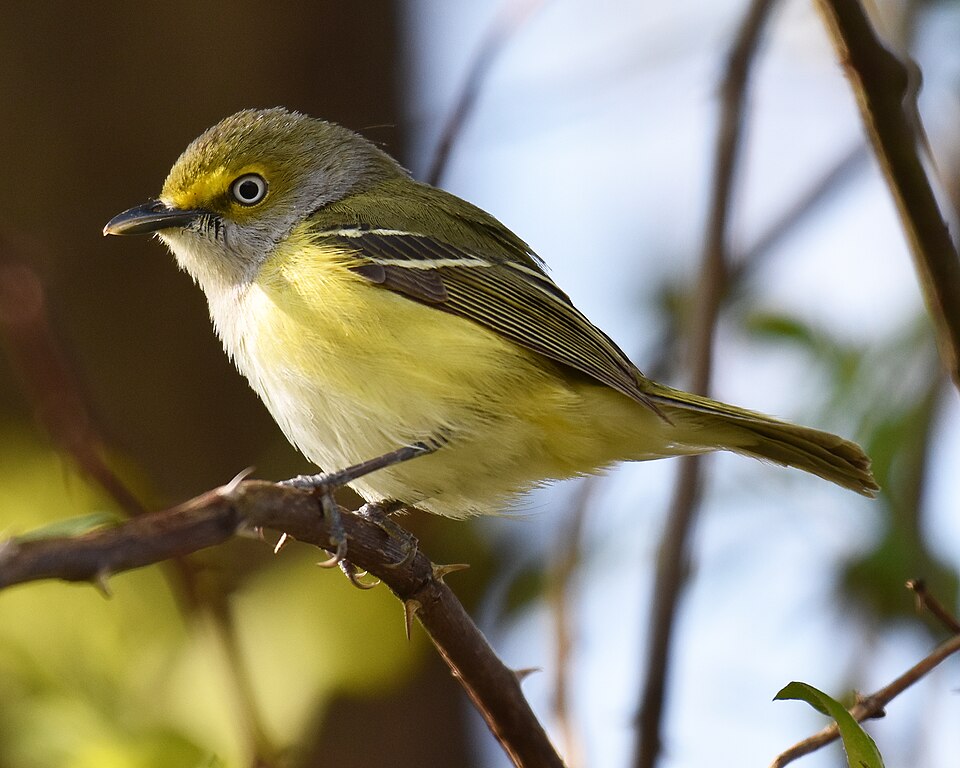
The Blue Mountain Vireo is a small passerine with a striking olive-green coloration on its back, which contrasts with its whitish underparts. Adults exhibit a distinct eye-ring and a white supercilium, giving them a characteristic facial appearance common to many vireos. The juveniles, while similar to adults, tend to have slightly duller plumage, lacking the bright contrast seen in mature birds.
Males and females appear similar, making sex differentiation in the field challenging. However, during the breeding season, males can be observed singing from exposed perches, which can aid in identification. The wings and tail of the Blue Mountain Vireo are relatively short, giving it a stocky appearance when perched. In flight, the bird displays a swift, direct line, typical of the vireo family.
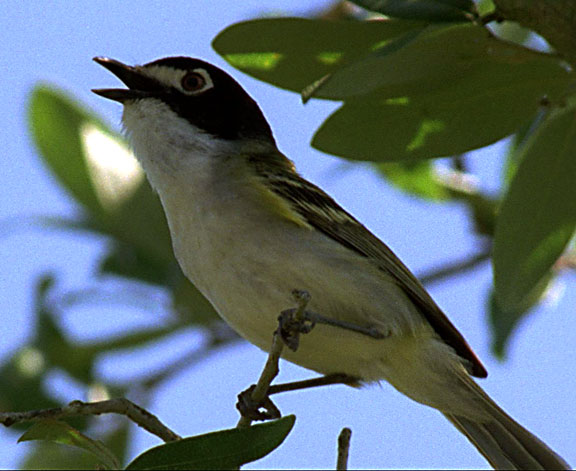
Confusion with other species is minimal due to its restricted range and unique plumage. However, one might mistake it for the Black-whiskered Vireo, which shares some range overlap, though the Blue Mountain Vireo lacks the black streaks near the throat characteristic of its cousin. When perched, the vireo often adopts an upright posture, aiding in the identification process.
Having trouble telling birds apart? Upload a photo to our bird identification tool for an instant species match.
Blue Mountain Vireo Habitat and Range
Preferred Habitat
The Blue Mountain Vireo is a habitat specialist, thriving in Jamaica's montane forests. These areas are characterized by their dense, moist foliage and cooler temperatures, offering an ideal environment for this bird. The vireo particularly favors elevations above 1,000 meters, where the forest canopy provides ample cover and foraging opportunities.
Within this habitat, the bird can be found in both primary and secondary forests, though it shows a marked preference for undisturbed areas where the ecosystem remains intact. Seasonal changes do not significantly alter its habitat use, as the vireo remains resident in the mountains year-round, adapting to the subtle shifts in climate.
Urban presence is negligible as the Blue Mountain Vireo avoids human-altered landscapes, reflecting its dependence on the natural forest ecosystems. Conservation of its habitat is therefore critical, as deforestation and habitat degradation pose significant threats to its population.
Geographic Range
The Blue Mountain Vireo's range is limited to Jamaica, particularly the Blue and John Crow Mountains, which offer the montane forest environment essential for its survival. This restricted range makes it a species of significant interest to ornithologists and conservationists alike.
Its breeding range is confined to these high-altitude forests, where the climate and habitat provide optimal breeding conditions. During the breeding season, which coincides with the rainy period, the vireo can be found throughout these montane regions, actively defending territories and nesting.
Unlike many other vireo species, the Blue Mountain Vireo does not migrate. It remains within its mountainous home throughout the year, taking advantage of the relatively stable conditions provided by the Jamaican highlands. Population density hotspots are found primarily within protected areas of the Blue Mountains, where conservation efforts help maintain suitable habitat conditions.
Want to know which birds visit your area? Browse our backyard birds by location guides for region-specific species lists.
What Does the Blue Mountain Vireo Eat?
The Blue Mountain Vireo has an insectivorous diet, primarily feeding on a variety of insects and their larvae. This dietary preference makes it an important player in pest control within its montane forest habitat. During the wet season, the abundance of insects allows the vireo to feed actively throughout the day, taking advantage of the increased food supply.
In addition to insects, the vireo occasionally supplements its diet with fruit, particularly during times when insect populations decline. This opportunistic feeding behavior ensures it can sustain itself across varying environmental conditions. The bird typically forages among the mid to upper canopy, gleaning insects from leaves and branches with its sharp bill.
The Blue Mountain Vireo exhibits a methodical foraging technique, often moving slowly through the foliage to locate prey. Its feeding schedule is largely diurnal, with peak activity in the early morning and late afternoon, coinciding with the most favorable conditions for insect activity.
Blue Mountain Vireo Behavior and Social Structure
The Blue Mountain Vireo is known for its solitary behavior outside of the breeding season. It fiercely defends its territory, using its song to establish dominance and ward off intruders. During the breeding season, males intensify their singing efforts, often from high perches, to attract mates and assert territorial claims.
Courtship displays are subtle but involve mutual preening and synchronized movements between paired individuals. Once paired, the birds demonstrate strong pair bonds, often remaining monogamous throughout the breeding season. The vireo's territorial nature extends to nesting, where it actively defends the nest site from potential threats, including other birds and small mammals.
The Blue Mountain Vireo's response to predators includes a variety of alarm calls and distraction displays designed to draw attention away from its nest or young. This bird is diurnal, with activity peaking during the early and late parts of the day, aligning with optimal foraging times and predator avoidance.
Blue Mountain Vireo Nesting and Reproduction
The Blue Mountain Vireo constructs a cup-shaped nest, strategically placing it in the fork of a tree branch, usually at a moderate height to ensure protection from ground predators. The nest is made from fine grasses, moss, and spider silk, providing both strength and camouflage.
Females typically lay 2 to 3 eggs per clutch, with incubation lasting around 12 to 14 days. Both parents share incubation duties, although the female spends more time on the nest. After hatching, the chicks remain in the nest for approximately 10 to 12 days before fledging.
Parental care continues post-fledging, with both parents involved in feeding and protecting the young until they are independent. The Blue Mountain Vireo generally raises one brood per year, although in optimal conditions, a second brood is possible.
Blue Mountain Vireo Sounds and Vocalizations
The Blue Mountain Vireo's song is a complex series of melodious phrases, delivered in a rhythmic pattern. It consists of a series of whistled notes that rise and fall in pitch, often described as sweet and plaintive.
In addition to its song, the vireo produces a variety of calls used for communication. These include short, sharp chips used as contact calls between mates or family members. Alarm calls are more urgent and harsh, serving to warn of nearby threats.
During the dawn chorus, the Blue Mountain Vireo is one of the prominent voices, adding to the rich soundscape of the Jamaican montane forests. Its vocalizations play a crucial role in territory establishment and mate attraction.
Interesting Facts About the Blue Mountain Vireo
- 1The Blue Mountain Vireo is endemic to Jamaica, making it a key species for local biodiversity conservation.
- 2Despite its name, the Blue Mountain Vireo does not have blue plumage; its olive-green color helps it blend into the forest canopy.
- 3The species was first described in 1919, highlighting its relatively recent scientific recognition compared to other vireos.
- 4This bird's preference for high-altitude habitats means it is rarely seen by casual birdwatchers or tourists.
- 5The Blue Mountain Vireo's melodious song can be heard year-round, contributing to the rich auditory landscape of its montane forest home.
- 6Studies indicate that the Blue Mountain Vireo has a stable pair bond, often remaining loyal to a single mate throughout the breeding season.
- 7The Blue Mountain Vireo typically forages in the upper canopy, showcasing its adaptation to life in dense forest environments.
Blue Mountain Vireo Conservation Status
The Blue Mountain Vireo is currently listed as Near Threatened on the IUCN Red List, primarily due to its limited range and habitat degradation. Population trends suggest a decline, largely driven by deforestation and the encroachment of agriculture into its montane forest habitat. Conservation efforts focus on habitat preservation, with protected areas such as the Blue and John Crow Mountains National Park playing a critical role in safeguarding this species. Efforts to control habitat destruction and promote sustainable land use practices are essential for its long-term survival. Historically, the vireo's population has fluctuated with changes in habitat availability, underscoring the need for continued conservation vigilance. Public awareness and engagement in conservation activities are crucial in reversing the negative trends affecting this unique bird.