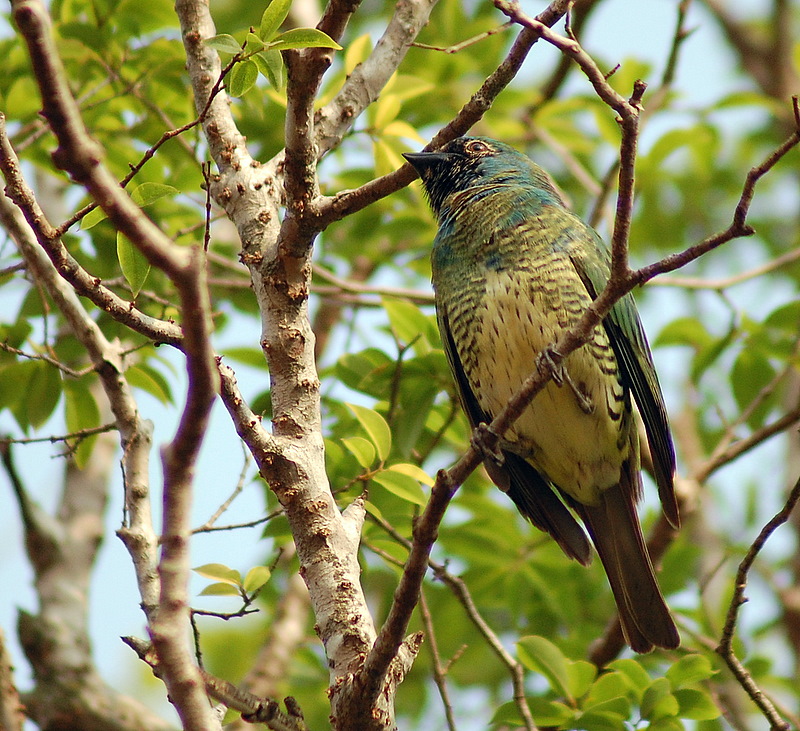
Blue-necked Tanager
Stilpnia cyanicollis
Order: Passeriformes / Family: Thraupidae

Wikimedia Commons
About the Blue-necked Tanager
The Blue-necked Tanager (Stilpnia cyanicollis) is a captivating small songbird belonging to the family Thraupidae. This species is renowned for its vivid plumage, which stands out against the dense greenery of its native habitats. These birds are primarily found in lowland and montane forests across South America, particularly in countries like Colombia, Peru, Ecuador, and Brazil. They thrive in humid tropical environments where they play a significant ecological role as seed dispersers and pollinators.
The Blue-necked Tanager is an integral component of the forest ecosystem. By foraging on a diet that includes fruits such as berries and figs, they help in the dispersal of seeds, facilitating the growth and regeneration of forest flora. Their presence is indicative of healthy forest systems, as they are sensitive to habitat degradation and prefer pristine environments. Ecologically, they contribute to the balance of insect populations by consuming them, aiding in pest control naturally.
Seasonally, the Blue-necked Tanager may exhibit slight altitudinal migration. During breeding periods, they tend to stay in areas rich in resources to support their young. However, outside the breeding season, they might be observed at varying elevations in search of food. Their adaptability to different forest strata allows them to exploit a range of resources, from the forest floor to the canopy. The Blue-necked Tanager's vibrant appearance and ecological contributions make it a vital subject of study for ornithologists and a delightful sight for birdwatchers.
The Blue-necked Tanager belongs to the family Thraupidae, within the order Passeriformes. These birds typically live average 5 years with a max recorded of 7 years.
How to Identify a Blue-necked Tanager
The Blue-necked Tanager is easily identified by its striking coloration, which makes it a favorite among birdwatchers. Adult males boast a brilliant blue neck and head, contrasted by a black back and wings. The underparts are a light greenish-blue, with a slight iridescence that catches the sunlight beautifully. Females and juveniles display a more subdued version of this plumage, with females generally having a duller blue and more greenish tones on the body.
Juveniles can be distinguished by their less vibrant colors and a more pronounced greenish hue compared to adults. Males and females are similar in size, typically measuring about 13 cm in length, but the males tend to have more vivid coloration. The Blue-necked Tanager can be confused with other tanagers; however, its unique combination of a blue head and neck with a black body is distinctive.
In flight, the Blue-necked Tanager displays a compact silhouette with rapid wing beats. Its perching posture is characteristically upright. When observed in the field, the contrast between its blue neck and black body is particularly noticeable against the foliage, aiding in its identification even when partially obscured by leaves.
Having trouble telling birds apart? Upload a photo to our bird identification tool for an instant species match.
Blue-necked Tanager Habitat and Range
Preferred Habitat
The Blue-necked Tanager predominantly inhabits tropical and subtropical moist lowland and montane forests. They are commonly found at elevations ranging from sea level up to 1,800 meters. These birds favor the edges of forests and clearings, where fruiting trees are abundant. Their habitat preference extends to secondary forests and occasionally plantations, showcasing a degree of adaptability to human-altered landscapes.
Seasonal habitat shifts may occur as they move to different elevations in search of food during non-breeding seasons. In urban areas, they are less common but can occasionally be spotted in gardens and parks that offer suitable vegetation. Despite their adaptability, the Blue-necked Tanager is most frequently encountered in undisturbed forest environments, where their ecological roles can be fully realized.
Geographic Range
The Blue-necked Tanager's range extends across several South American countries, including Colombia, Ecuador, Peru, Bolivia, and parts of Brazil. They are non-migratory, residing year-round in these regions. However, they may undertake local movements in response to food availability and breeding needs. Populations are particularly dense in the Andean foothills and Amazon basin, where they find ideal conditions for survival.
While they do not engage in long-distance migrations, their presence across a broad range of elevations allows them to exploit various ecological niches. In some areas, especially where forests are intact, they are quite common. Conversely, in regions where deforestation is prevalent, their numbers may be lower, highlighting the importance of habitat conservation for their continued presence.
Want to know which birds visit your area? Browse our backyard birds by location guides for region-specific species lists.
What Does the Blue-necked Tanager Eat?
The Blue-necked Tanager has a diverse diet primarily composed of fruits and insects, reflecting their role as both seed dispersers and insectivores. They favor small fruits and berries, such as those from the Melastomataceae and Moraceae families. During the breeding season, their diet shifts slightly to include more protein-rich insects, which are essential for chick development.
Foraging predominantly occurs in the canopy and mid-levels of the forest, where they use their agile movements to glean fruits and insects from foliage. They occasionally join mixed-species flocks, which allows them to access a wider range of food sources while benefiting from the vigilance of other bird species. Observations indicate that the Blue-necked Tanager feeds throughout the day, with peak activity often occurring in the early morning and late afternoon when insect activity is high.
Blue-necked Tanager Behavior and Social Structure
The Blue-necked Tanager exhibits a range of social behaviors, often seen in small groups or pairs. They are not particularly territorial, although they may defend feeding areas or nesting sites during the breeding season. Courtship displays are subtle, involving mutual preening and soft calls between mates. Flocking behavior is common, with these tanagers frequently joining mixed-species flocks, which provide advantages such as increased foraging success and protection from predators.
Their response to predators is typically one of alarm and evasion, relying on the dense foliage for cover. During the day, their activity patterns include consistent foraging interspersed with rest periods. They are most active in the cooler parts of the day. Despite their vivid coloration, they can be surprisingly inconspicuous among the dense leaves, often noticed only when they move or vocalize.
Blue-necked Tanager Nesting and Reproduction
Blue-necked Tanagers build cup-shaped nests using a variety of plant materials such as moss, twigs, and leaves. These are typically located in the mid to upper levels of the forest, often well-concealed among dense foliage. The female lays a clutch of 2 to 3 eggs, which she incubates for approximately 14 days.
Both parents share in feeding the chicks, which fledge about 16 days after hatching. The involvement of both parents ensures a high survival rate for the young. The Blue-necked Tanager usually raises one brood per year, although there can be variation depending on environmental conditions like food availability and weather.
Blue-necked Tanager Sounds and Vocalizations
The Blue-necked Tanager's song is a series of high-pitched, melodious notes delivered in a rapid sequence. The rhythm is lively and the pitch remains consistently high, giving it a cheerful quality. Their calls include short, sharp chips used for communication between individuals, particularly during foraging or when alarmed. Alarm calls are more hurried and can signal the presence of predators.
During the dawn chorus, the Blue-necked Tanager's song can be heard intermingling with those of other forest birds, adding to the rich tapestry of sound. Their vocalizations are not as complex as some other songbirds, but they are distinctive enough to aid in identification.
Interesting Facts About the Blue-necked Tanager
- 1The Blue-necked Tanager's diet helps control insect populations in tropical forests, making it an important ecological player.
- 2Despite their vibrant coloration, Blue-necked Tanagers are surprisingly adept at blending into the dense foliage of their forest habitats.
- 3These tanagers often join mixed-species flocks, which can include up to a dozen different bird species, enhancing their foraging efficiency.
- 4The Blue-necked Tanager is one of over 200 species of tanagers, a diverse family of colorful birds endemic to the Americas.
- 5Their ability to thrive in both lowland and montane forests demonstrates their adaptability within tropical ecosystems.
Blue-necked Tanager Conservation Status
The Blue-necked Tanager is currently listed as Least Concern by the IUCN, with a stable population trend. However, habitat loss due to deforestation poses a significant threat. Conservation efforts focus on preserving large tracts of tropical forest to ensure the continued survival of this species. The historical population has remained relatively stable, but localized declines are evident in areas where forest cover has been significantly reduced. Continued monitoring and habitat protection are crucial in preventing future population declines.
Other Thraupidae Species


Birds Similar to the Blue-necked Tanager
These species are often confused with the Blue-necked Tanager due to similar appearance or overlapping range.