
Brown-backed Chat-Tyrant
Ochthoeca fumicolor
Order: Passeriformes / Family: Tyrannidae
Wikimedia Commons
About the Brown-backed Chat-Tyrant
The Brown-backed Chat-Tyrant, Ochthoeca fumicolor, is a member of the Tyrannidae family, renowned for its adaptability across various Andean landscapes. This species finds its home primarily in montane forests, preferring elevations between 2,500 to 4,000 meters. The bird's presence spans across countries like Colombia, Ecuador, Peru, and northern Argentina. These regions offer the dense shrubbery and open woodland edges that the species favors. Its ecological role is significant as it contributes to insect population control, serving as both predator and prey within its ecosystem. The Brown-backed Chat-Tyrant exhibits seasonal behaviors, often moving to slightly lower elevations during harsher weather to exploit available resources. Its adaptive behavior ensures its survival in environments where climatic conditions can be harsh and variable. During breeding seasons, these birds become more vocal and territorial, signaling their presence in the lush, dense vegetation. This bird's adaptability to various Andean habitats underlines its ecological importance and resilience. Its presence in these ecosystems indicates a healthy balance of predator-prey dynamics, showcasing the intricate web of interactions within montane forest environments. By understanding the role of the Brown-backed Chat-Tyrant, conservationists can better appreciate the complex interplay of species that maintain the health and diversity of these high elevation ecosystems.
The Brown-backed Chat-Tyrant belongs to the family Tyrannidae, within the order Passeriformes. These birds typically live average 5 years with max recorded around 6 years.
How to Identify a Brown-backed Chat-Tyrant
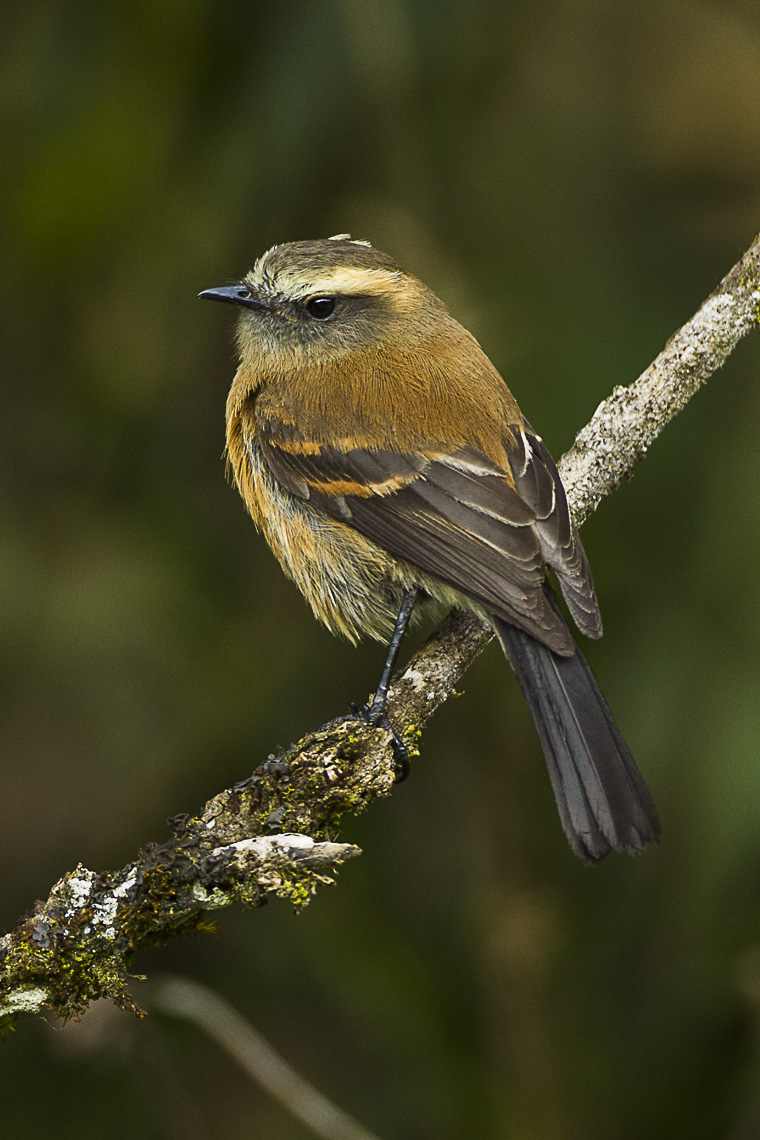
Adult Brown-backed Chat-Tyrants are medium-sized birds with a length of approximately 15 cm. Their most noticeable feature is the rich brown coloration of their back, which contrasts sharply with their white throat and underparts. The head is gray with a subtle supercilium, while the wings and tail are darker brown, providing a uniform appearance when perched. Juveniles often display a duller palette, with less pronounced white on the throat and a more mottled brown back, which can be misleading for inexperienced birders. There is little sexual dimorphism in this species, meaning males and females are similar in appearance. However, during the breeding season, males may exhibit slightly more vibrant coloration due to hormonal changes. The Brown-backed Chat-Tyrant can sometimes be confused with the Rufous-breasted Chat-Tyrant, but the latter has a more pronounced rufous coloration on the breast. In flight, the Brown-backed Chat-Tyrant shows a distinctive silhouette with rapid wing beats and a slightly rounded tail. When perched, they often hold their tails slightly cocked, a posture that can aid in identification.
Having trouble telling birds apart? Upload a photo to our bird identification tool for an instant species match.
Brown-backed Chat-Tyrant Habitat and Range
Preferred Habitat
The Brown-backed Chat-Tyrant occupies montane forests and subtropical or tropical moist shrubland, primarily found in the Andes. Its preferred elevations range from 2,500 to 4,000 meters, where it thrives in dense shrubbery and open woodland edges. This bird is adaptable, also found in forest edges and clearings within these regions. During seasonal habitat shifts, it may descend to slightly lower altitudes to escape extreme weather conditions. While it mostly avoids urban areas, the species can occasionally be spotted in rural settings near forested regions, adapting to secondary growth environments that provide ample cover and foraging opportunities.
Geographic Range
The Brown-backed Chat-Tyrant is predominantly found along the Andes mountain range, with its distribution spanning from Colombia through Ecuador, Peru, and into northern Argentina. Its breeding range is largely confined to the more temperate sections of these countries, where suitable montane habitats are available. While not migratory in the traditional sense, this species exhibits altitudinal movements, shifting to lower elevations during colder months. Population density tends to be higher in regions with intact forest ecosystems, such as the cloud forests of Ecuador and Peru, where the bird's specific habitat requirements are met.
Want to know which birds visit your area? Browse our backyard birds by location guides for region-specific species lists.
What Does the Brown-backed Chat-Tyrant Eat?
The Brown-backed Chat-Tyrant primarily feeds on insects, playing a crucial role in controlling insect populations in its habitat. Its diet includes beetles, caterpillars, and various winged insects, which it captures through a combination of sallying flights and gleaning from foliage. During the breeding season, the bird may increase its intake of protein-rich insects to support offspring development. In colder months, it adapts its foraging strategy to include more stationary prey, such as spiders and other arthropods. This species typically forages alone or in pairs, methodically searching through the underbrush and lower canopy layers during daylight hours.
Brown-backed Chat-Tyrant Behavior and Social Structure
The Brown-backed Chat-Tyrant exhibits a solitary or paired social structure, with individuals maintaining and defending territories especially during the breeding season. Males frequently engage in courtship displays that include a combination of vocalizations and physical postures to attract females. These displays often involve fluttering flights and tail fanning. While generally not flocking birds, Brown-backed Chat-Tyrants may join mixed-species foraging flocks during non-breeding seasons, benefiting from the safety in numbers. The species demonstrates a keen awareness of predators, such as raptors and snakes, often issuing alarm calls to warn of danger. Daily activity peaks in the early morning and late afternoon, with rest periods during the hottest part of the day.
Brown-backed Chat-Tyrant Nesting and Reproduction
Brown-backed Chat-Tyrants build cup-shaped nests using a variety of materials including moss, grass, and twigs. These nests are strategically located in shrubs or small trees, usually at heights of 1 to 3 meters. The chosen locations often provide concealment from predators and harsh weather. Clutch size typically ranges from two to three eggs, which the female incubates over a period of approximately 14 days. Both parents participate in feeding the nestlings, which fledge about 16 to 18 days after hatching. The species generally produces one brood per year, although favorable conditions may allow for a second.
Brown-backed Chat-Tyrant Sounds and Vocalizations
The primary song of the Brown-backed Chat-Tyrant consists of a series of melodious, descending notes that are both rich and clear. These songs serve to establish territory and attract mates during the breeding season. Call notes are generally sharp and short, often used to communicate with mates or signal alarm. When threatened, the bird emits a rapid series of chattering sounds that alert nearby birds to potential danger. During the dawn chorus, the Brown-backed Chat-Tyrant's song is a prominent feature, resonating through the montane forests as day breaks.
Interesting Facts About the Brown-backed Chat-Tyrant
- 1The Brown-backed Chat-Tyrant can be found at elevations as high as 4,000 meters, showcasing its adaptability to high-altitude environments.
- 2Despite its name, the Brown-backed Chat-Tyrant is not a tyrant in behavior, but rather a solitary bird that prefers quiet environments.
- 3The species is known for its distinctive tail-flicking behavior while perched, which is thought to aid in communication or predator deterrence.
- 4Brown-backed Chat-Tyrants often use the same nesting sites year after year if conditions remain favorable.
- 5The bird's melodious song is a key component of the Andean dawn chorus, echoing through the montane forests at first light.
Brown-backed Chat-Tyrant Conservation Status
According to the IUCN, the Brown-backed Chat-Tyrant currently holds a status of Least Concern. The population trend appears stable, with no significant declines reported in recent years. However, habitat loss due to deforestation and agricultural expansion poses a potential threat. Conservation efforts focus on preserving montane forest habitats and promoting sustainable land use practices. Historically, this bird has shown resilience in the face of environmental changes, adapting to secondary forests and disturbed habitats when necessary.


