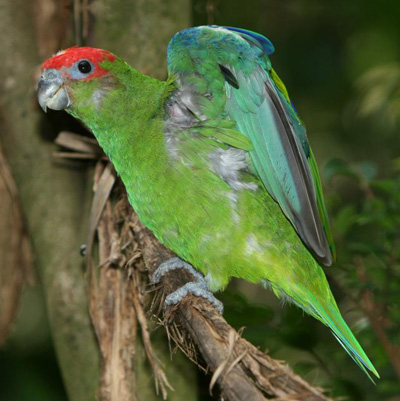
Brown-hooded Parrot
Pionopsitta haematotis
Order: Psittaciformes / Family: Psittacidae

Wikimedia Commons
About the Brown-hooded Parrot
The Brown-hooded Parrot (Pionopsitta haematotis) is a striking member of the Psittacidae family. This medium-sized parrot is primarily found in the tropical forests of Central America, stretching from southern Mexico through to western Panama. Its presence is most notable in humid lowland forests, though it can occasionally be seen in montane regions. The species plays a critical role in seed dispersal, contributing to the ecological balance of its habitat. Brown-hooded Parrots are often seen in pairs or small flocks, navigating the dense forest canopy with agility. They are particularly significant for their interaction with the local flora, aiding in the regeneration of forested areas through their feeding and foraging behaviors.
These parrots exhibit a remarkable adaptability to various forest environments. During the dry season, they may venture into secondary growth areas and forest edges, seeking food sources that are less abundant in their primary habitats. Their seasonal movements are influenced by the availability of fruiting trees, underscoring their adaptability and resilience. As a seed disperser, the Brown-hooded Parrot contributes to the maintenance of forest diversity and structure, ensuring the survival of numerous plant species.
In regions such as Costa Rica and Panama, the Brown-hooded Parrot is an integral part of the avian community. Their interactions with other bird species, including competition and cooperation for food, highlight the complex interdependencies within these ecosystems. As climate change and deforestation pose increasing threats to their habitat, understanding the ecological role of the Brown-hooded Parrot becomes even more critical. Research into their behavior and habitat preferences continues to shed light on the intricate dynamics of tropical forest ecosystems.
The Brown-hooded Parrot belongs to the family Psittacidae, within the order Psittaciformes. These birds typically live average 15 years with a maximum recorded of 25 years..
How to Identify a Brown-hooded Parrot
The Brown-hooded Parrot can be identified by its distinctive brown cap, which contrasts sharply with its otherwise green plumage. Adults display a vibrant green body with a touch of blue on their wings and tail. The underwing coverts feature a striking red, which is visible during flight. Juveniles do not possess the full intensity of adult colors, often showing a more subdued palette. Males and females are similar in appearance, making sex differentiation challenging without close observation.
In terms of size, the Brown-hooded Parrot measures approximately 21 centimeters in length, making it a medium-sized parrot. Its robust bill is grayish, designed to crack open seeds and fruits, while its eyes are encircled by bare white skin, another distinguishing feature. When perched, the parrot maintains an upright posture, often tilting its head inquisitively as it surveys its surroundings.
The Brown-hooded Parrot is sometimes confused with the White-crowned Parrot, which also inhabits Central America. However, the latter has a distinct white crown and lacks the brown hood characteristic of Pionopsitta haematotis. Observing flight patterns can also aid in identification; the Brown-hooded Parrot exhibits a rapid, direct flight, often in small flocks that maneuver through the forest with ease.
Having trouble telling birds apart? Upload a photo to our bird identification tool for an instant species match.
Brown-hooded Parrot Habitat and Range
Preferred Habitat
The Brown-hooded Parrot predominantly resides in humid tropical lowland forests but is also found in subtropical or tropical moist montane forests. It thrives in areas with dense canopy cover, relying on the rich biodiversity for sustenance and shelter. These parrots are most commonly sighted between sea level and elevations up to 1500 meters. In places like Costa Rica, they are frequent inhabitants of the Caribbean lowlands and the foothills of the Cordillera de Talamanca.
While primarily forest-dwellers, Brown-hooded Parrots adapt to human-altered landscapes to some extent. They can occasionally be spotted at the edges of plantations or in secondary growth forests, especially when primary forest resources are scarce. Urban presence is limited, as these parrots prefer the seclusion and resources provided by forested environments, making rural areas more conducive to their lifestyle.
During the wet season, their habitat range may expand slightly as they follow the fruiting patterns of different forest trees. This seasonal habitat shift ensures they have access to adequate food supplies throughout the year.
Geographic Range
The range of the Brown-hooded Parrot extends across Central America, from southern Mexico through Belize, Guatemala, and Honduras, down to Nicaragua, Costa Rica, and western Panama. Within these countries, they are more densely populated in areas with extensive forest cover, such as the Caribbean slopes and the rainforests of the Pacific slope.
The Brown-hooded Parrot does not exhibit long-distance migratory behavior. Instead, they are considered resident birds, occupying core breeding and feeding territories year-round. However, local movements are common, with flocks shifting between different forest types in response to seasonal food availability. Migration corridors are not applicable to this species due to their non-migratory nature.
Population density hotspots for the Brown-hooded Parrot include the lowland rainforests of Costa Rica and Panama, where they are frequently observed in protected areas such as national parks and reserves. These regions provide vital habitat for sustaining their populations, amidst increasing threats from deforestation and habitat fragmentation.
Want to know which birds visit your area? Browse our backyard birds by location guides for region-specific species lists.
What Does the Brown-hooded Parrot Eat?
The Brown-hooded Parrot primarily consumes a diet of fruits, seeds, and nuts, making them frugivorous birds. Their strong, curved beaks are adept at cracking open tough seed shells and accessing nutrient-rich kernels. They favor a variety of fruiting trees native to the Central American forests, including figs and palm fruits.
During different seasons, their diet adapts to the availability of food sources. In the wet season, when fruits are plentiful, they indulge in a wider variety of fruits, while the dry season may see them relying more heavily on seeds and nuts. Their foraging technique often involves agile movements through the forest canopy, using their dexterous feet to manipulate food items while perched.
In addition to fruits and seeds, the Brown-hooded Parrot occasionally consumes leaf buds and flowers, contributing to their varied diet. They typically forage in the early morning and late afternoon, taking advantage of cooler temperatures and reduced competition from other frugivores.
Brown-hooded Parrot Behavior and Social Structure
The Brown-hooded Parrot exhibits a highly social structure, often forming small, cohesive flocks that enhance protection and foraging efficiency. These flocks, usually composed of family groups, move through the forest canopy searching for food and potential nesting sites.
Territorial behavior is not strongly pronounced, although they may defend feeding areas from rival flocks. During the breeding season, pairs engage in courtship displays, which include mutual preening and synchronized movements. This strengthens pair bonds and prepares them for the nesting period.
Flocking patterns can vary, with larger aggregations forming around abundant food sources. These communal gatherings facilitate information sharing about food locations and potential threats. The Brown-hooded Parrot's response to predators involves alarm calls and rapid dispersal into denser foliage, where their green plumage provides effective camouflage.
Daily activity patterns include active foraging sessions during the cooler parts of the day, followed by periods of rest during the midday heat. Vocalizations play a significant role in maintaining group cohesion and coordinating movements within the forest.
Brown-hooded Parrot Nesting and Reproduction
Brown-hooded Parrots nest in natural cavities found in trees, often at heights ranging from 5 to 15 meters above the ground. They do not construct their own nests but instead rely on existing cavities, which they may modify slightly for comfort and security.
The typical clutch size consists of 2 to 4 eggs, which are incubated primarily by the female. The incubation period lasts approximately 24 to 26 days, during which the male provides food to the brooding female. After hatching, both parents participate in feeding the chicks, regurgitating a diet of semi-digested fruits and seeds.
The fledging timeline for Brown-hooded Parrots is roughly 8 to 10 weeks, after which the young parrots leave the nest and join their parents in foraging activities. Typically, the species raises one brood per year, although in areas with abundant resources, a second brood is possible.
Brown-hooded Parrot Sounds and Vocalizations
The Brown-hooded Parrot's primary song consists of a series of soft, melodic whistles interspersed with short, choppy notes. These vocalizations serve to maintain contact between flock members and establish presence within a territory.
Call notes are more abrupt, often used as alarm signals when predators are detected. These calls can be compared to a sharp 'keet-keet' sound, which carries well through dense foliage. During the dawn chorus, their vocalizations become more frequent and complex, as they communicate with other flock members and respond to the waking forest.
The quality of their calls is generally soft and pleasant, lacking the harshness associated with some other parrot species. This makes them less conspicuous, aiding in their ability to avoid detection by predators.
Interesting Facts About the Brown-hooded Parrot
- 1Brown-hooded Parrots can live up to 20 years in the wild, benefiting from stable food sources.
- 2These parrots exhibit zygodactyl feet, with two toes facing forward and two backward, aiding in their arboreal lifestyle.
- 3They have a specialized tongue that helps them manipulate and consume a variety of fruits and seeds.
- 4Brown-hooded Parrots are known to mimic the calls of other bird species to deter predators and communicate.
- 5Their flight is characterized by rapid wingbeats and a swift, direct trajectory through the forest canopy.
- 6The Brown-hooded Parrot's green plumage provides excellent camouflage against the lush forest backdrop.
- 7These parrots contribute significantly to forest regeneration by dispersing seeds far from the parent tree.
Brown-hooded Parrot Conservation Status
The Brown-hooded Parrot is currently classified as Least Concern by the IUCN, with a stable population trend. However, habitat loss due to deforestation and agricultural expansion remains a significant threat. Conservation efforts focus on protecting large tracts of tropical forest, ensuring these parrots have access to essential food and nesting resources. Protected areas in countries like Costa Rica and Panama play a critical role in safeguarding their habitat. Efforts to reforest degraded areas and promote sustainable land-use practices also contribute to their continued survival. Historically, the Brown-hooded Parrot's range has been relatively stable, but ongoing environmental pressures necessitate vigilant conservation measures to maintain their populations.
Other Psittacidae Species


Birds Similar to the Brown-hooded Parrot
These species are often confused with the Brown-hooded Parrot due to similar appearance or overlapping range.