
White-eared Puffbird
Bucco leucomelas
Order: Piciformes / Family: Bucconidae
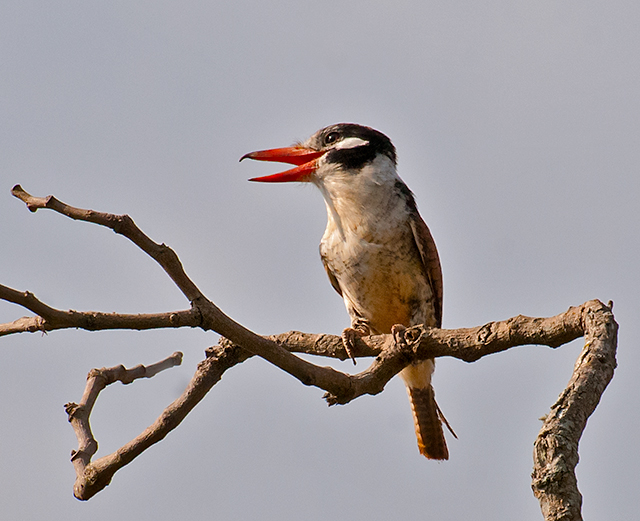
Wikimedia Commons
About the White-eared Puffbird
The White-eared Puffbird, Bucco leucomelas, stands out in the avian world with its distinctive black and white facial pattern and robust, compact body. This bird belongs to the family Bucconidae and order Piciformes, which includes other puffbirds known for their unique appearance and behaviors. The White-eared Puffbird inhabits the lowland forests and savannahs of South America, primarily found in regions such as the Amazon basin, and extending into the Orinoco River basin and as far south as Bolivia and Paraguay. With its striking appearance and intriguing behaviors, the White-eared Puffbird holds a special place in the ecosystems it inhabits.
The significance of the White-eared Puffbird extends beyond its aesthetic appeal. As an insectivore, it plays a crucial role in controlling insect populations in its native habitats. Puffbirds are often seen perched silently on branches, scanning their surroundings for movement before swooping down to capture prey. This behavior not only aids in maintaining balanced insect populations but also facilitates seed dispersal, as some of the larger insects they consume are known to carry seeds.
Seasonally, the White-eared Puffbird does not exhibit long-distance migratory behavior, instead showing some local movements in response to food availability. During the wet season, when insect populations peak, puffbirds are more active, taking advantage of the abundance of prey. In the drier months, they may become less conspicuous, moving to areas where water and food sources remain ample. This adaptability aids in their survival across diverse environments, from dense forests to more open woodland and savannah regions.
The White-eared Puffbird belongs to the family Bucconidae, within the order Piciformes. These birds typically live typically around 5-7 years, with a maximum recorded lifespan of 10 years..
How to Identify a White-eared Puffbird
The White-eared Puffbird is easily identifiable by its distinctive facial markings. Adults exhibit a bold black mask that contrasts sharply with their white cheeks and throat. Their stout, slightly hooked bill is well-suited for their insectivorous diet. The plumage on the rest of the body is primarily brown, with subtle streaks that enhance their camouflage among branches and foliage.
Juveniles resemble adults but may have slightly less pronounced coloring, with a more mottled appearance as their plumage develops. Males and females appear similar, making sex differentiation in the field challenging without behavioral cues during breeding.
In flight, the White-eared Puffbird exhibits a direct, somewhat labored flight pattern, with rounded wings and a short tail that give it a compact silhouette. When perched, they adopt an upright posture, often remaining motionless for extended periods, providing the perfect opportunity for birdwatchers to observe their striking features. They can be mistaken for similar species like the Black-cheeked Puffbird, but the latter lacks the white ear patch that is a key identifying feature of Bucco leucomelas.
Having trouble telling birds apart? Upload a photo to our bird identification tool for an instant species match.
White-eared Puffbird Habitat and Range
Preferred Habitat
White-eared Puffbirds inhabit a variety of forested environments, from dense tropical rainforests to more open woodland and savannah areas. They are frequently found along the edges of forests, where they have access to open perches and abundant prey. In the Amazon basin, they are at home among the towering canopy and dense understory, while in the Orinoco basin they may frequent the gallery forests that line the riverbanks.
These birds are typically found at elevations ranging from sea level to about 1,000 meters, although they prefer areas where trees and shrubs offer ample perching opportunities. Unlike many bird species, the White-eared Puffbird does not typically venture into urban areas, preferring the tranquility and resources of more natural settings. Seasonal habitat shifts occur primarily with local movements toward areas with greater food availability, particularly during dry periods.
Geographic Range
The White-eared Puffbird's range extends across a broad expanse of South America, primarily within the lowland regions. Its core distribution includes the Amazon basin, where it is found in countries like Brazil, Peru, and Colombia. The bird's range also stretches into the Orinoco basin, reaching Venezuela and parts of the Guianas.
While the White-eared Puffbird does not migrate long distances, it may exhibit some local movements in response to environmental conditions and food availability. During the breeding season, which coincides with the wet season in its range, the puffbird becomes more conspicuous as it calls and engages in courtship behaviors. Outside of the breeding season, it remains within its range, though less visible as it seeks out quieter, more secluded areas.
Population densities are highest in regions where forested areas remain intact and continuous, such as the central Amazon. Deforestation and habitat fragmentation pose significant threats to its range, potentially leading to local declines if these issues are not addressed.
Want to know which birds visit your area? Browse our backyard birds by location guides for region-specific species lists.
What Does the White-eared Puffbird Eat?
The White-eared Puffbird primarily feeds on a diet of insects and other small arthropods. It shows a marked preference for beetles, grasshoppers, and crickets, which make up the bulk of its diet. These birds employ a sit-and-wait foraging strategy, perching silently and scanning their surroundings for movement before darting out to capture prey.
During the wet season, when insect populations surge, the puffbird's diet becomes more varied, occasionally including small vertebrates like lizards and frogs. This dietary flexibility allows the puffbird to exploit a wide range of food sources depending on availability.
Prey size can vary, but the puffbird typically targets medium-sized insects that fit easily into its stout bill. Feeding primarily occurs during the early morning and late afternoon, when insect activity peaks and temperatures are cooler. This schedule allows the White-eared Puffbird to conserve energy while maximizing foraging success.
White-eared Puffbird Behavior and Social Structure
The White-eared Puffbird exhibits fascinating behaviors that are of great interest to birdwatchers and ornithologists alike. As solitary birds, they often perch prominently on tree branches, silently observing their environment for potential prey. This behavior not only aids in their hunting strategy but also helps in avoiding predators by remaining motionless and inconspicuous.
Territoriality plays a crucial role in the life of the White-eared Puffbird. Males establish and defend territories during the breeding season, using their characteristic calls to assert dominance and ward off rivals. These calls are also integral to courtship displays, as males use them to attract females and strengthen pair bonds.
White-eared Puffbirds are generally non-flocking birds, preferring to maintain solitary or paired associations. However, during the breeding season, they become more vocal and active, engaging in displays that include bobbing motions and wing flicks to catch the attention of potential mates. Daily activity patterns show peaks in the early morning and late afternoon, aligning with their feeding schedule and the cooler parts of the day, which supports their energy needs and minimizes exposure to midday heat.
White-eared Puffbird Nesting and Reproduction
White-eared Puffbirds exhibit unique nesting habits that reflect their adaptability and resourcefulness. They typically nest in tree cavities, which offer protection from predators and environmental elements. These cavities are often old woodpecker holes or natural hollows, sometimes modified slightly by the puffbirds.
Clutch size for the White-eared Puffbird usually consists of two to three eggs, which the female incubates over a period of approximately 16 to 18 days. Both parents participate in feeding the chicks, ensuring a steady supply of insects and small vertebrates to support their rapid growth.
The fledging timeline for White-eared Puffbird chicks is around 20 to 25 days post-hatching, during which time the young birds develop the plumage and strength necessary to leave the nest. Parental roles are generally shared, with both the male and female contributing to nurturing and protecting their offspring until they are independent. Typically, the White-eared Puffbird raises one brood per year, although in particularly favorable conditions, a second brood may occasionally be attempted.
White-eared Puffbird Sounds and Vocalizations
The White-eared Puffbird's vocalizations are a defining characteristic of its presence in the forest. Its primary song consists of a series of melodious whistles, each note delivered in a steady, rhythmic cadence. This song is often repeated at regular intervals during the early morning hours, forming a part of the dawn chorus that resonates through their habitat.
In addition to their song, White-eared Puffbirds produce distinct call notes that vary from sharp, single 'peep' sounds to more complex series of descending whistles. These calls serve multiple purposes, including communication between mates and territorial defense.
Alarm calls are shorter and more abrupt, serving as warnings to other birds about potential threats. These calls are less musical than their songs and are often delivered in rapid succession if a predator is detected nearby.
Interesting Facts About the White-eared Puffbird
- 1The White-eared Puffbird's name derives from the white patch on its cheek, which contrasts with its otherwise dark plumage.
- 2Unlike many other bird species, White-eared Puffbirds do not typically sing in flocks, preferring solitary vocalizations.
- 3The puffbird's diet primarily consists of insects, but they will occasionally eat small lizards and amphibians.
- 4White-eared Puffbirds can remain motionless for extended periods, a behavior that aids in both hunting and predator avoidance.
- 5Their robust bill is well-suited for capturing and processing a variety of insect prey, making them efficient hunters.
- 6The White-eared Puffbird's distinctive calls can be heard up to 500 meters away, a testament to their powerful vocalizations.
- 7This bird species is an essential part of the ecosystem, helping control insect populations and dispersing seeds.
White-eared Puffbird Conservation Status
The White-eared Puffbird is currently classified as a species of Least Concern by the IUCN. Despite this seemingly favorable conservation status, the puffbird faces significant threats from habitat destruction and fragmentation. Deforestation in the Amazon and Orinoco basins, driven by agriculture and urban expansion, poses the greatest threat to its habitat integrity. Conservation efforts in these regions are essential to safeguard the habitats that support the White-eared Puffbird and other forest-dependent species. Establishing protected areas and promoting sustainable land-use practices are critical steps in mitigating habitat loss. Historically, the White-eared Puffbird has maintained stable population levels thanks to its adaptability, but continued habitat degradation could alter this trend. Monitoring population trends and habitat conditions remains vital to ensuring the long-term survival of this striking bird.
Other Bucconidae Species


Birds Similar to the White-eared Puffbird
These species are often confused with the White-eared Puffbird due to similar appearance or overlapping range.

