
Buff-spotted Flameback
Chrysocolaptes lucidus
Order: Piciformes / Family: Picidae
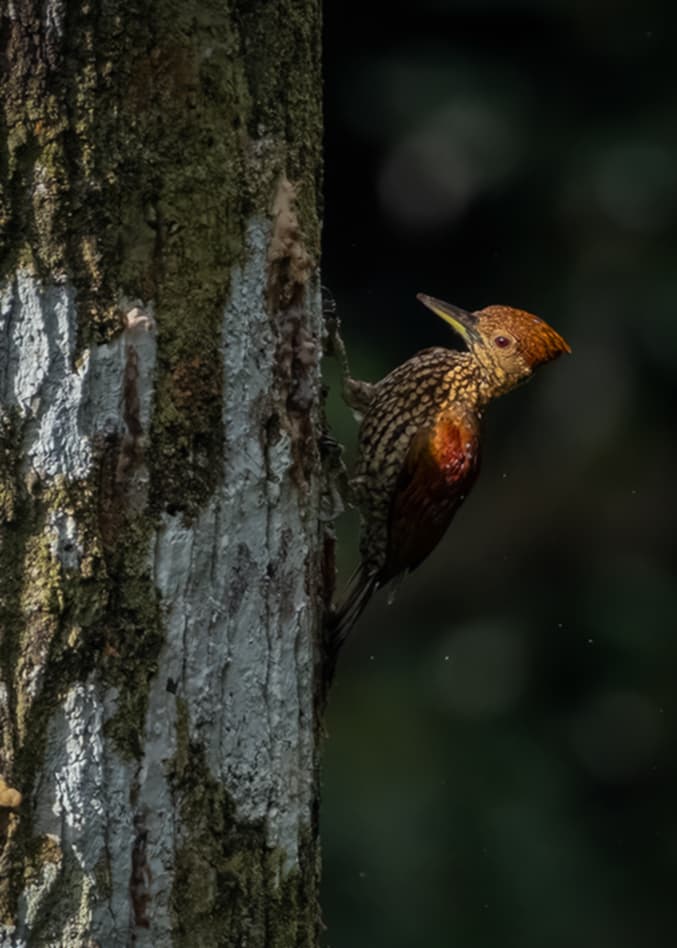
Wikimedia Commons
About the Buff-spotted Flameback
The Buff-spotted Flameback, scientifically known as Chrysocolaptes lucidus, is a medium-sized woodpecker in the family Picidae, order Piciformes. This species is notable for its vivid golden-yellow plumage marked by buff-colored spots, which make it easily identifiable against the verdant backdrops of its native habitats. Residing primarily in the Philippines, the Buff-spotted Flameback plays a vital ecological role as an insectivore, contributing to pest control and promoting the health of trees and forests. This woodpecker is often observed in primary and secondary forests but can also adapt to subtropical and tropical mangroves, as well as rural gardens.
Found predominantly in the lowlands, the Buff-spotted Flameback thrives in forested areas where it can excavate cavities for nesting and forage for insects. Its presence in a variety of habitats underscores its ecological adaptability, although it shows a preference for areas rich in large trees. The species' contribution to the ecosystem is significant, as it helps control insect populations and assists in seed dispersal through its foraging activities. The Buff-spotted Flameback's drumming and vocalizations add to the acoustic landscape of its environment, playing a role in maintaining territorial boundaries and facilitating mate attraction.
Seasonally, the Buff-spotted Flameback demonstrates some variation in behavior. During the breeding season, which generally spans the months of February to May, these woodpeckers become more vocal and exhibit increased drumming activity. This period also sees the birds more frequently engaging in pair bonding displays. Their ecological importance extends beyond their role as insectivores, as their nesting activities create habitats for secondary cavity-nesting birds and mammals, thereby enhancing local biodiversity.
The Buff-spotted Flameback belongs to the family Picidae, within the order Piciformes. These birds typically live average 5-8 years, with a max recorded of 10 years..
How to Identify a Buff-spotted Flameback
The Buff-spotted Flameback is distinguished by its bright golden-yellow plumage adorned with buff-colored spots, especially on its back and wings. Adult males have a striking red crown and nape, which set them apart from the females, whose crowns are yellow. This sexual dimorphism is a key identification feature. Juveniles resemble adults but generally have a duller overall appearance, with less pronounced buff spots and a paler red crown in males.
In flight, the Buff-spotted Flameback displays a characteristic undulating pattern, typical of woodpeckers, with rapid wingbeats followed by short glides. When perched, it often clings vertically to tree trunks, using its strong tail feathers for support. This posture highlights its robust, chisel-like beak, which it uses effectively to bore into wood in search of insect prey.
The Buff-spotted Flameback might be confused with other flameback species found within its range, such as the Greater Flameback. However, the Buff-spotted Flameback's distinct buff spots and smaller size help in distinguishing it from similar species. Observers should note the bird's behavior, such as its distinctive drumming and foraging techniques, which can further aid in proper identification.
Having trouble telling birds apart? Upload a photo to our bird identification tool for an instant species match.
Buff-spotted Flameback Habitat and Range
Preferred Habitat
The Buff-spotted Flameback inhabits a range of forested environments, primarily in the Philippines. It favors lowland primary and secondary forests but is also found in subtropical or tropical mangrove forests and rural gardens. This adaptability allows the bird to thrive in various forest types, from dense rainforests to the edges of agricultural areas.
Typically, this woodpecker prefers areas with abundant old-growth trees, which provide suitable nesting sites and ample foraging opportunities. The Buff-spotted Flameback is found from sea level up to elevations of about 1,200 meters, although it is most commonly observed in lower elevations.
While it is not typically associated with urban environments, it may occasionally be seen in more rural areas where forest patches remain. Seasonal shifts in habitat are not pronounced, as the Buff-spotted Flameback is a non-migratory resident, with its range largely determined by the availability of suitable habitats for nesting and feeding.
Geographic Range
The Buff-spotted Flameback is endemic to the Philippines, where it occupies a range of forested habitats across the archipelago. It is widely distributed throughout the larger islands such as Luzon, Mindoro, and Leyte, with populations also present on smaller islands where suitable forest environments exist.
This species does not engage in long-distance migrations, remaining within its established territories throughout the year. Its distribution is largely influenced by the availability of forested habitats, which provide the necessary resources for feeding and nesting.
Population densities are higher in regions with extensive forest cover, especially in areas where logging and habitat destruction have been limited. However, in regions where deforestation has occurred, the Buff-spotted Flameback's presence can be more sporadic, highlighting the bird's dependence on undisturbed forest environments.
Want to know which birds visit your area? Browse our backyard birds by location guides for region-specific species lists.
What Does the Buff-spotted Flameback Eat?
The Buff-spotted Flameback primarily feeds on insects, making it an important insectivore within its ecosystem. Its diet consists largely of ants, beetles, and larvae, which it extracts from tree bark and wood using its strong bill. The bird's foraging technique involves pecking at the bark to dislodge insects or excavating deeper into the wood to reach hidden larvae.
During the dry season, when insect activity is reduced, the Buff-spotted Flameback may supplement its diet with fruits and seeds, showcasing its adaptability to seasonal changes in food availability. Despite this occasional dietary shift, the bird remains predominantly carnivorous.
Foraging typically occurs during daylight hours, with peak activity in the early morning and late afternoon. The Buff-spotted Flameback's methodical approach to searching for food involves both visual and auditory cues to locate prey, using its keen hearing to detect the movements of insects within trees.
Buff-spotted Flameback Behavior and Social Structure
The Buff-spotted Flameback exhibits a range of behaviors typical of woodpecker species, with notable social and territorial characteristics. It is primarily solitary or found in pairs, especially during the breeding season, when pair bonds are reinforced through mutual preening and courtship displays.
Territorial behavior is pronounced, with individuals and pairs defending their chosen areas through drumming and vocalizations. The bird's drumming serves both as a territorial marker and a means of communication between mates. When faced with potential intruders, the Buff-spotted Flameback may engage in aggressive displays, including wing-fluttering and bill-pointing.
Courtship involves elaborate displays, such as the male showcasing its vivid plumage and performing aerial maneuvers to attract a mate. Outside of the breeding season, these woodpeckers may occasionally join mixed-species flocks, although they generally maintain a degree of independence.
The Buff-spotted Flameback's daily activity revolves around foraging and territory maintenance, with peak activity during the cooler parts of the day. Its response to predators includes alarm calls and evasive maneuvers, utilizing its strong flight capabilities to escape potential threats.
Buff-spotted Flameback Nesting and Reproduction
The Buff-spotted Flameback constructs its nest in tree cavities, often selecting dead or decaying trees that are easier to excavate. Both males and females participate in nest building, using their powerful bills to hollow out a suitable nesting site.
Nests are typically located several meters above the ground, providing protection from ground-based predators. The interior of the nest cavity is left unlined, relying on the wood chips created during excavation for bedding. The clutch size ranges from two to four eggs, which are white and unmarked.
The incubation period lasts approximately 11 to 14 days, with both parents sharing the responsibility of incubating the eggs and feeding the hatchlings. After hatching, the young woodpeckers remain in the nest for about 24 to 30 days before fledging. Parental care continues for several weeks post-fledging, as the young are taught crucial foraging skills. The Buff-spotted Flameback typically raises one brood per year, although a second brood is possible if conditions allow.
Buff-spotted Flameback Sounds and Vocalizations
The Buff-spotted Flameback's vocal repertoire includes a variety of calls and drumming patterns. Its primary song consists of a series of sharp, high-pitched notes, often described as 'pik-pik-pik', which can be heard echoing through the forest. These calls serve as both territorial signals and mating calls.
In addition to its song, the Buff-spotted Flameback produces distinct drumming sounds by rapidly striking its bill against tree trunks. This drumming is not only a means of communication but also a territorial display, warning other woodpeckers of an occupied territory. Alarm calls, characterized by a rapid 'chuk-chuk', are used to alert mates and nearby individuals of potential threats.
During the dawn chorus, the Buff-spotted Flameback is particularly vocal, contributing to the symphony of sounds that mark the beginning of the day in its forest habitat. Comparatively, the woodpecker's sounds are sharper and more rhythmic than those of other birds in its range, such as the mellow coos of doves or the complex songs of thrushes.
Interesting Facts About the Buff-spotted Flameback
- 1The Buff-spotted Flameback's drumming can reach speeds of up to 20 strikes per second, a remarkable feat of speed and precision.
- 2This woodpecker's long, barbed tongue can extend up to three times the length of its bill, allowing it to extract insects from deep crevices.
- 3Despite its colorful appearance, the Buff-spotted Flameback is well-camouflaged in its forest environment, blending in with sunlit foliage.
- 4The Buff-spotted Flameback can peck with a force of up to 15 miles per hour, yet it avoids brain injury thanks to shock-absorbing adaptations.
- 5Each Buff-spotted Flameback territory can span up to 20 hectares, highlighting the bird's need for extensive forested areas.
- 6The species' diet flexibility allows it to cope with seasonal changes in food availability, shifting from insects to fruits when necessary.
- 7Studies show that the Buff-spotted Flameback contributes to forest health by controlling insect populations and facilitating seed dispersal.
Buff-spotted Flameback Conservation Status
The Buff-spotted Flameback currently holds a conservation status of Least Concern according to the IUCN Red List. While its population appears stable across its range, the primary threats to its survival include habitat destruction and fragmentation, primarily due to logging and agricultural expansion. Conservation efforts focus on preserving its natural forest habitats and promoting sustainable land-use practices. Protected areas and national parks within the Philippines provide vital refuges for this species, ensuring the conservation of critical habitats. Historically, the Buff-spotted Flameback has demonstrated resilience in the face of habitat changes, although continued deforestation poses a significant risk. Conservationists advocate for reforestation and habitat restoration projects to mitigate the impact of habitat loss and to ensure the long-term survival of this striking woodpecker.


