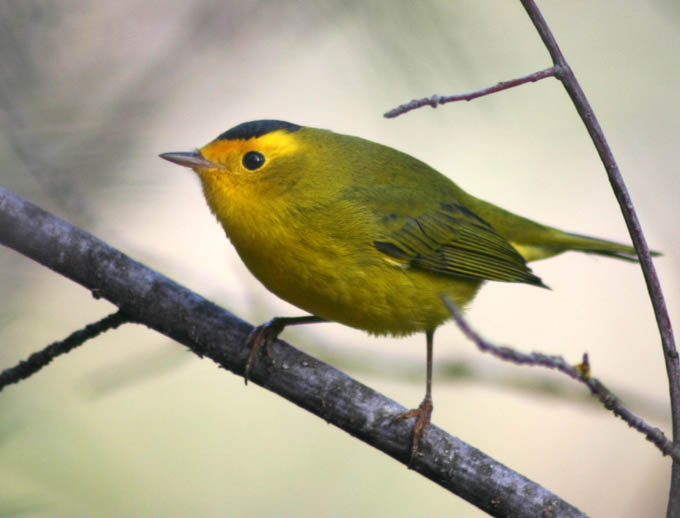
Canada Warbler
Cardellina canadensis
Order: Passeriformes / Family: Parulidae

Wikimedia Commons
About the Canada Warbler
The Canada Warbler (Cardellina canadensis) is a striking songbird found primarily in North America's boreal forests during the breeding season. Known for its vibrant yellow underparts and distinctive black necklace, this bird plays a vital role in the health of its forested ecosystem. Its presence is a strong indicator of the ecological integrity of its habitat, as it is sensitive to habitat changes and fragmentation. The Canada Warbler's breeding range spans from southeastern British Columbia across Canada to Newfoundland, and south into the northern United States, including states like Minnesota, Maine, and parts of the Appalachian Mountains. In these northern forests, they prefer moist, mixed woodlands often characterized by a dense understory of shrubs and ferns. During the breeding season, the Canada Warbler's energetic foraging and insectivorous diet help control insect populations, making them essential in maintaining ecological balance. As fall approaches, these warblers embark on a remarkable migration to their wintering grounds in northern South America, primarily in the Andean regions of Colombia, Venezuela, Ecuador, and Peru. This long-distance migration highlights their adaptability and the interconnectedness of ecosystems across continents. Their winter habitats differ significantly from their breeding grounds, as they occupy the understory of montane forests, often at elevations ranging from 500 to 2,500 meters. The Canada Warbler's seasonal behaviors include a noticeable change in vocal activity. During spring and early summer, males sing persistently to establish territories and attract mates, while their calls become less frequent as they shift focus to foraging and preparing for migration. Despite their vibrant appearance, Canada Warblers face several challenges, including habitat loss on both breeding and wintering grounds. Deforestation and land conversion for agriculture pose significant threats, leading to declines in their population. Conservation efforts are crucial in ensuring the survival of this species, emphasizing the importance of protecting large tracts of forested land and promoting sustainable land use practices. Due to these efforts, the Canada Warbler serves as a symbol of international conservation collaboration, reminding us of the shared responsibility to protect migratory bird species.
The Canada Warbler belongs to the family Parulidae, within the order Passeriformes. These birds typically live the average lifespan is around 6-7 years, with a maximum recorded of 8 years..
How to Identify a Canada Warbler
Adult Canada Warblers are easily identified by their bright yellow underparts, contrasted with a slate-gray back and wings. The most striking field mark is the black necklace-like band across the throat, which is more pronounced in males. Females and juveniles have a similar pattern but tend to have a paler overall coloration and a less distinct necklace. Juveniles also lack the intensity of the adults' yellow plumage. Males and females can be differentiated by the more vivid colors in males and the slightly duller tones in females. The Canada Warbler's eye ring is prominent and white, adding to its distinctive facial pattern. In flight, their short, rounded wings and relatively long tail create a compact silhouette typical of many warblers. While perching, they often flick their tails and forage energetically among dense foliage, which can aid in identification. The Canada Warbler can be confused with similar species like the Magnolia Warbler, which also has a black necklace, but the latter has more distinctive wing bars and a contrasting back pattern. The Wilson's Warbler may also cause confusion; however, it lacks the necklace and has a more uniform olive-green back. These distinguishing features are crucial for birders aiming to accurately identify the Canada Warbler in the field.
Having trouble telling birds apart? Upload a photo to our bird identification tool for an instant species match.
Canada Warbler Habitat and Range
Preferred Habitat
The Canada Warbler thrives in moist, mixed deciduous and coniferous forests with a dense understory. Typical habitats include areas with abundant shrubs, ferns, and young saplings, providing cover and foraging opportunities. They are often found at elevations ranging from sea level to around 1,500 meters in their breeding range. During migration, these warblers may be seen in a variety of habitats, including forest edges, riparian zones, and even suburban areas with sufficient tree cover. In their wintering grounds, they prefer montane forests with a rich understory, often between 500 and 2,500 meters above sea level. Unlike some other warblers, the Canada Warbler does not adapt well to urban environments, relying instead on undisturbed forested areas. Seasonal habitat shifts are pronounced, with the birds occupying different forest types between their breeding and wintering areas, underscoring their need for diverse, intact habitats throughout their range.
Geographic Range
The Canada Warbler breeds across a wide swath of North America, from southeastern British Columbia through the boreal forest regions of Canada to Newfoundland and into the northern United States, including parts of New England and the Appalachian Mountains. During migration, they travel through the eastern United States, often following the Atlantic Flyway, and some populations use the Mississippi Flyway as well. Their wintering range is primarily in the northern Andes of South America, where they inhabit montane forests in Colombia, Venezuela, Peru, and Ecuador. The highest population densities during breeding are found in dense, moist forests, while wintering populations are concentrated in Andean cloud forests. Being long-distance migrants, Canada Warblers face challenges such as habitat fragmentation and loss in both their breeding and wintering areas, making them a focus of conservation efforts across their range.
Want to know which birds visit your area? Browse our backyard birds by location guides for region-specific species lists.
What Does the Canada Warbler Eat?
As insectivores, Canada Warblers primarily feed on a variety of insects and spiders, which they glean from foliage and branches. Their diet includes beetles, caterpillars, moths, and flies, making them important for controlling insect populations in their habitats. During the breeding season, their diet is rich in protein to support the demands of nesting and rearing young. They employ active foraging techniques, often seen flitting about in dense underbrush or among branches, rapidly picking insects from leaves. In the fall and winter, they may expand their diet to include some berries and other fruit, providing essential energy for migration and survival in varied winter habitats. Prey size ranges from tiny aphids to larger caterpillars, demonstrating their adaptability in foraging strategies. Canada Warblers typically feed throughout the day, with peak activity in the early morning and late afternoon, aligning with insect availability.
Canada Warbler Behavior and Social Structure
Canada Warblers exhibit a mix of territorial and social behaviors, especially during the breeding season. Males establish and defend territories through song and occasional physical displays, ensuring an area rich in food resources and nesting sites. Courtship involves a series of displays and vocalizations, with males often pursuing females through dense understory vegetation. Though generally solitary during breeding, they may form small mixed-species flocks during migration and on their wintering grounds, enhancing foraging efficiency and predator vigilance. These warblers are diurnal, engaging in most activities during daylight hours. In response to predators, they rely on their cryptic coloration and quick, agile movements to elude detection. When threatened, they may emit alarm calls and engage in distraction displays to protect nests. Their daily activities include foraging, singing, and nest tending, with males participating in feeding and territorial defense.
Canada Warbler Nesting and Reproduction
Canada Warblers construct cup-shaped nests, typically placed low to the ground in dense vegetation or among tree roots and stumps. These nests are made from materials like grass, moss, and leaves, lined with fine materials such as hair or feathers. Nesting sites are chosen for their concealment and proximity to abundant food sources. A typical clutch consists of 3 to 5 eggs, which are incubated by the female for about 12 to 14 days. Both parents participate in feeding the chicks, which fledge approximately 10 to 12 days after hatching. Canada Warblers usually produce one brood per year, although some may attempt a second if the first fails. The shared parental roles ensure the young receive adequate care and feeding, crucial for their survival in dense forest environments.
Canada Warbler Sounds and Vocalizations
The Canada Warbler's song is a rapid, musical series of notes, often described as a 'chip-chupety swee-ditchety.' This energetic song serves both territorial and mate-attraction purposes. Their calls include sharp 'chip' notes, used for communication between individuals and as alarm calls. During the dawn chorus, males are particularly vocal, establishing their presence in the forest. Compared to other warblers, the Canada Warbler's song is relatively fast-paced and complex, making it a distinctive sound of the boreal forest. The variety in pitch and rhythm can help differentiate it from the songs of similar species.
Interesting Facts About the Canada Warbler
- 1The Canada Warbler travels over 4,000 kilometers during its migration from North America to South America.
- 2Despite its name, the Canada Warbler is also a common breeder in the northeastern United States.
- 3This species builds its nests primarily on or near the ground, which makes them susceptible to ground predators.
- 4Males often arrive at breeding grounds about a week before females to establish territories.
- 5The Canada Warbler is one of the last warblers to migrate north in spring, arriving as late as May in some areas.
- 6Their population has declined by nearly 60% since the 1960s, making conservation efforts crucial.
- 7Canada Warblers are part of mixed-species flocks during migration, often seen with other warblers and vireos.
Canada Warbler Conservation Status
Currently listed as Near Threatened by the IUCN, the Canada Warbler faces a declining population trend. Primary threats include habitat loss and fragmentation in both breeding and wintering areas, largely due to deforestation and land conversion. Conservation efforts focus on protecting critical habitats and promoting sustainable forestry practices. Historical data indicate a significant decline in population numbers over the past few decades, prompting increased attention from conservation organizations. Initiatives such as cross-border habitat protection agreements and reforestation projects in both North and South America aim to stabilize and eventually increase their populations.
Other Parulidae Species


Birds Similar to the Canada Warbler
These species are often confused with the Canada Warbler due to similar appearance or overlapping range.