
Cinereous Tit
Parus cinereus
Order: Passeriformes / Family: Paridae
Wikimedia Commons
About the Cinereous Tit
The Cinereous Tit (Parus cinereus) is a prominent member of the Paridae family, recognized for its adaptability across a wide range of environments in Asia. This bird is often spotted in various regions including the Indian subcontinent, Southeast Asia, and parts of China, thriving in forested areas and urban settings alike. Its ecological role is significant as it helps control insect populations, thus maintaining a balance within its ecosystem.
In natural settings, the Cinereous Tit is a vital participant in forest dynamics, where it forages for insects and other small arthropods. Its presence in urban areas highlights its adaptability and the importance of urban green spaces for biodiversity. This species exhibits varied seasonal behaviors, such as forming mixed-species flocks during the non-breeding season, which helps in mutual protection and increases foraging success.
The significance of the Cinereous Tit extends beyond its ecological role. It serves as a bioindicator for environmental health, with changes in its population providing insights into habitat quality and ecosystem changes. Observations of the species across different habitats, from deciduous and mixed forests to city gardens, underscore its ecological flexibility and its ability to thrive amid human-altered landscapes.
Overall, the Cinereous Tit's adaptability, combined with its role in pest control and ecosystem health, makes it a species of interest for both ornithologists and conservationists. Its presence across diverse habitats and regions highlights the intricate balance of regional ecosystems and the importance of preserving such environments for future generations.
The Cinereous Tit belongs to the family Paridae, within the order Passeriformes. These birds typically live 3-5 years on average, with a record of up to 9 years..
How to Identify a Cinereous Tit
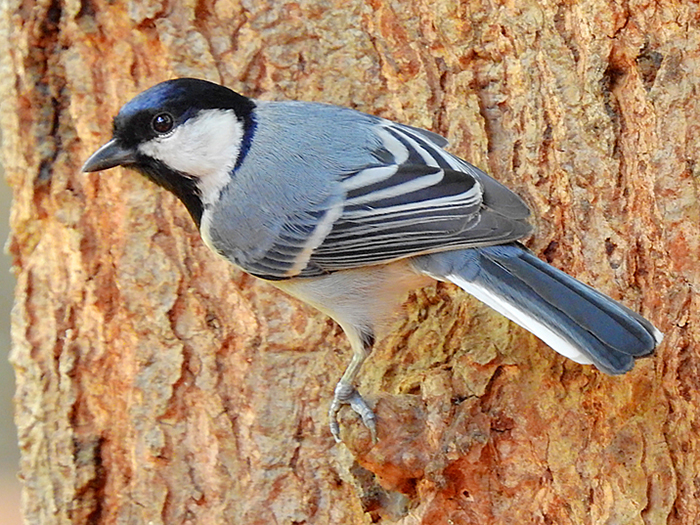
The Cinereous Tit is easily recognized by its distinctive black-and-white coloration. Adult birds display a striking black cap and bib, which contrast sharply with their white cheeks and underparts. The upperparts are a soft gray, while the wings and tail feature white-edged feathers that stand out in flight. Compared to juveniles, adults have more pronounced black markings, with juveniles showing a more subdued coloration and slightly browner tones.
Males and females exhibit similar plumage, making it difficult to distinguish them by sight alone. However, males are generally slightly larger with more robust black markings. The flight silhouette of the Cinereous Tit is characterized by its rapid wingbeats and short glides, typical of the Paridae family. When perching, the bird often adopts a slightly hunched posture, frequently flicking its wings and tail.
In terms of confusion with similar species, the Cinereous Tit could be mistaken for the Great Tit (Parus major) in regions where their ranges overlap. However, the Great Tit usually has more vibrant yellow underparts and a broader black band running down the chest. Observers should note these subtle differences in plumage and behavior to accurately identify the Cinereous Tit.
Having trouble telling birds apart? Upload a photo to our bird identification tool for an instant species match.
Cinereous Tit Habitat and Range
Preferred Habitat
The Cinereous Tit inhabits a variety of environments, ranging from deciduous and mixed forests to urban parks and gardens. It shows a preference for areas with plenty of tree cover, which provide ample foraging opportunities and nesting sites. Typically found at elevations from sea level up to 2,400 meters, this species demonstrates remarkable adaptability to different altitudinal zones.
In rural areas, the Cinereous Tit thrives in woodlands and scrubby areas, often alongside rivers and streams where insect life flourishes. During the breeding season, it tends to inhabit denser forested areas, while in the non-breeding season, it is more commonly seen in open areas and urban settings. This seasonal shift helps the bird exploit varying food resources and avoid competition.
Urban environments provide unique challenges and opportunities for the Cinereous Tit. Parks and gardens offer suitable habitats with abundant food and nesting sites, allowing the species to maintain stable populations even in cities. This adaptability to both natural and human-altered landscapes underscores the bird's resilience and ecological versatility.
Geographic Range
The breeding range of the Cinereous Tit spans a significant portion of Asia. It is commonly found in countries such as India, Nepal, Bhutan, Bangladesh, and across Southeast Asia, including Thailand, Myanmar, and Vietnam. Northern populations extend into parts of China and Taiwan, where the bird occupies suitable habitats throughout the year.
During the winter months, some populations of the Cinereous Tit may undertake short-distance migrations, moving to lower elevations or slightly different regions in search of food. However, many populations remain resident within their breeding range year-round, particularly in regions where the climate remains favorable.
Population density hotspots include the foothills of the Himalayas and the Western Ghats in India, where diverse habitats support large numbers of these birds. Additionally, urban areas across its range provide refuge for substantial populations, highlighting the species' adaptability and the importance of maintaining urban biodiversity.
Want to know which birds visit your area? Browse our backyard birds by location guides for region-specific species lists.
What Does the Cinereous Tit Eat?
The Cinereous Tit primarily feeds on insects and other small invertebrates, playing a crucial role in controlling pest populations. Its diet includes caterpillars, beetles, spiders, and occasionally small seeds and fruits. During the breeding season, the bird's diet shifts slightly to accommodate the nutritional needs of its young, with a higher emphasis on protein-rich insect prey.
Foraging techniques are varied and adaptive. The bird employs gleaning and hovering to capture insects from leaves and branches. It is also known to forage on the ground, especially in leaf litter where it probes for hidden arthropods. The prey size typically ranges from small insects to medium-sized caterpillars, which are ideal for feeding nestlings.
Feeding occurs throughout the day, with peaks in activity during the early morning and late afternoon when insect activity is highest. This schedule allows the Cinereous Tit to maximize its foraging efficiency and effectively support its offspring during the breeding season.
Cinereous Tit Behavior and Social Structure
The Cinereous Tit exhibits a complex social structure, particularly outside the breeding season when it forms mixed-species flocks with other small birds. This behavior provides enhanced protection against predators and increases foraging efficiency, as various species exploit different ecological niches within the same habitat.
Territorial behavior is most pronounced during the breeding season, with males defending their nesting area through vocalizations and displays. Courtship includes male displays involving wing fluttering and singing to attract a mate. Once paired, the birds exhibit strong pair bonds and cooperate in raising their young.
Response to predators involves alarm calls and mobbing behavior, where several birds team up to drive away potential threats. Daily activity patterns revolve around foraging and social interactions, with peak activity occurring in the cooler parts of the day. The Cinereous Tit's adaptability to various environments contributes to its complex and dynamic behavioral repertoire.
Cinereous Tit Nesting and Reproduction
The breeding season of the Cinereous Tit varies across its range, often coinciding with peak insect availability. Nest construction occurs in tree cavities or artificial nest boxes, with both sexes participating in gathering materials such as moss, leaves, and feathers to line the nest.
A typical clutch consists of 4-7 eggs, which the female incubates for about 12-14 days. During this period, the male provides food to the incubating female. Once hatched, both parents share responsibilities in feeding and caring for the young, which fledge after about 16-21 days.
The Cinereous Tit may raise two broods per year, depending on environmental conditions and food availability. Parental roles are well-defined, with both male and female actively involved in nurturing and protecting the young, ensuring a high survival rate for the offspring.
Cinereous Tit Sounds and Vocalizations
The primary song of the Cinereous Tit is a repetitive, clear whistle often described as 'tzi-tzi-tzi'. This song serves to establish territory and attract a mate. Call notes are varied, including sharp 'chip' sounds used for communication between individuals.
Alarm calls are harsher and more rapid, serving to alert other birds to the presence of predators. During the dawn chorus, the Cinereous Tit's song is particularly prominent, contributing to the cacophony of sounds that mark the early morning hours.
These vocalizations play a crucial role in the bird's social interactions and territorial defense, making auditory identification an important tool for birdwatchers and researchers alike.
Interesting Facts About the Cinereous Tit
- 1The Cinereous Tit is closely related to the Great Tit but can be distinguished by its lack of yellow underparts.
- 2This species is highly adaptable and found in both dense forests and bustling urban environments.
- 3Cinereous Tits are known to use a wide range of nest sites, including holes in buildings and artificial nest boxes.
- 4The bird's song frequency can vary regionally, adapting to local soundscapes for effective communication.
- 5In some areas, Cinereous Tits have been observed using tools, such as sticks, to extract insects from tree bark.
- 6Their wingspans range from 20 to 25 cm, allowing agile flight through dense foliage.
- 7The species can live up to 5 years in the wild, a relatively long lifespan for a small passerine bird.
Cinereous Tit Conservation Status
The IUCN lists the Cinereous Tit as Least Concern, reflecting its stable population trend across most of its range. However, habitat loss due to deforestation and urban expansion poses potential threats to certain populations. Conservation efforts focus on preserving natural habitats and promoting urban green spaces, which are crucial for maintaining healthy populations. In some areas, local conservationists actively monitor population trends to detect any shifts that might indicate environmental changes. Historically, the Cinereous Tit has demonstrated resilience and adaptability, with its range expanding in some areas due to its ability to thrive in human-altered landscapes. Continued monitoring and habitat conservation are essential to ensure this species remains common and widespread.
Other Paridae Species


Birds Similar to the Cinereous Tit
These species are often confused with the Cinereous Tit due to similar appearance or overlapping range.
