
Colima Pygmy-Owl
Glaucidium palmarum
Order: Strigiformes / Family: Strigidae
Wikimedia Commons
About the Colima Pygmy-Owl
The Colima Pygmy-Owl (Glaucidium palmarum) is a small owl species endemic to the Pacific slopes of western Mexico, specifically from the states of Nayarit to Guerrero. This owl plays an important ecological role as both predator and prey within its habitat. Measuring merely 14 to 16 centimeters in length, it presents a remarkable example of evolutionary adaptation to its environment. The Colima Pygmy-Owl thrives in tropical dry forests and semi-deciduous areas, often found at elevations ranging from sea level up to 1,500 meters. Its presence in these ecosystems contributes to the control of insect and small vertebrate populations, maintaining ecological balance. Unlike many owl species, the Colima Pygmy-Owl exhibits diurnal activity, making it more visible to birdwatchers and researchers. Its active hunting during daylight hours distinguishes it from other nocturnal owls. Seasonal behaviors include increased vocal activity during the breeding season, which typically occurs from February to June. During this period, the owls engage in more frequent calling to establish territories and attract mates. These vocalizations serve as both a mating call and a territorial warning to other owls. The Colima Pygmy-Owl's significance extends to its role as an indicator species for the health of its habitat. Changes in its population can reflect broader environmental shifts, making it a valuable subject for conservation efforts. Due to habitat loss and fragmentation, largely driven by agricultural expansion and urban development, the Colima Pygmy-Owl faces ongoing threats. Conservationists emphasize the need for habitat preservation to ensure the survival of this species. Its presence in areas such as Manantlán Biosphere Reserve highlights the importance of protected areas in conserving biodiversity. The owl's interactions with its environment underscore its adaptability and resilience, yet underscore the fragility of its existence in the face of human encroachment. Understanding the Colima Pygmy-Owl's ecological role and behavior aids in formulating effective conservation strategies and in raising awareness about the importance of preserving tropical dry forest ecosystems.
The Colima Pygmy-Owl belongs to the family Strigidae, within the order Strigiformes. These birds typically live average 5-8 years in the wild..
How to Identify a Colima Pygmy-Owl
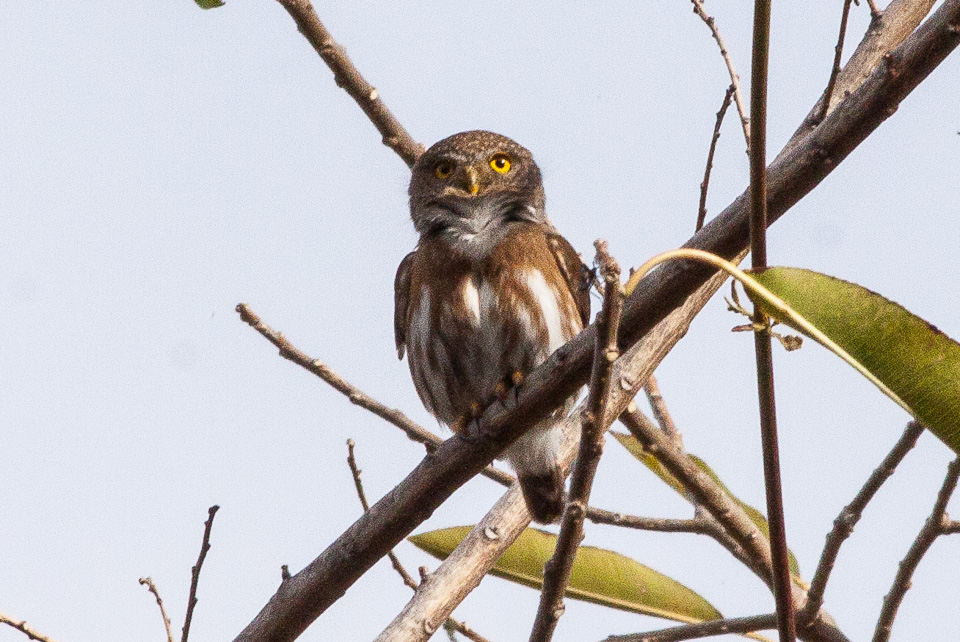
The Colima Pygmy-Owl can be identified by its small size, measuring 14 to 16 centimeters in length, and its distinct round head lacking ear tufts. Its plumage features a warm brown coloration with white speckling on the crown and upperparts, while its underparts exhibit a whitish background with brown streaking. The tail is notably barred with a few narrow white bands, offering a key field mark for identification. Juvenile Colima Pygmy-Owls resemble adults but may display slightly less defined markings. Males and females appear similar in plumage, making sex differentiation difficult in the field. Compared to the Northern Pygmy-Owl, the Colima Pygmy-Owl is slightly smaller and more restricted in range. In flight, this owl shows a rapid, direct flight pattern with steady wing beats, typical of small owls. When perched, its upright posture and alert expression, with large yellow eyes, make it a distinctive sight. Observers may mistake it for other pygmy-owl species, but noting its location and specific markings can aid in accurate identification.
Having trouble telling birds apart? Upload a photo to our bird identification tool for an instant species match.
Colima Pygmy-Owl Habitat and Range
Preferred Habitat
The Colima Pygmy-Owl inhabits tropical dry forests, semi-deciduous forests, and occasionally edges of humid forests. It prefers areas with dense canopy cover and abundant undergrowth. These habitats range from sea level to elevations of 1,500 meters. The owl is rarely found in open fields or heavily urbanized areas, but it may venture into rural landscapes adjacent to forested regions. Unlike other owls that might adapt to urban environments, the Colima Pygmy-Owl remains primarily forest-bound. Seasonal habitat shifts are minimal, although slight movements might occur in response to food availability. Its presence in protected areas, such as the Manantlán Biosphere Reserve, emphasizes the owl's preference for undisturbed habitats.
Geographic Range
The Colima Pygmy-Owl's range is confined to the Pacific slopes of western Mexico, from the state of Nayarit southward through Jalisco, Colima, Michoacán, and into Guerrero. It is a resident species, displaying limited migratory behavior, primarily moving within its range in response to food availability. The owl's population is densest in areas with well-preserved tropical dry forests, where it finds ample food resources and suitable nesting sites. Although it does not migrate over long distances, local movements within its range are common during the breeding season to establish territories. While the overall range is relatively restricted compared to more widespread species, the Colima Pygmy-Owl remains an integral part of the avifaunal community within these specific Mexican states.
Want to know which birds visit your area? Browse our backyard birds by location guides for region-specific species lists.
What Does the Colima Pygmy-Owl Eat?
The Colima Pygmy-Owl's diet consists primarily of insects and small vertebrates. It preys on a variety of insects, including beetles, grasshoppers, and moths, as well as small lizards, mammals, and birds. The owl employs a sit-and-wait hunting technique, perching silently before swooping down to capture prey with precision. Seasonal diet changes are minimal, although the abundance of certain prey types may influence its diet composition. During the breeding season, increased demand for food leads to more frequent hunting activity. Prey size typically ranges from small insects to small vertebrates, reflecting the owl's adaptability and opportunistic feeding behavior.
Colima Pygmy-Owl Behavior and Social Structure
The Colima Pygmy-Owl exhibits a range of intriguing behaviors, many of which reflect its diurnal and solitary nature. Outside of the breeding season, these owls tend to maintain solitary territories, often marked by vocalizations to warn off intruders. During the breeding season, from February to June, they become more vocal and engage in courtship displays that include bowing and vocal duets. These behaviors serve to strengthen pair bonds and establish breeding territories. The owl's response to predators includes a blend of vocal alarm calls and evasive flight maneuvers, often retreating to dense foliage for cover. Throughout the day, the Colima Pygmy-Owl alternates between hunting and resting periods, with heightened activity during the early morning and late afternoon. Its lack of flocking behavior distinguishes it from more social bird species, emphasizing its role as a solitary predator.
Colima Pygmy-Owl Nesting and Reproduction
The Colima Pygmy-Owl typically nests in natural tree cavities or abandoned woodpecker holes, preferring sites that offer protection from predators and environmental elements. Nesting occurs during the breeding season, with a clutch size ranging from 3 to 5 eggs. The incubation period lasts approximately 28 to 30 days, with the female primarily responsible for incubation while the male provides food. Once hatched, the young remain in the nest for about 4 to 5 weeks before fledging. Both parents participate in feeding and caring for the chicks. The species generally produces one brood per year, although in favorable conditions, a second brood may occur. Nest site selection prioritizes areas with abundant prey and minimal disturbance, ensuring the survival and success of the offspring.
Colima Pygmy-Owl Sounds and Vocalizations
The Colima Pygmy-Owl's primary song consists of a series of rapid, high-pitched toots, often delivered in sequences that can be mistaken for the call of a distant quail. These vocalizations serve as territorial declarations and courtship calls. Call notes include a variety of whistled and trilled sounds, often used in communication between mates. Alarm calls are sharper and more urgent, designed to alert conspecifics of potential threats. At dawn and dusk, the owl becomes particularly vocal, contributing to the ambient soundscape of its habitat. The distinctive calls of the Colima Pygmy-Owl aid birders in locating this elusive species amidst dense foliage.
Interesting Facts About the Colima Pygmy-Owl
- 1The Colima Pygmy-Owl is one of the smallest owl species, measuring just 14 to 16 centimeters in length.
- 2Unlike most owls, the Colima Pygmy-Owl is primarily diurnal, hunting during the day.
- 3This species is endemic to Mexico, with a range limited to the Pacific slopes from Nayarit to Guerrero.
- 4The owl's call consists of rapid toots that can be mistaken for a quail, aiding in its identification.
- 5Colima Pygmy-Owls can have up to five eggs per clutch, with both parents participating in chick rearing.
- 6Despite its small size, the owl preys on a variety of insects and small vertebrates, showcasing its adaptability.
- 7The owl's presence in protected areas highlights the importance of conservation efforts in preserving biodiversity.
Colima Pygmy-Owl Conservation Status
The IUCN currently lists the Colima Pygmy-Owl as Near Threatened, reflecting concerns over habitat loss and fragmentation. Although the population trend remains relatively stable, ongoing deforestation and agricultural expansion pose significant threats to its habitat. Conservation efforts focus on habitat preservation and the establishment of protected areas like the Manantlán Biosphere Reserve. Historical population changes have been driven largely by human activities, underscoring the need for sustainable land management practices. By raising awareness and promoting conservation initiatives, researchers aim to safeguard the future of this unique owl species.


