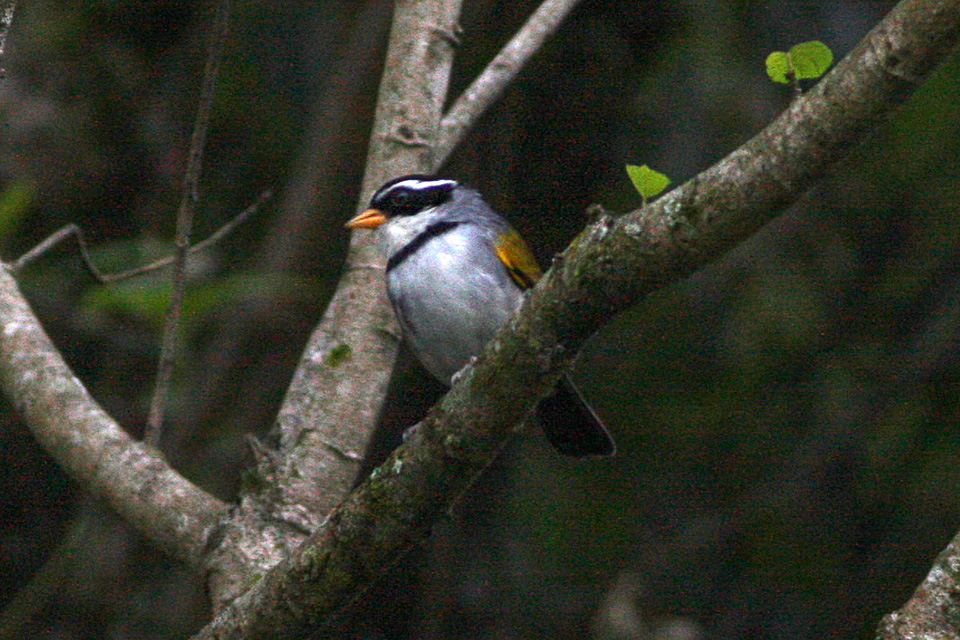
Costa Rican Brushfinch
Arremon costaricensis
Order: Passeriformes / Family: Passerellidae

Wikimedia Commons
About the Costa Rican Brushfinch
The Costa Rican Brushfinch (Arremon costaricensis) is a vibrant member of the Passerellidae family, uniquely adapted to the lush, dense forests of Central America. This species presents itself as an emblem of the biodiverse ecosystems found across Costa Rica and parts of western Panama. Known for its striking green upperparts and contrasting white underparts, the Costa Rican Brushfinch is a testament to the rich avian diversity of this region. Its ecological significance cannot be overstated, as it plays a crucial role in seed dispersal and insect population control within its habitat.
This bird frequents elevations from 600 to 2,200 meters, favoring the humid montane forests that span the Talamanca and Central Volcanic mountain ranges. The Costa Rican Brushfinch is a resident species, not undertaking long migrations, but it does exhibit some altitudinal movement based on seasonal food availability and breeding activities. During the wet season, from May to November, these birds remain more localized, engaging in breeding and raising their young.
As an integral part of the forest ecosystem, the Costa Rican Brushfinch contributes to the health of the forest floor by participating in the natural cycle of seed dispersal. This activity aids in plant regeneration, supporting the overall biodiversity of the region. Additionally, the brushfinch's diet, primarily composed of insects and seeds, helps regulate insect populations, further contributing to ecological balance.
The presence of the Costa Rican Brushfinch is indicative of the health of montane forest ecosystems. Its relatively stable population reflects the ongoing commitment to conservation efforts within its range, though habitat destruction remains a concern. The bird serves as a charismatic ambassador for conservation initiatives aimed at preserving the rich tapestry of life found in the montane forests of Central America.
The Costa Rican Brushfinch belongs to the family Passerellidae, within the order Passeriformes. These birds typically live averages around 5-7 years, with a maximum recorded of 10 years..
How to Identify a Costa Rican Brushfinch
The Costa Rican Brushfinch is easily identified by its striking plumage and distinctive features. Adult birds showcase a vibrant olive-green back contrasting sharply with their snow-white underbelly. A notable characteristic is the bold black stripe running from the base of the beak, over the eye, and down the neck, highlighting the bird's face. This stripe complements the bird's dark eye, creating an arresting facial pattern. Juvenile brushfinches, while similar in appearance, often have duller plumage and less pronounced facial markings, which can make them harder to spot in dense foliage.
Both males and females exhibit similar plumage, making visual sex differentiation challenging in the field. However, males typically exhibit slightly brighter plumage during the breeding season, a subtle difference noted by experienced observers. In flight, the Costa Rican Brushfinch demonstrates a compact silhouette with rounded wings and a short tail, suited for maneuvering through dense undergrowth.
This species could be confused with the similar-looking White-naped Brushfinch (Atlapetes albinucha). However, careful observers will note the Costa Rican Brushfinch's more distinct facial stripe and lack of the white nape that characterizes its relative. When perched, the Costa Rican Brushfinch often adopts an alert posture, frequently flicking its tail as it forages, a behavior that can aid in identification.
Having trouble telling birds apart? Upload a photo to our bird identification tool for an instant species match.
Costa Rican Brushfinch Habitat and Range
Preferred Habitat
The Costa Rican Brushfinch thrives in the humid montane forests that characterize much of its Central American range. Preferring elevations between 600 and 2,200 meters, these birds are commonly found in the Talamanca and Central Volcanic mountain ranges. They favor areas with dense undergrowth and abundant leaf litter, which provide both foraging opportunities and protection from predators.
While primarily a forest-dwelling bird, the Costa Rican Brushfinch can occasionally be found at the edges of forests where thick shrubbery and secondary growth occur. During the breeding season, these birds are more frequently observed in secluded areas with ample ground cover. Though not typically associated with urban environments, they may venture into rural gardens that mimic their natural undergrowth habitat.
The brushfinch's habitat preference does not shift dramatically with the seasons, but slight altitudinal movements may occur in response to food availability. Unlike many migratory species, the Costa Rican Brushfinch remains a resident bird, maintaining permanent territories that it defends vigorously against intruders.
Geographic Range
The Costa Rican Brushfinch inhabits a limited geographical range, primarily located within the montane regions of Costa Rica and extending into western Panama. This restricted range emphasizes the bird's reliance on specific forest habitats for survival and reproduction.
Within this range, they are most densely populated in the highland regions of the Talamanca Mountains. This area provides the ideal combination of climate, vegetation, and altitude that suits their ecological needs. Unlike many other bird species, the Costa Rican Brushfinch does not undertake long-distance migrations, choosing instead to remain within its established territories year-round.
While they do not migrate in the traditional sense, these brushfinches may adjust their range vertically, moving to slightly different elevations during different times of the year. This altitudinal migration is often driven by the seasonal availability of food resources, particularly the abundance of insects and seeds. Despite their limited range, the Costa Rican Brushfinch remains common within its preferred habitats, benefiting from the relative isolation and protection afforded by these montane forests.
Want to know which birds visit your area? Browse our backyard birds by location guides for region-specific species lists.
What Does the Costa Rican Brushfinch Eat?
The diet of the Costa Rican Brushfinch consists primarily of insects and seeds, with significant variations occurring seasonally. During the wet season, when insect populations are abundant, the brushfinch predominantly feeds on a variety of insects, including beetles, caterpillars, and spiders. This increased protein intake supports the energy demands of breeding and raising young.
As the dry season approaches, the availability of insects diminishes, prompting the brushfinch to shift its diet towards seeds and fruits. The forest's undergrowth provides a rich array of seed-bearing plants, allowing the brushfinch to maintain its nutritional intake throughout the year. This seasonal dietary flexibility underscores the bird's adaptability and its role in both seed dispersal and insect population control.
Foraging behavior typically involves ground-level activity, where the brushfinch uses its sharp beak to sift through leaf litter and soil in search of food. They are most active during the early morning and late afternoon hours, taking advantage of cooler temperatures and reduced competition from other foraging bird species. This feeding schedule allows the Costa Rican Brushfinch to efficiently exploit the available food resources within its habitat.
Want to attract Costa Rican Brushfinchs to your yard? See our recommended feeders and seed types for the best results.
Costa Rican Brushfinch Behavior and Social Structure
The Costa Rican Brushfinch exhibits a variety of behaviors that reflect its adaptation to the dense montane forests it inhabits. These birds are generally solitary or found in pairs, particularly during the breeding season when they establish and defend territories. Territorial behavior is pronounced, with both males and females actively engaging in displays to deter intruders.
Courtship displays are subtle but important, involving a series of calls and mutual preening to strengthen pair bonds. Once established, pairs remain together throughout the breeding season, which aligns with the wet season from May to November. During this time, the brushfinch becomes more vocal, with its song serving both as a territorial marker and a means of communication between mates.
While the Costa Rican Brushfinch is not known for flocking behavior, it may join mixed-species foraging flocks outside the breeding season. This behavior increases foraging efficiency and provides additional protection from predators. When threatened, the brushfinch relies on its cryptic coloration and dense habitat for concealment, often remaining motionless until the danger has passed. Daily activity patterns reflect a balance between feeding and resting, with peak activity occurring during the cooler parts of the day.
Costa Rican Brushfinch Nesting and Reproduction
Nesting habits of the Costa Rican Brushfinch are closely aligned with the wet season, ensuring ample food resources for raising young. Nests are typically constructed on or near the ground, well-hidden among dense vegetation and leaf litter. The female primarily undertakes nest-building, using a combination of grasses, leaves, and twigs to create a cup-shaped structure that blends seamlessly with the surrounding environment.
Clutch size typically ranges from two to three eggs, which are pale with subtle speckling. Both parents share incubation duties, which last approximately 12 to 14 days. During this period, the male provides food for the incubating female, ensuring the continuity of parental care. Once hatched, the chicks remain in the nest for another 10 to 12 days before fledging.
Parental roles extend beyond the fledging stage, with both parents involved in feeding and protecting the young until they are fully independent. The Costa Rican Brushfinch generally raises one brood per year, though favorable conditions may allow for a second brood. This reproductive strategy reflects a balance between resource availability and the demands of raising offspring in a competitive forest environment.
Costa Rican Brushfinch Sounds and Vocalizations
The primary song of the Costa Rican Brushfinch is a series of clear, melodic notes that rise and fall in a rhythmic pattern. Typically delivered from a hidden perch within dense foliage, the song serves as both a territorial declaration and a means of communication between mates. The pitch is medium to high, with a quality that carries well through the forest.
Call notes are shorter and less musical, often used in social interactions or as alarm calls. These calls are sharp and distinctive, aiding in the quick identification of potential threats or the presence of other brushfinches. During the dawn chorus, the Costa Rican Brushfinch contributes a unique voice to the cacophony, its song intertwining with those of other early risers.
Alarm calls are more rapid and insistent, serving as an effective warning to other birds of nearby danger, such as predatory birds or mammals. The Costa Rican Brushfinch's vocal repertoire is an essential aspect of its survival strategy, enabling it to maintain territory, attract a mate, and avoid predators.
Interesting Facts About the Costa Rican Brushfinch
- 1The Costa Rican Brushfinch is often found at elevations as high as 2,200 meters in the Talamanca Mountains.
- 2This bird's diet shifts significantly from insects during the wet season to seeds during the dry season.
- 3The Costa Rican Brushfinch uses its strong beak to sift through leaf litter, showcasing its adaptation to forest floor foraging.
- 4Despite its vibrant plumage, the Costa Rican Brushfinch blends well into the forest undergrowth, aiding in its defense against predators.
- 5The Costa Rican Brushfinch's song can be heard throughout the day, but it is especially pronounced during the dawn chorus.
- 6These birds are primarily non-migratory, with only slight altitudinal movements in response to seasonal changes.
- 7The Costa Rican Brushfinch contributes significantly to seed dispersal, a vital ecological role in its montane forest environment.
Costa Rican Brushfinch Conservation Status
The Costa Rican Brushfinch is currently classified as a species of Least Concern by the IUCN, reflecting a stable population across its limited range. However, ongoing habitat destruction poses a potential threat to its long-term viability. Deforestation for agriculture and urban development continues to encroach upon its montane forest habitat, reducing available territory and resources. Conservation efforts focus on preserving large tracts of montane forest to ensure the survival of this and other forest-dependent species. Protected areas within Costa Rica, such as national parks and reserves, play a critical role in safeguarding the habitats crucial for the brushfinch's survival. Historically, the population of the Costa Rican Brushfinch has remained relatively stable, thanks in part to the country's strong conservation policies and commitment to preserving biodiversity. Continued monitoring and habitat protection are essential to maintaining this stability and ensuring that the brushfinch continues to thrive in its native environment.
Attracting Costa Rican Brushfinchs to Your Feeder
The Costa Rican Brushfinch is a regular visitor to backyard bird feeders across its range. At the Eye On The Fly feeding station, we observe Costa Rican Brushfinchs regularly and capture footage with our feeder cameras.
Other Passerellidae Species


Birds Similar to the Costa Rican Brushfinch
These species are often confused with the Costa Rican Brushfinch due to similar appearance or overlapping range.