
Crested Fireback
Lophura ignita
Order: Galliformes / Family: Phasianidae
Wikimedia Commons
About the Crested Fireback
The Crested Fireback (Lophura ignita) is a dazzling pheasant native to the tropical forests of Southeast Asia. Its habitat spans the lush, humid environments of the Malay Peninsula, Sumatra, and Borneo. As a member of the Phasianidae family, the Crested Fireback captivates bird enthusiasts and ecologists with its vibrant plumage and intriguing behaviors. This bird plays a significant role in its ecosystem by aiding in seed dispersal, contributing to the health and diversity of its forest habitat. The Crested Fireback is not only a symbol of the rich biodiversity found in Southeast Asia but also an indicator of the health of these ecosystems, as its presence reflects the condition of the forest understorey.
In terms of ecological importance, the Crested Fireback assists in the control of insect populations and serves as prey for larger predators, maintaining the balance within its food web. During the breeding season, which typically occurs between February and June, these pheasants engage in elaborate courtship displays and vocalizations, contributing to the dynamic auditory landscape of their habitat. Their role in seed dispersal is crucial, as they consume various fruits and help propagate the trees and plants essential for forest regeneration.
Throughout the year, the Crested Fireback participates in seasonal behaviors that reflect the availability of resources in its environment. These birds are most active during the cooler hours of the morning and late afternoon, foraging on the forest floor for seeds, insects, and small vertebrates. Despite facing threats from habitat loss and hunting, which have led to a decline in some populations, the Crested Fireback remains a vital component of its ecosystem, highlighting the need for conservation efforts to ensure the preservation of its natural habitat.
The Crested Fireback belongs to the family Phasianidae, within the order Galliformes. These birds typically live average 6-10 years, with some reaching up to 12 years..
How to Identify a Crested Fireback
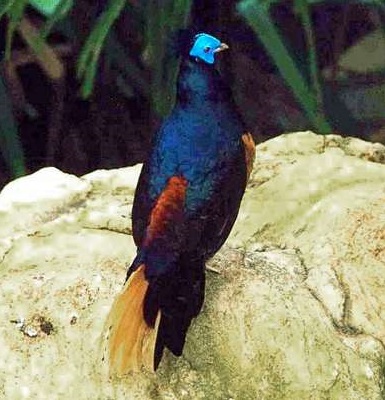
Male Crested Firebacks exhibit a remarkable array of colors, with glossy blue-black plumage on the head and body, complemented by a striking white crest and tail feathers. Their wings feature an iridescent sheen that can appear greenish-blue under certain lighting conditions. Females, in contrast, have a more subdued appearance, with mottled brown plumage that offers better camouflage in the dense undergrowth. Juveniles resemble the females but with even duller coloration.
The Crested Fireback can be distinguished from similar pheasant species by its unique crest and the contrasting colors of its plumage. While in flight, its broad, rounded wings and long tail create a distinctive silhouette. Males often perch in an erect posture, showcasing their vibrant feathers during courtship displays, while females typically remain more concealed.
Unlike the similar-looking Great Argus, which has elongated tail feathers, the Crested Fireback's tail is relatively shorter and more uniform in color. This feature, along with its distinctive white crest, aids in its identification. Observers should note the male's red facial skin and blue ear coverts, which are absent in the female, further aiding in distinguishing between the sexes.
Having trouble telling birds apart? Upload a photo to our bird identification tool for an instant species match.
Crested Fireback Habitat and Range
Preferred Habitat
The Crested Fireback thrives in humid tropical rainforests, particularly in lowland areas and foothills. It prefers dense undergrowth and the forest floor, where it can forage for food while remaining concealed from predators. Elevations of up to 1200 meters are common, but these birds are most frequently found closer to sea level.
During the wet season, these pheasants may venture to slightly elevated areas to avoid flooding, but they generally exhibit minimal seasonal habitat shifts. While primarily forest dwellers, Crested Firebacks may occasionally appear in secondary forests or areas of logged forest, provided that sufficient cover remains.
They are not typically found in urban or suburban settings, as their need for dense cover and specific dietary requirements make them more suited to undisturbed forest habitats.
Geographic Range
The Crested Fireback's range is centered in Southeast Asia, with populations primarily found in Malaysia, Sumatra, and Borneo. While they do not undertake long migrations, these birds may exhibit local movements in response to food availability or habitat changes. The highest population densities occur in regions where forest cover remains dense and undisturbed.
In Malaysia, they are prevalent in the Taman Negara and Endau-Rompin National Parks, while in Sumatra, they inhabit the Bukit Barisan Selatan National Park. On Borneo, the species is more distributed across the island's lowland forests. Despite their relatively limited range, Crested Firebacks are considered local residents rather than migratory birds.
Their presence in protected areas highlights the importance of conservation efforts in maintaining population stability. Although not as widespread as some other pheasant species, Crested Firebacks remain a key indicator species for the health of Southeast Asian rainforests.
Want to know which birds visit your area? Browse our backyard birds by location guides for region-specific species lists.
What Does the Crested Fireback Eat?
The Crested Fireback primarily feeds on a diverse diet that includes seeds, fruits, and insects. During the dry season, the availability of fruits and seeds increases, allowing these birds to forage more extensively. They often employ a scratching technique on the forest floor, using their strong legs to uncover insects and fallen seeds concealed beneath the leaf litter.
In addition to seeds and fruits, the Crested Fireback's diet includes small vertebrates such as lizards and frogs, which they opportunistically consume. This varied diet helps meet their nutritional needs and supports their active lifestyle, particularly during the breeding season when energy demands are higher.
Feeding usually occurs during the cooler parts of the day, with these birds often foraging in small groups or pairs. The Crested Fireback's ability to adapt its diet based on seasonal availability demonstrates its role as a flexible forager in its ecosystem.
Crested Fireback Behavior and Social Structure
Crested Firebacks exhibit a complex social structure, often forming small groups that consist of a dominant male, several females, and their offspring. These groups, or harems, are typically territorial, with males engaging in displays to assert dominance and ward off rivals. Courtship displays involve elaborate plumage presentations, where the male fans his tail and raises his crest to attract females.
Their daily activity patterns revolve around foraging during the cooler hours of the morning and late afternoon, with resting periods in between. Crested Firebacks are generally ground-dwelling birds, preferring to walk or run rather than fly, although they can take to the air if startled by predators.
In response to threats, these pheasants may exhibit a range of behaviors from freezing in place to sudden, explosive flights into dense vegetation for cover. Vocalizations play a key role in maintaining group cohesion and signaling alarm, with distinct calls used to communicate within the group.
Crested Fireback Nesting and Reproduction
The nesting habits of Crested Firebacks involve constructing simple ground nests, often concealed beneath dense undergrowth or fallen logs to protect against predators. The nests consist of shallow scrapes in the ground lined with leaves and twigs.
Females typically lay between 4 to 8 eggs per clutch, with incubation lasting approximately 24 days. During this period, the female takes on most of the incubation duties, while the male remains nearby to guard the nesting area.
Once hatched, the chicks are precocial, leaving the nest shortly after birth to follow the female and learn essential survival skills. The fledging period is relatively short, with young birds gradually gaining independence over several weeks. Crested Firebacks usually produce one to two broods per year, depending on environmental conditions and food availability.
Crested Fireback Sounds and Vocalizations
The primary song of the Crested Fireback consists of a series of resonant, low-pitched calls that travel well through dense forest environments. These calls serve to maintain contact between group members and also play a role in territorial defense.
Alarm calls are sharper and more urgent, designed to alert the group to potential threats. During the dawn chorus, Crested Firebacks contribute a rhythmic series of whistles and trills, which can help define the territorial boundaries of competing males.
The vocal repertoire of the Crested Fireback is less varied than that of songbirds but remains an essential component of their behavioral ecology, facilitating communication and coordination within their social groups.
Interesting Facts About the Crested Fireback
- 1Male Crested Firebacks use their vibrant feathers to attract females, fanning their tails and raising their crests in a display of color.
- 2The distinct white tail feathers of the male Crested Fireback set it apart from other pheasants, making it easier to identify in dense forests.
- 3Despite their striking appearance, Crested Firebacks can be elusive, often using dense undergrowth to evade predators and observers alike.
- 4The Crested Fireback's diet includes small vertebrates, showcasing their adaptability and role as opportunistic foragers in the ecosystem.
- 5Females of the species are well-camouflaged, using their mottled brown plumage to blend into the forest floor while nesting or foraging.
- 6Crested Firebacks play a key role in seed dispersal, aiding in the propagation of various plant species throughout their forest habitats.
- 7These birds are primarily ground-dwellers, preferring to walk or run through their habitat rather than relying on flight for daily movement.
Crested Fireback Conservation Status
The Crested Fireback is currently classified as Near Threatened by the IUCN, with population trends showing a decline primarily due to habitat loss and hunting pressure. The expansion of agriculture and logging activities in Southeast Asia poses significant threats to their forest habitats. Conservation efforts focus on habitat protection, with several national parks and reserves providing crucial refuges for this species. Initiatives aimed at reducing hunting and promoting sustainable land-use practices are also important for their long-term survival. Historical population fluctuations have been influenced by changing land use patterns, highlighting the importance of continued conservation efforts to stabilize and rebuild populations across their range.


