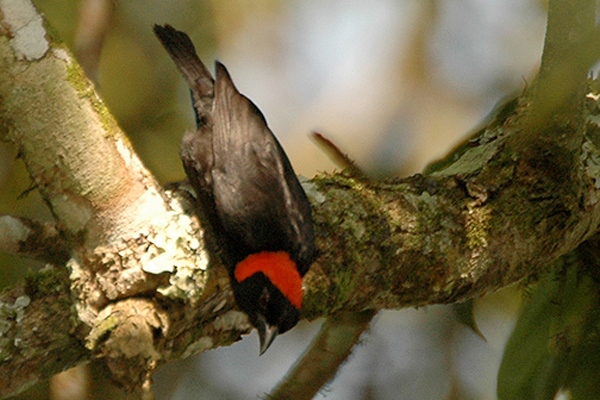
Crested Malimbe
Malimbus malimbicus
Order: Passeriformes / Family: Ploceidae

Wikimedia Commons
About the Crested Malimbe
The Crested Malimbe, scientifically known as Malimbus malimbicus, is a vibrant member of the Ploceidae family, primarily inhabiting the lush forests of West Africa. This bird is particularly noted for its striking red and black plumage that makes it stand out against the verdant backdrop of its tropical home. The Crested Malimbe plays a significant ecological role as both a consumer of insects and a disperser of seeds, contributing to the health and regeneration of its forest environment. Its presence in the forest is a key indicator of a healthy ecosystem due to its reliance on dense, undisturbed habitats. The bird's range extends across several countries, including Liberia, Ghana, Nigeria, and Cameroon, where it thrives in the subtropical or tropical moist lowland forests. Unlike many other bird species, the Crested Malimbe tends to be non-migratory, residing year-round in its chosen habitat. The bird is known for its social nature, often found in pairs or small family groups, engaging in cooperative breeding practices. During the breeding season, which typically aligns with the rainy season in its native regions, the Crested Malimbe becomes even more conspicuous as males actively participate in intricate courtship displays. These displays are characterized by elaborate vocalizations and physical posturing aimed at attracting mates and establishing territories. Overall, the Crested Malimbe is a fascinating species that not only captivates birdwatchers with its vivid appearance but also plays an essential role in its ecosystem.
The Crested Malimbe belongs to the family Ploceidae, within the order Passeriformes. These birds typically live average 5-6 years, with some individuals reaching 8 years..
How to Identify a Crested Malimbe
The Crested Malimbe is easily identified by its vibrant red head and breast, contrasted with its black back and wings. Adult males and females are similar in appearance, although females may have slightly duller red tones. Juvenile Crested Malimbes initially display more subdued coloration, lacking the vivid intensity of mature adults. The contrast between the red and black plumage is a distinctive field mark, helping differentiate this species from other birds in the same habitat. In flight, the Crested Malimbe's silhouette is characterized by a rounded tail and broad wings, typical of the weaver family. When perched, its posture is upright, often seen clinging to tree trunks or branches as it forages for food. While the Crimson-crowned Weaver may appear similar at a distance, its lack of a crested appearance and geographical range help avoid confusion. Observers should note the bird's preference for the mid-story of the forest, often found in areas with dense foliage.
Having trouble telling birds apart? Upload a photo to our bird identification tool for an instant species match.
Crested Malimbe Habitat and Range
Preferred Habitat
The Crested Malimbe primarily inhabits tropical moist lowland forests, favoring areas with dense undergrowth and a rich canopy. These environments provide ample food sources and nesting sites. The bird is often found in primary and secondary forests, as well as forest edges, where it can easily forage and build its nests. The Crested Malimbe does not typically venture into urban areas, maintaining a preference for undisturbed natural habitats. It is most commonly encountered at elevations ranging from sea level to about 1,000 meters. There is little evidence to suggest significant seasonal habitat shifts, as the bird remains within its forested territory year-round. Its presence in rural versus urban settings is minimal, reinforcing its reliance on forest ecosystems.
Geographic Range
The Crested Malimbe's range spans several countries in West Africa, including Liberia, Ghana, Nigeria, and Cameroon. This distribution is relatively localized compared to many other passerines, with the species favoring the humid and lush environments of these regions. While not migratory, the Crested Malimbe is nonetheless subject to the seasonal rhythms of its environment, particularly the rainy season, which influences breeding behaviors and food availability. Population density hotspots tend to be in areas with expansive, undisturbed forest cover, where human encroachment is minimal. Its non-migratory nature ensures that its presence is consistent throughout the year, making it a reliable resident of its chosen habitats.
Want to know which birds visit your area? Browse our backyard birds by location guides for region-specific species lists.
What Does the Crested Malimbe Eat?
The Crested Malimbe primarily feeds on a diet of insects and other small invertebrates, which it captures with precision. It also consumes a variety of fruits and seeds, contributing to seed dispersal within its habitat. Foraging typically occurs in the mid-story of the forest, where the bird searches for prey among the leaves and branches. The Crested Malimbe uses a methodical approach, often pausing to inspect potential food sources before striking. During the breeding season, its diet may shift slightly to accommodate the nutritional needs of its young, incorporating more protein-rich prey. The bird's feeding schedule aligns with daylight hours, showing increased activity in the early morning and late afternoon.
Crested Malimbe Behavior and Social Structure
The Crested Malimbe exhibits a complex social structure, often forming small family groups. It displays territorial behavior during the breeding season, with males engaging in vocal and physical displays to defend their territory and attract mates. Courtship is a notable aspect of its behavior, featuring a combination of vocalizations and physical postures. These displays are crucial in establishing pair bonds and ensuring successful reproduction. The bird is generally non-aggressive outside of the breeding season, often seen foraging in mixed-species flocks. When confronted with predators, the Crested Malimbe relies on its agility and the dense forest cover for protection. Daily activity patterns are characterized by periods of foraging interspersed with rest and preening.
Crested Malimbe Nesting and Reproduction
The Crested Malimbe constructs its nests in trees, utilizing a variety of natural materials such as grass, leaves, and twigs. Nests are typically suspended from branches, offering protection from ground-dwelling predators. The preferred location is within the forest canopy, where the nest is well camouflaged among the foliage. A typical clutch consists of two to four eggs, which are incubated primarily by the female. The incubation period lasts approximately 12 to 14 days, after which the chicks hatch. Both parents participate in feeding and caring for the young, ensuring a high rate of survival. Fledging occurs about 18 to 21 days post-hatching, with juveniles remaining dependent on their parents for some time thereafter. The Crested Malimbe typically raises one or two broods per year.
Crested Malimbe Sounds and Vocalizations
The Crested Malimbe's primary song is a series of melodious whistles and trills, characterized by a rhythmic and pleasing quality. These vocalizations play a key role during the breeding season, aiding in mate attraction and territory establishment. The bird's call notes are sharp and distinct, often used to communicate with flock members. Alarm calls, while less common, are more abrupt and serve as a warning to potential threats. During the dawn chorus, the Crested Malimbe's song can be heard resonating through the forest, adding to the symphony of avian sounds. Its vocalizations are an integral part of its behavioral repertoire, facilitating social interactions and environmental awareness.
Interesting Facts About the Crested Malimbe
- 1The Crested Malimbe's nest is often suspended from tree branches, providing excellent protection from ground predators.
- 2Both male and female Crested Malimbes participate in the construction of their intricate nests, showcasing their cooperative nature.
- 3The Crested Malimbe's vibrant red plumage serves as a visual signal during territorial disputes and courtship displays.
- 4Despite being non-migratory, the Crested Malimbe exhibits seasonal changes in diet and behavior, aligning with the rainy season.
- 5The species is known for its role in seed dispersal, contributing to the health and regeneration of its forest habitat.
- 6The Crested Malimbe often joins mixed-species flocks, benefiting from collective foraging and increased awareness of predators.
- 7Juvenile Crested Malimbes lack the vivid coloration of adults, allowing them to blend in more easily with their surroundings.
Crested Malimbe Conservation Status
The Crested Malimbe is currently classified as Least Concern by the IUCN, though its population trend appears to be decreasing. Primary threats include habitat loss due to deforestation and human encroachment, which reduce the availability of suitable nesting and foraging areas. Conservation efforts focus on protecting existing forest habitats and promoting sustainable land use practices. Historical population changes have been marked by fluctuations corresponding to environmental pressures and human activities. Despite these challenges, the Crested Malimbe remains a resilient species, benefiting from conservation initiatives aimed at preserving West Africa's rich biodiversity.
Other Ploceidae Species



Birds Similar to the Crested Malimbe
These species are often confused with the Crested Malimbe due to similar appearance or overlapping range.