
Curl-crested Jay
Cyanocorax cristatellus
Order: Passeriformes / Family: Corvidae
Wikimedia Commons
About the Curl-crested Jay
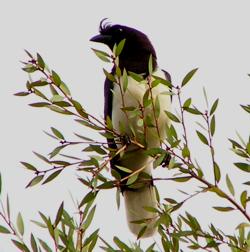
The Curl-crested Jay, Cyanocorax cristatellus, is a striking member of the Corvidae family, native to South America. This bird is primarily found in Brazil, particularly in the cerrado biome, a vast tropical savanna that spans central Brazil. The species is known for its vibrant blue plumage, contrasted by a unique crown of curled feathers that give the bird its name. These jays are an integral part of the ecosystem, playing roles as both seed dispersers and scavengers. Their ability to adapt to various environments, including disturbed areas near human settlements, highlights their ecological significance. The Curl-crested Jay thrives in areas with a mix of open savanna and forested patches, making it a common sight within its range. Observers can often spot them foraging in groups, displaying their social nature. During the breeding season, typically between September and December, these jays exhibit increased territorial behaviors as they establish nesting sites. Outside of breeding, the Curl-crested Jay forms larger flocks, which can sometimes number up to 30 individuals, allowing them to better defend against predators and locate food. This species is non-migratory, meaning it remains within its range year-round, though some seasonal movements may occur locally in response to food availability. Their role in seed dispersal is particularly noteworthy in the cerrado, as they help promote plant diversity and ecosystem health. Despite being relatively common, the Curl-crested Jay faces threats from habitat destruction due to agricultural expansion and urbanization. Conservation efforts in Brazil aim to protect the cerrado and its unique biodiversity, ensuring a stable future for this captivating bird.
The Curl-crested Jay belongs to the family Corvidae, within the order Passeriformes. These birds typically live average 9 years; max recorded 12 years.
How to Identify a Curl-crested Jay
Identifying the Curl-crested Jay involves noting its vivid blue plumage and the distinctive curled feathers adorning its head. Adults showcase a striking contrast between their blue body and the black face mask and throat. These markings are particularly prominent against the paler chest and belly, which vary from white to light gray. Juveniles resemble adults but possess slightly duller plumage and less pronounced crest feathers. Male and female Curl-crested Jays appear similar, making gender determination challenging without close observation of behavior. In flight, the Curl-crested Jay displays broad wings and a long tail, both contributing to its agile aerial maneuvers. When perched, its upright posture and active crest movements make it easily recognizable. The species can be confused with other jays, such as the Purplish Jay (Cyanocorax cyanomelas), but the latter lacks the curl in its crest and has a more uniform dark plumage. Overall, the curled crest remains the most reliable feature for accurate identification.
Having trouble telling birds apart? Upload a photo to our bird identification tool for an instant species match.
Curl-crested Jay Habitat and Range
Preferred Habitat
The Curl-crested Jay predominantly inhabits the cerrado biome, characterized by its tropical savanna landscape interspersed with shrubland and forest patches. This diverse habitat offers the jays ample foraging opportunities and nesting sites. They often favor areas with a mixture of open grasslands and wooded regions, where they can easily locate food while staying sheltered from predators. The species can be found at elevations ranging from sea level to around 1,200 meters above sea level. Although primarily associated with rural settings, the Curl-crested Jay has shown adaptability to urban environments, often frequenting parks and gardens where natural habitats intersect with human development. Seasonal habitat shifts are minimal, as the species is non-migratory, though some local movements may occur in search of food or optimal nesting locations.
Geographic Range
The Curl-crested Jay's range is largely confined to Brazil, with a strong presence in the central states such as Goiás, Mato Grosso, and Tocantins. The species is also found in western parts of Minas Gerais and occasionally extends into eastern Bolivia and northern Paraguay. This distribution aligns with the extent of the cerrado biome, where the bird is most abundant. Population density hotspots are particularly notable in areas where natural habitats remain relatively undisturbed by agricultural activities. The Curl-crested Jay does not undertake long-distance migrations, but local dispersal can occur in response to resource availability, especially during breeding season when establishing territories becomes crucial.
Want to know which birds visit your area? Browse our backyard birds by location guides for region-specific species lists.
What Does the Curl-crested Jay Eat?
The diet of the Curl-crested Jay is diverse, reflecting its omnivorous nature. Primary food sources include a variety of fruits, seeds, and insects, which are abundant in the cerrado. The jays are adept at foraging on the ground and in trees, using their strong bills to extract food. During the wet season, when fruit availability peaks, these birds consume large quantities of fleshy fruits such as those from the annatto and cecropia trees. In the dry season, they switch to a diet rich in seeds and insects, adapting their foraging techniques accordingly. They employ a methodical approach, turning over leaf litter and probing bark to uncover hidden invertebrates. The Curl-crested Jay is also known to scavenge, feeding on carrion or leftovers from other animals. Their feeding schedule is primarily diurnal, with peak activity in the early morning and late afternoon when temperatures are cooler.
Curl-crested Jay Behavior and Social Structure
The Curl-crested Jay exhibits a complex social structure, often forming small family groups or larger flocks outside of the breeding season. These social groups enhance their ability to locate food and protect against predators. The species displays strong territorial behavior during the breeding season, with pairs or small groups defending their chosen nesting area. Courtship displays involve vocalizations and physical posturing, often with the crest feathers prominently raised. When threatened, the Curl-crested Jay emits loud alarm calls and may engage in mobbing behavior, collectively harassing intruders such as snakes or birds of prey. Daily activity patterns include foraging in the early morning and late afternoon, with periods of rest or preening during the hottest part of the day. The jays demonstrate a high degree of curiosity and intelligence, often investigating new objects or changes in their environment.
Curl-crested Jay Nesting and Reproduction
Curl-crested Jays construct their nests predominantly in trees or large shrubs, selecting sites that offer both concealment and accessibility. The nests are cup-shaped, crafted from twigs, roots, and grasses, and lined with softer materials such as feathers or hair. Nesting occurs between September and December, coinciding with the onset of the rainy season. Clutch sizes range from 3 to 5 eggs, with an incubation period lasting approximately 18 to 20 days. Both parents participate in feeding and caring for the chicks, which fledge around 25 to 30 days after hatching. The species typically produces one brood per year, though favorable conditions may lead to a second attempt. Parental roles are shared, with both sexes involved in nest defense and chick rearing.
Curl-crested Jay Sounds and Vocalizations
The Curl-crested Jay's vocalizations are varied, consisting of harsh, metallic-sounding calls and more melodious whistles. Their primary song is a series of rapid, chattering notes, often described as a 'cha-cha-cha' sequence. These vocalizations serve to communicate within the flock, establish territory, and warn of predators. Alarm calls are sharp and loud, intended to alert other jays and nearby animals to potential threats. During the dawn chorus, Curl-crested Jays contribute a lively and dynamic element, their calls echoing through the savanna. Compared to other jays, their vocal repertoire is distinctive, marked by both its complexity and volume.
Interesting Facts About the Curl-crested Jay
- 1The Curl-crested Jay's curled feathers result from a genetic mutation unique to this species, differentiating it from other jays.
- 2This species is especially social, often engaging in cooperative breeding behaviors where non-breeding individuals help raise young.
- 3Curl-crested Jays have been observed using tools, a rare behavior among birds, to extract insects from bark.
- 4The species plays a critical role in seed dispersal within the cerrado, aiding in the maintenance of plant diversity.
- 5These jays are highly adaptable and can thrive in disturbed habitats, including urban parks and suburban areas.
- 6Despite their vibrant appearance, Curl-crested Jays can be elusive, often remaining hidden in dense foliage when threatened.
- 7Their vocal and social complexity rivals that of the more widely studied New World jays, making them a fascinating subject for behavioral studies.
Curl-crested Jay Conservation Status
As of the latest assessments, the Curl-crested Jay is classified as Least Concern by the IUCN. Its population trend appears stable, with no immediate threats of significant declines. However, habitat destruction due to agricultural expansion and urban development poses ongoing challenges. Conservation efforts focus on preserving the cerrado biome through protected areas and sustainable land use practices. Historical population changes have largely been influenced by habitat modification, emphasizing the need for continued conservation vigilance.
Other Corvidae Species


Birds Similar to the Curl-crested Jay
These species are often confused with the Curl-crested Jay due to similar appearance or overlapping range.

