
Dark-throated Seedeater
Sporophila ruficollis
Order: Passeriformes / Family: Thraupidae
Wikimedia Commons
About the Dark-throated Seedeater
The Dark-throated Seedeater (Sporophila ruficollis) is a small finch-like bird belonging to the family Thraupidae and is primarily found across the grasslands of South America. This species plays a crucial role in its ecosystem by aiding in seed dispersion, which contributes to plant diversity and habitat maintenance. Its presence is significant in countries such as Argentina, Brazil, and Paraguay, where it thrives in open grassland and savanna environments. The Dark-throated Seedeater is not only a delight to birdwatchers but also a key species for researchers studying the dynamics of grassland ecosystems. While the bird remains relatively common in its preferred habitats, its numbers fluctuate with seasonal changes in food availability. During the breeding season, which typically occurs from September to December, the Dark-throated Seedeater becomes particularly active. Males can be observed singing persistently to establish territories and attract females. As the breeding season concludes, these birds may disperse over a broader range in search of food, although they are not considered long-distance migrants. Their role as seed dispersers becomes particularly noticeable in the wet season when grasses and seed plants flourish, and their feeding habits shift to exploit the abundance of seeds. This ecological contribution is vital for maintaining the health and diversity of South American grasslands.
The Dark-throated Seedeater belongs to the family Thraupidae, within the order Passeriformes. These birds typically live average 3-5 years, with a maximum recorded up to 7 years.
How to Identify a Dark-throated Seedeater
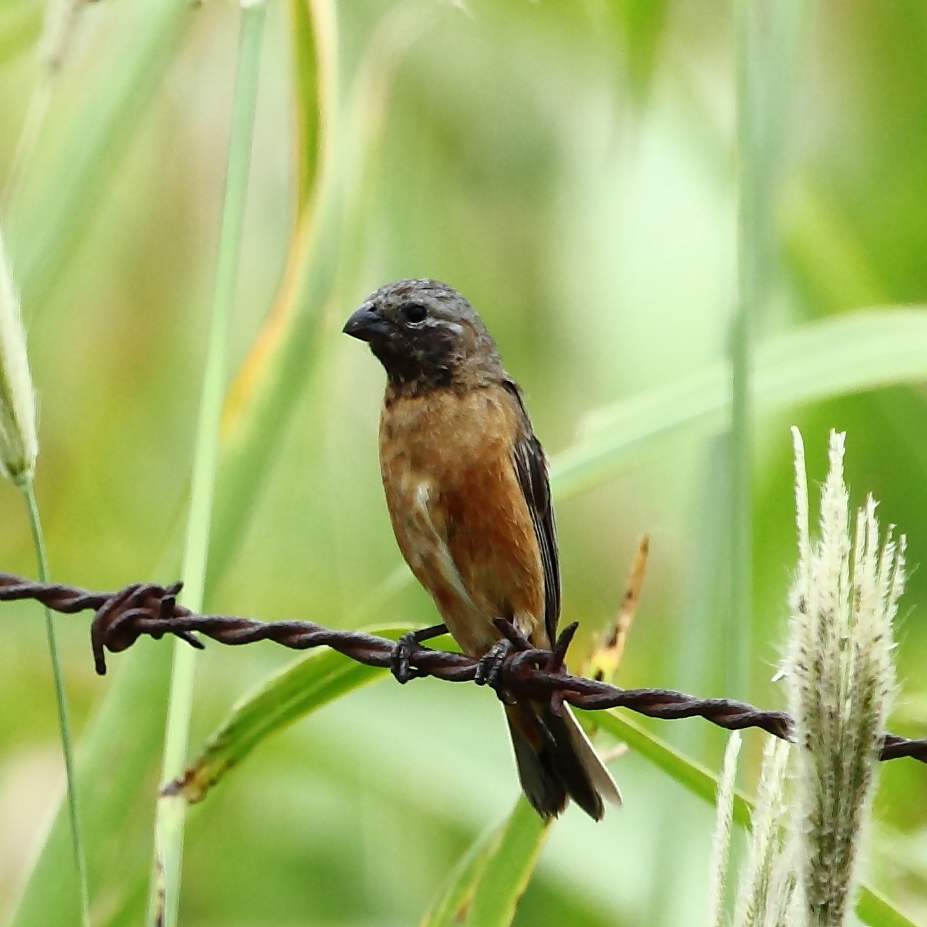
The Dark-throated Seedeater is a small bird, measuring approximately 10 to 12 centimeters in length. Its most distinguishing feature is the dark throat patch found in males, which contrasts starkly with their otherwise pale underparts. The upperparts are generally a muted brown, offering excellent camouflage in their grassy habitats. In contrast, females tend to have a more uniform brown coloration, lacking the striking throat patch of the males. Juveniles resemble females but are often paler and may show some streaking on the breast. Both sexes have a stout, conical bill adapted for seed consumption. When compared to similar species, such as the Rusty-collared Seedeater, the Dark-throated Seedeater can be differentiated by its smaller size and less pronounced collar. In flight, this bird displays a rapid, fluttering pattern, keeping low to the ground. When perched, it often adopts an upright posture, using elevated grass stems or low shrubs as vantage points.
Having trouble telling birds apart? Upload a photo to our bird identification tool for an instant species match.
Dark-throated Seedeater Habitat and Range
Preferred Habitat
The Dark-throated Seedeater is predominantly found in open grasslands, savannas, and agricultural areas. It thrives in lowland regions where grasses are abundant, typically at elevations below 1500 meters. While it shows a strong preference for rural landscapes, the bird can occasionally be found in urban parks or gardens, particularly those adjacent to its natural habitats. During the rainy season, when grasses are lush and seed production is high, the seedeater may move to slightly wetter areas, but it generally avoids densely forested or heavily urbanized regions.
Geographic Range
The Dark-throated Seedeater's range encompasses much of southeastern South America, including significant portions of Argentina, Brazil, and Paraguay. It is a resident breeder in these areas, with some local movement observed in response to food availability. The species is most commonly found in the Pampas of Argentina and the Cerrado of Brazil. During non-breeding periods, the seedeater may spread into peripheral regions where grasslands are still present. However, it does not undertake long migrations and tends to remain within its general geographic range throughout the year.
Want to know which birds visit your area? Browse our backyard birds by location guides for region-specific species lists.
What Does the Dark-throated Seedeater Eat?
The Dark-throated Seedeater primarily feeds on seeds, which constitute the bulk of its diet. It exhibits a preference for the seeds of grasses and other herbaceous plants, taking advantage of seasonal abundance. During the breeding season, when energy demands are high, it may also consume small insects and larvae to provide additional protein. Foraging occurs mainly on the ground, where the bird uses its strong bill to crack open seeds. It often feeds in small groups, moving systematically through grassland patches. The bird's feeding schedule is most active in the early morning and late afternoon when temperatures are cooler, and its natural predators are less active.
Want to attract Dark-throated Seedeaters to your yard? See our recommended feeders and seed types for the best results.
Dark-throated Seedeater Behavior and Social Structure
The Dark-throated Seedeater is a social bird, often seen in small flocks outside the breeding season. During the breeding period, however, males become territorial, establishing and defending small areas through song and displays. Courtship involves the male singing persistently from prominent perches, often accompanied by fluttering flights to showcase his dark throat patch. These displays are crucial in attracting females and deterring rival males. In response to predators, the seedeater employs a tactic of rapid, low flight to dense grass cover, where it can remain concealed until the threat has passed. Daily activity peaks during cooler parts of the day, as the bird seeks to avoid the intense midday heat common in its native grasslands.
Dark-throated Seedeater Nesting and Reproduction
Dark-throated Seedeaters typically construct their nests low to the ground, hidden within dense grass or shrubs. The nest is a small, cup-shaped structure made from woven grasses and lined with softer materials such as feathers or fine plant fibers. A typical clutch consists of two to three eggs, which are incubated primarily by the female for about 12 to 14 days. Once hatched, both parents take an active role in feeding the chicks, providing a diet rich in seeds and insects. The fledging period lasts approximately 10 to 12 days, after which the young birds leave the nest but remain dependent on their parents for some time. The species generally raises one or two broods per year, depending on environmental conditions and food availability.
Dark-throated Seedeater Sounds and Vocalizations
The primary song of the Dark-throated Seedeater is a series of clear, melodious notes delivered in rapid succession. The pitch tends to be high, and the quality is often described as flute-like, making it a distinctive sound in its grassland habitat. Call notes are short and sharp, used for communication between individuals within a flock or as alarm calls in response to nearby threats. During the dawn chorus, the seedeater's song is particularly prominent, as males compete to establish territories and attract mates. Compared to other seedeaters, its song is less complex but remains a key identifier for the species.
Interesting Facts About the Dark-throated Seedeater
- 1The Dark-throated Seedeater's diet is so seed-heavy that it has specialized digestive adaptations to efficiently process hard seed coats.
- 2Unlike many small birds, the Dark-throated Seedeater's song can be heard over long distances, a trait that aids in territory establishment.
- 3Males and females of the Dark-throated Seedeater can be quite similar in size, making them more difficult to distinguish than in other species.
- 4This species engages in a unique fluttering flight display during courtship, which is not only for attracting mates but also for deterring rivals.
- 5The Dark-throated Seedeater has been observed using different foraging strategies based on seed type and availability, showcasing its adaptability.
Dark-throated Seedeater Conservation Status
The Dark-throated Seedeater is currently listed as Least Concern by the IUCN, with a stable population trend. The primary threats to this species include habitat loss due to agricultural expansion and the intensification of land use. Conservation efforts focus on preserving native grasslands and implementing sustainable agricultural practices. Historically, the population of the Dark-throated Seedeater has fluctuated in response to changes in land use, but current trends suggest a stable status, owing in part to its adaptability to modified landscapes.
Attracting Dark-throated Seedeaters to Your Feeder
The Dark-throated Seedeater is a regular visitor to backyard bird feeders across its range. At the Eye On The Fly feeding station, we observe Dark-throated Seedeaters regularly and capture footage with our feeder cameras.


