
Diademed Tanager
Stephanophorus diadematus
Order: Passeriformes / Family: Thraupidae
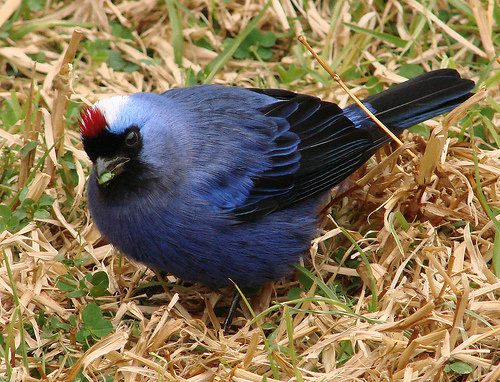
Wikimedia Commons
About the Diademed Tanager
The Diademed Tanager (Stephanophorus diadematus) is a captivating bird native to the temperate regions of South America. It belongs to the family Thraupidae, which is renowned for its diversity and colorful members. This tanager stands out due to its vibrant blue plumage and a distinctive white crown, from which it gets its common name. The species plays a significant ecological role as both a seed disperser and an insect predator, contributing to the health of the ecosystems it inhabits. Found primarily in the southern parts of Brazil, Paraguay, Uruguay, and northeastern Argentina, the Diademed Tanager thrives in montane forests and open woodland areas. These regions provide the optimal mix of foliage and open spaces necessary for foraging and nesting. One of the most fascinating aspects of the Diademed Tanager's life cycle is its seasonal behavior. During the breeding season, which occurs primarily in the spring and early summer months of the Southern Hemisphere, males exhibit heightened territoriality. Their song, a series of melodious whistles, becomes more pronounced and frequent as they defend their nesting sites and attract mates. Outside of the breeding season, these tanagers are less vocal and exhibit a more social behavior, often joining mixed-species flocks. This seasonal shift in behavior highlights the adaptability of the Diademed Tanager to changing environmental conditions and resource availability. Their presence is an indicator of healthy forest ecosystems, as they rely on a diverse array of fruits and insects that flourish in undisturbed habitats. Conservationists consider the Diademed Tanager to be a species of least concern, yet ongoing habitat destruction poses a potential threat. Forest clearance for agriculture and urban expansion continues to reduce suitable habitat. However, protected areas in their range help maintain stable populations. Efforts to preserve these environments not only benefit the Diademed Tanager but also the myriad other species sharing its habitat. Appreciating the ecological significance of the Diademed Tanager underscores the importance of conserving the rich biodiversity of South American forests.
The Diademed Tanager belongs to the family Thraupidae, within the order Passeriformes. These birds typically live average 6 years with a max recorded of 10 years.
How to Identify a Diademed Tanager
The Diademed Tanager is a medium-sized bird measuring approximately 18 cm in length. It is easily identified by its striking blue plumage, which covers most of its body. The most distinguishing feature is the white crown or 'diadem' on its head, which contrasts sharply with the deep blue coloring. Adult males and females exhibit similar plumage, although males may display slightly brighter hues. Juveniles, on the other hand, tend to have duller plumage, lacking the full intensity of the adult blue and often missing the complete white crown. When observing in the field, note the bird's black lores and a subtle black mask extending through the face, enhancing its distinct appearance. In flight, the Diademed Tanager displays a somewhat slow and deliberate wingbeat, with broad, rounded wings that are typical of many tanagers. Their flight silhouette is not as agile or streamlined as some other passerines, which can aid in identification. While perched, they often adopt an upright posture, giving clear views of their decorative crown. In terms of similar species, the Diademed Tanager can be confused with other blue tanagers, such as the Blue-and-black Tanager (Tangara vassorii). However, the white crown of the Diademed Tanager is a definitive marker for differentiation. Observing these specific field marks helps in accurately identifying this striking bird.
Having trouble telling birds apart? Upload a photo to our bird identification tool for an instant species match.
Diademed Tanager Habitat and Range
Preferred Habitat
The Diademed Tanager predominantly inhabits montane forests and open woodlands. It prefers regions with a mix of dense foliage and open areas, which provide both shelter and foraging opportunities. In Brazil, they are commonly found in the Atlantic Forest biome, thriving in the subtropical and temperate zones. These forests, characterized by high humidity and rich biodiversity, offer an ideal environment for the species. Elevation plays a significant role in their habitat preference, with the Diademed Tanager often found at altitudes ranging from 500 to 2,500 meters. This elevation range allows them to exploit the resources of both lower montane and cloud forests. During the non-breeding season, they may venture into secondary forests and overgrown clearings, indicating some adaptability to altered landscapes. However, they are less frequently observed in urban areas, as they require large forested tracts to meet their ecological needs. Seasonal habitat shifts are minimal, as they are largely resident birds, maintaining territories within their chosen habitats year-round. Conservation of these forested areas is crucial for the continued health of Diademed Tanager populations.
Geographic Range
The Diademed Tanager's range is primarily concentrated in the southern part of Brazil, extending into Paraguay, Uruguay, and northeastern Argentina. In Brazil, they are especially prevalent in the states of Rio Grande do Sul and Santa Catarina, where the Atlantic Forest provides ideal conditions. They are considered non-migratory, residing within their range throughout the year, though some altitudinal movements may occur in response to changing food availability and climatic conditions. These movements are typically limited to descending to lower elevations during harsher weather in the winter months. Within their range, population density varies, with higher concentrations in pristine forest areas where human impact is minimal. In Paraguay and Uruguay, they extend into the more temperate forested regions, although sightings are less frequent than in Brazil. In northeastern Argentina, they are most commonly found in the Misiones province, which harbors extensive forest reserves. Despite their limited geographic range, the Diademed Tanager is relatively adaptable within its preferred habitats, making it a widespread species within its range.
Want to know which birds visit your area? Browse our backyard birds by location guides for region-specific species lists.
What Does the Diademed Tanager Eat?
The Diademed Tanager has a diverse diet, primarily consisting of fruits and insects. This omnivorous feeding behavior allows them to adapt to seasonal changes in food availability. During the warmer months, when insects are abundant, they actively hunt for beetles, caterpillars, and other small invertebrates. This insectivorous diet is crucial during the breeding season, providing the necessary protein for growing chicks. As the seasons change and fruit becomes more plentiful, their diet shifts to include a variety of berries and small fruits. They have been observed feeding on the fruits of native trees such as Myrsine and various species of Melastomataceae, which are abundant in their habitat. The Diademed Tanager typically forages in the mid to upper canopy, using a combination of gleaning and aerial sallying techniques. This method involves perching on branches and making short flights to capture prey or pluck fruit. Despite being primarily diurnal, they are most active during the morning and late afternoon, aligning with peak insect activity and fruit availability. Understanding their diet provides insight into their role as both seed dispersers and insect population controllers within their ecosystems.
Diademed Tanager Behavior and Social Structure
The Diademed Tanager exhibits a range of behaviors that reflect its social and ecological adaptations. During the breeding season, marked territoriality is observed, with males vigorously defending their nesting areas through song and displays. They use their melodious whistles not only to attract mates but also to deter rival males from encroaching upon their territories. Courtship involves a series of visual displays, including wing flicking and tail fanning, which are accompanied by vocalizations. Outside of the breeding season, these tanagers become more social, often joining mixed-species flocks. This flocking behavior enhances foraging efficiency and provides protection against predators. Their daily activity pattern involves active foraging during the cooler parts of the day, with periods of rest and preening during midday. In response to predators, the Diademed Tanager employs a combination of alarm calls and evasive maneuvers. They are known to be vigilant and alert, using dense foliage as cover. Their keen awareness of their surroundings helps them avoid predation and maintain their position within mixed-species groups. These behavioral traits reflect the adaptability and survival strategies of the Diademed Tanager in its natural environment.
Diademed Tanager Nesting and Reproduction
The nesting habits of the Diademed Tanager reflect its adaptation to forest life. They build cup-shaped nests, typically using materials such as twigs, grasses, and mosses. These nests are often lined with softer materials like feathers or plant fibers to provide insulation and comfort for the eggs and chicks. Nest placement is strategic, usually located in the mid to upper canopy to avoid ground predators and isolate the nest from disturbances. The preferred location is on a sturdy branch of a tree or shrub, where foliage provides additional camouflage. The female typically lays a clutch of two to three eggs, which are pale blue-green with brownish speckles. Both parents participate in the incubation process, which lasts approximately 14 to 16 days. Once the eggs hatch, the altricial chicks are fed by both parents, primarily on a diet of small insects and fruit. The fledging period is around two to three weeks, after which the young leave the nest but continue to be fed by the parents until they are fully independent. The Diademed Tanager typically produces one to two broods per year, depending on environmental conditions and food availability. Their nesting strategy ensures a high survival rate for the offspring, contributing to the stability of their populations.
Diademed Tanager Sounds and Vocalizations
The Diademed Tanager's vocalizations are an essential aspect of its behavior, especially during the breeding season. Their primary song consists of a series of clear, melodic whistles that vary in pitch and rhythm. These whistles are often described as flute-like, carrying well through the dense forest canopy. The song serves multiple purposes, including attracting mates and delineating territory. In addition to their song, Diademed Tanagers have a repertoire of call notes used in various contexts. These calls are generally softer and more conversational, serving as communication between mates or to alert others in the flock of potential threats. Their alarm calls are sharp and more urgent, designed to warn of nearby predators. During the dawn chorus, the Diademed Tanager's song is a prominent feature, echoing through the forest and marking the start of the day. This vocal presence not only establishes their territory but also plays a crucial role in their social interactions.
Interesting Facts About the Diademed Tanager
- 1The Diademed Tanager's diet shifts seasonally, from predominantly insectivorous in the breeding season to more frugivorous outside of it.
- 2Despite their vivid blue coloration, Diademed Tanagers are surprisingly well camouflaged in their forest habitats due to the dappled light of the canopy.
- 3Diademed Tanagers are known to join mixed-species flocks, which can include other tanagers and even non-passerines, enhancing their foraging success.
- 4The white crown of the Diademed Tanager is not present at birth but develops gradually as they mature, reaching full prominence in adulthood.
- 5Their name 'diadematus' refers to the distinctive white 'diadem' or crown, a rare feature among tanagers that aids in species recognition.
Diademed Tanager Conservation Status
The Diademed Tanager is currently listed as a species of least concern by the IUCN, indicating a stable population trend. However, habitat destruction due to deforestation and land conversion for agriculture poses significant threats to its natural habitat. The Atlantic Forest, a primary habitat for the Diademed Tanager, has experienced significant fragmentation, leading to concerns about long-term population viability. Conservation efforts focus on protecting existing forested areas and promoting reforestation initiatives to restore degraded habitats. Protected areas and nature reserves within its range, particularly in Brazil and Argentina, play a crucial role in safeguarding their habitats. Historical population data suggest that while the species has managed to maintain stable numbers, continuous monitoring and habitat preservation are necessary to ensure its future. Public awareness campaigns and community involvement in conservation efforts are also essential to mitigate human impact on these vital ecosystems.
Other Thraupidae Species


Birds Similar to the Diademed Tanager
These species are often confused with the Diademed Tanager due to similar appearance or overlapping range.
