
Dideric Cuckoo
Chrysococcyx caprius
Order: Cuculiformes / Family: Cuculidae
Wikimedia Commons
About the Dideric Cuckoo
The Dideric Cuckoo, or Chrysococcyx caprius, is a small yet striking bird native to sub-Saharan Africa. It thrives in a variety of habitats, from dense forests to open woodlands. Known for its iridescent green plumage and long tail, this cuckoo is a remarkable example of avian adaptation and survival. Unlike many birds, it does not construct its own nest but rather practices brood parasitism, laying its eggs in the nests of other bird species. This cunning strategy allows the Dideric Cuckoo to devote more energy to foraging and reproduction.
During the breeding season, which occurs from September to March, the Dideric Cuckoo can be found in higher densities in areas rich with its host species, including weavers and bulbuls. Its call, a repetitive and melodic "dee-dee-deederick," is often the first indication of its presence. This call is not only a territorial signal but also plays a role in attracting mates. Males are especially vocal during this period, showcasing their striking plumage during aerial displays.
Ecologically, the Dideric Cuckoo plays a complex role in its environment. By relying on brood parasitism, it influences the population dynamics of its host species. This interaction can lead to increased vigilance and adaptive behaviors among host birds. Additionally, the cuckoo contributes to the biodiversity of its habitat, ensuring a balance between predator and prey species. As a widespread species, the Dideric Cuckoo is an integral part of the avian communities it inhabits, both as a competitor and a symbiotic partner.
The Dideric Cuckoo belongs to the family Cuculidae, within the order Cuculiformes. These birds typically live typically 4-6 years, with some individuals living longer under favorable conditions..
How to Identify a Dideric Cuckoo
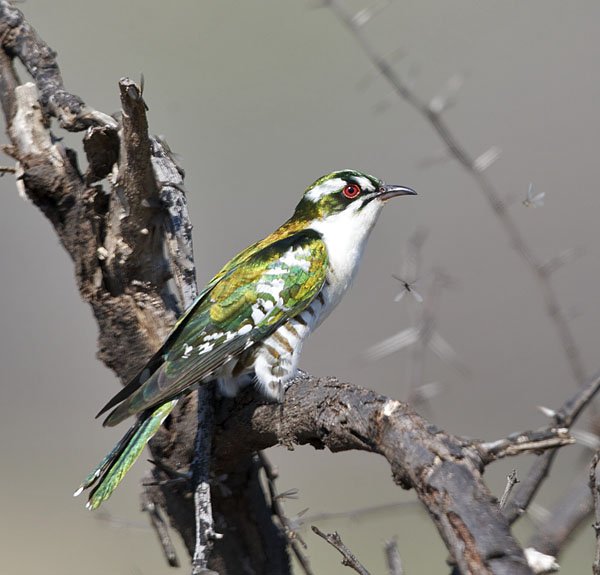
The Dideric Cuckoo is a small bird, averaging 18-20 cm in length, with iridescent green upperparts and white underparts. Its long tail features distinctive white tips, which are particularly visible in flight. Adult males boast a more vibrant green sheen, while females tend to have a slightly duller appearance with more barring on the belly. Juveniles exhibit a more subdued coloration, with a speckled appearance that helps them remain inconspicuous.
When comparing males and females, the primary difference lies in the intensity of their plumage. The male's brilliant green contrasts sharply with the female's subtle barring. In flight, the Dideric Cuckoo presents a slim silhouette, with rapid wingbeats and a direct flight pattern. Perched, the cuckoo often sits quietly, using its long tail for balance.
The Dideric Cuckoo can be confused with other small cuckoos, such as the Klaas's Cuckoo (Chrysococcyx klaas), but it can be distinguished by its brighter plumage and unique call. The Klaas's Cuckoo also displays more uniform green coloring without the barred underparts seen in the Dideric Cuckoo.
Having trouble telling birds apart? Upload a photo to our bird identification tool for an instant species match.
Dideric Cuckoo Habitat and Range
Preferred Habitat
The Dideric Cuckoo occupies a wide range of habitats across sub-Saharan Africa. It thrives in open woodlands, savannas, and forest edges, often near water sources. The bird is adaptable and can be found from sea level up to 2,500 meters in elevation. During the breeding season, it seeks out areas abundant with potential host nests, particularly favoring habitats with a high density of weavers and other suitable host species.
In urban and suburban areas, the Dideric Cuckoo can be spotted in large gardens and parks with ample tree cover. However, it is more commonly observed in rural settings where natural habitats provide optimal foraging and nesting opportunities. Seasonal movements are linked to the availability of host nests and food resources, with the cuckoo moving to areas with higher rainfall and insect abundance during breeding.
Geographic Range
The Dideric Cuckoo is widespread across sub-Saharan Africa, with its range extending from the southern edge of the Sahara Desert to the southernmost parts of the continent. It is a resident breeder in countries such as South Africa, Botswana, Kenya, and Tanzania, among others. The bird exhibits partial migratory behavior, with populations in the northern regions moving southward during the breeding season.
Migration corridors include routes through eastern and southern Africa, where the cuckoo follows the rains and the abundance of insect prey. During the non-breeding season, it may disperse more widely across its range, although precise movement patterns can vary depending on regional climate conditions. Densities of the Dideric Cuckoo are highest in areas with suitable nesting sites and abundant food sources, such as the Okavango Delta in Botswana and the wetlands of the Zambezi River.
Want to know which birds visit your area? Browse our backyard birds by location guides for region-specific species lists.
What Does the Dideric Cuckoo Eat?
The Dideric Cuckoo primarily feeds on insects, with caterpillars forming a significant portion of its diet. It uses its sharp bill to catch and consume a variety of invertebrates, including beetles and grasshoppers. The cuckoo's diet shifts seasonally, with an increased reliance on caterpillars during the breeding season, when these soft-bodied insects are plentiful and nutritious for both adults and their developing young.
Foraging techniques include gleaning from foliage and capturing prey in short flights. The Dideric Cuckoo is often observed foraging alone, although it may join mixed-species flocks when food is abundant. It typically feeds during the day, with peak activity in the early morning and late afternoon when insect activity is highest. The cuckoo's ability to exploit a range of insect prey contributes to its adaptability across diverse habitats.
Dideric Cuckoo Behavior and Social Structure
The Dideric Cuckoo is a solitary bird outside of the breeding season, exhibiting territorial behavior during courtship. Males call persistently to establish territory and attract females, using their distinctive "dee-dee-deederick" call. Courtship displays involve aerial chases and the presentation of food items to potential mates.
Despite being generally solitary, Dideric Cuckoos do not form flocks. They exhibit strong territoriality, especially during breeding, often chasing other birds, including conspecifics, from their chosen area. When confronted by predators, they rely on their speed and agility in flight to evade capture, often retreating to dense foliage for cover.
Daily activity patterns are heavily influenced by feeding and breeding cycles. The cuckoo is most active during the morning and late afternoon, with periods of rest and preening during the hotter midday hours. Its interactions with host species are particularly intriguing, as the cuckoo must carefully time its egg-laying to avoid detection and rejection by the host birds.
Dideric Cuckoo Nesting and Reproduction
The Dideric Cuckoo does not build its own nest but instead practices brood parasitism, laying its eggs in the nests of other birds. Preferred hosts include several species of weavers and bulbuls, which are abundant in its range. The cuckoo's eggs closely mimic those of its host, reducing the likelihood of rejection.
A female Dideric Cuckoo will lay a single egg in a host's nest, often removing one of the host's eggs to avoid suspicion. The incubation period is typically around 12 days, after which the cuckoo chick hatches, often ejecting remaining host eggs or chicks to monopolize parental care. The chick fledges within 18-21 days, during which time it is fed by the unsuspecting host parents.
The Dideric Cuckoo can produce multiple broods per year, depending on the availability of host nests. This reproductive strategy allows the species to maximize its breeding success across a range of environmental conditions.
Dideric Cuckoo Sounds and Vocalizations
The Dideric Cuckoo is best known for its distinctive call, a series of repetitive "dee-dee-deederick" notes that rise and fall in pitch. This call serves both territorial and mating purposes, often echoing through woodlands and savannas during the breeding season. In addition to its primary song, the cuckoo emits a variety of calls, including harsh alarm notes when threatened.
The song of the Dideric Cuckoo is best heard during the early morning hours, when males are most vocal. This dawn chorus is an important part of their courtship and territorial defense. The cuckoo's call can be likened to the sound of a distant flute, carrying over long distances in its habitat. Despite its small size, the Dideric Cuckoo's voice is a defining feature of its presence in the African landscape.
Interesting Facts About the Dideric Cuckoo
- 1The Dideric Cuckoo's call is so distinctive that it has inspired local names in several African languages, mimicking its unique sound.
- 2Unlike many birds, the Dideric Cuckoo can lay up to 20 eggs per breeding season, each in a different host's nest.
- 3The cuckoo's eggs hatch faster than their host's, giving the cuckoo chick a competitive advantage in the nest.
- 4Dideric Cuckoos are known to time their breeding to coincide with peak insect abundance, ensuring ample food for their young.
- 5The species is named after Diderik, a character in a traditional African folktale renowned for cunning and mischief.
- 6Dideric Cuckoos can be found at elevations up to 2,500 meters, showcasing their adaptability to diverse environments.
- 7Despite being solitary, Dideric Cuckoos are sometimes observed following herds of large mammals, taking advantage of insects disturbed by their movement.
Dideric Cuckoo Conservation Status
The Dideric Cuckoo is currently listed as Least Concern by the IUCN, with a stable population trend across its range. While habitat destruction and climate change pose potential threats, the species' adaptability and wide distribution offer some resilience against these pressures. Conservation efforts focus on preserving key habitats, particularly wetlands and woodlands, where the cuckoo and its host species coexist. Historically, the Dideric Cuckoo has maintained a stable population, benefiting from the abundance of suitable host species and diverse habitats across Africa. Continued monitoring and habitat protection are essential to ensuring the long-term survival of this and other brood-parasitic birds.


