Duchess Lorikeet
Charmosynoides margarethae
Order: Psittaciformes / Family: Psittaculidae

Wikimedia Commons
About the Duchess Lorikeet
The Duchess Lorikeet, scientifically known as Charmosynoides margarethae, is a captivating parrot species belonging to the family Psittaculidae. This lorikeet is endemic to the lush forests of the Solomon Islands, where its vivid plumage provides a striking contrast against the tropical foliage. With their specialized brush-tipped tongues, Duchess Lorikeets have adapted to a unique ecological niche, feeding predominantly on nectar and pollen from native blossoms. These birds play a crucial role in pollination, aiding in the reproductive cycle of various plant species within their habitat. The Duchess Lorikeet's presence is indicative of healthy ecosystems, as they thrive in environments with abundant floral resources. Seasonally, these lorikeets exhibit changes in behavior corresponding to the flowering patterns of their preferred plants. During times of abundant blooms, they become highly active, engaging in energetic foraging and social interactions. Conversely, during periods of floral scarcity, they may broaden their dietary preferences to include fruits and occasionally insects. The Duchess Lorikeet is not only significant for its ecological contributions but also as a symbol of the vibrant biodiversity found in the Solomon Islands. The species’ affinity for dense, undisturbed forests underscores the importance of habitat conservation in these regions, where deforestation poses a continual threat. Conservation efforts focus on preserving these critical habitats to ensure the survival of this and other interdependent species. As a species with a relatively limited geographic range, the Duchess Lorikeet remains a priority for ornithologists and conservationists aiming to maintain the rich avian diversity of Oceania.
The Duchess Lorikeet belongs to the family Psittaculidae, within the order Psittaciformes. These birds typically live 8-12 years in the wild, with some reaching 15 years in captivity..
How to Identify a Duchess Lorikeet
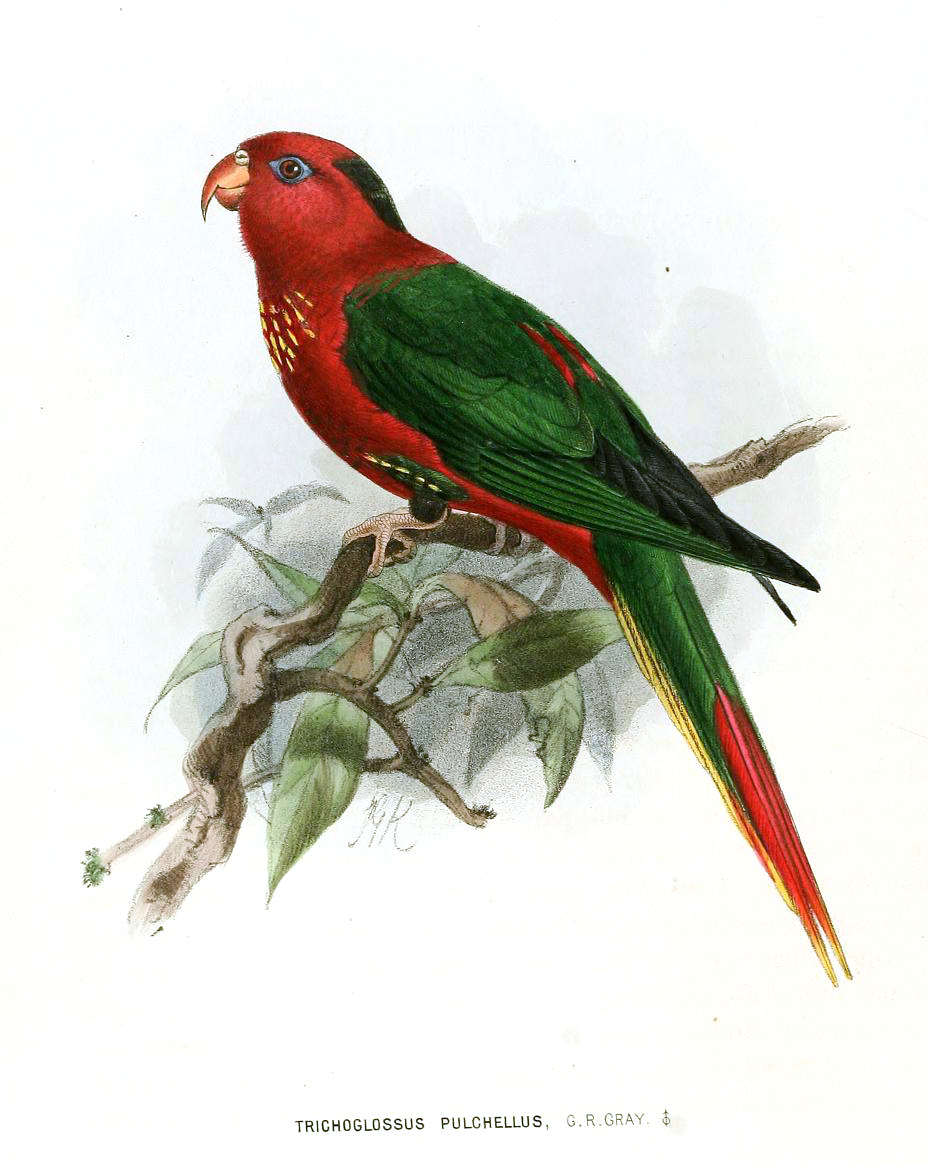
The Duchess Lorikeet is a small, vividly colored parrot with a prominent red and green plumage. Adult birds showcase a brilliant red head and chest, with contrasting green wings and back, making them quite conspicuous among the forest canopy. The tail is predominantly green with yellow undertones, and the underwings reveal a striking combination of red and green. Juvenile Duchess Lorikeets, while similar in coloration, tend to have duller plumage than adults, with a less pronounced red on the head and chest. Both males and females appear similar in plumage, making visual sex differentiation challenging without close examination. In flight, the Duchess Lorikeet presents a swift, direct flight pattern, with rapid wing beats typical of lorikeets. When perched, they exhibit an upright posture, often engaging in acrobatic maneuvers as they navigate branches and foliage. Despite their colorful appearance, they can sometimes be confused with the Cardinal Lorikeet (Charmosyna cardinalis), another brightly colored species found in overlapping regions. However, the Duchess Lorikeet can be distinguished by the absence of blue coloration, which is present in the Cardinal Lorikeet.
Having trouble telling birds apart? Upload a photo to our bird identification tool for an instant species match.
Duchess Lorikeet Habitat and Range
Preferred Habitat
Duchess Lorikeets inhabit the tropical, lowland rainforests and montane forests of the Solomon Islands. These birds are typically found at elevations ranging from sea level up to 1,500 meters, favoring areas with dense canopy cover and a rich diversity of flowering plants. The lorikeet's habitat preference includes primary forests and undisturbed secondary growth, where they can find abundant floral resources. During certain seasons, their habitat use may shift slightly to include edge habitats where flowering trees are prevalent. In contrast to many parrot species, Duchess Lorikeets seldom venture into urban areas, maintaining a strong preference for native forest ecosystems.
Geographic Range
The range of the Duchess Lorikeet is restricted to the Solomon Islands, an archipelago in the western Pacific Ocean. Within this region, they are distributed across multiple islands, including Guadalcanal, Malaita, and Makira. The species is predominantly resident, with little evidence of long-distance migration. However, they may engage in local movements in response to the availability of flowering resources. Population density tends to be highest in areas with extensive, unfragmented forest cover, where they can exploit a variety of floral species. The isolation of the Solomon Islands has resulted in a high degree of endemism, with the Duchess Lorikeet serving as a prime example of the unique avian diversity found in this part of Oceania.
Want to know which birds visit your area? Browse our backyard birds by location guides for region-specific species lists.
What Does the Duchess Lorikeet Eat?
The diet of the Duchess Lorikeet is specialized and primarily consists of nectar and pollen from a variety of flowering plants. Key food sources include the blossoms of trees in the Myrtaceae and Proteaceae families, which are prevalent in their native habitat. During periods when floral resources are plentiful, these lorikeets engage in frequent foraging bouts throughout the day, utilizing their brush-tipped tongues to efficiently extract nectar. They may also feed on soft fruits such as figs and berries, supplementing their diet with essential nutrients. Insects and their larvae form a minor part of their diet, providing protein during the breeding season when nutritional demands increase. The Duchess Lorikeet's feeding schedule is dictated by the availability of floral resources, with peak foraging activity occurring during the early morning and late afternoon.
Duchess Lorikeet Behavior and Social Structure
Duchess Lorikeets exhibit social behavior, often forming small, cohesive flocks outside of the breeding season. These groups communicate with a series of high-pitched calls, maintaining contact as they forage and travel between feeding sites. While generally non-territorial, they may become more aggressive during the breeding season, defending nesting sites from intruders. Courtship displays involve vocalizations and synchronized flight patterns, integral to pair bonding. The birds exhibit a high level of curiosity and intelligence, engaging in playful interactions such as hanging upside down from branches. As diurnal creatures, their activity peaks during the early morning and late afternoon, while midday hours are spent resting or preening. In response to predators, such as raptors, Duchess Lorikeets rely on rapid, agile flight to evade capture, often seeking refuge in dense foliage.
Duchess Lorikeet Nesting and Reproduction
Duchess Lorikeets nest in natural cavities found in large trees, often selecting sites high above the ground for added security. The nesting season typically aligns with the peak flowering period, ensuring ample food supply for the raising of young. Nests are lined with soft materials such as wood dust and feathers to cushion the eggs. A typical clutch consists of two to three eggs, which the female incubates for approximately 24 days. During this period, the male plays a vital role in provisioning the female with food. After hatching, both parents participate in feeding the chicks through regurgitation of semi-digested food. The fledging period lasts about seven to eight weeks, after which the young birds gradually gain independence. Duchess Lorikeets may produce one to two broods per year, depending on environmental conditions.
Duchess Lorikeet Sounds and Vocalizations
The Duchess Lorikeet's vocalizations include a series of sharp, high-pitched calls that serve as contact notes within flocks. Their primary song consists of a rapid series of chirps and whistles, delivered in a melodious but somewhat erratic pattern. These vocalizations can carry over considerable distances, facilitating communication in dense forest environments. Alarm calls are more urgent and staccato, often eliciting a coordinated response from nearby flock members. During the dawn chorus, their vocalizations are most pronounced, as they engage in a symphony of calls to establish territory and reaffirm social bonds.
Interesting Facts About the Duchess Lorikeet
- 1The Duchess Lorikeet uses its specialized brush-tipped tongue to extract nectar, a trait unique to the lorikeet family.
- 2Unlike many parrot species, Duchess Lorikeets exhibit little sexual dimorphism, making it difficult to distinguish males from females at a glance.
- 3These lorikeets can be observed engaging in acrobatic feats, such as hanging upside down to access flowers in challenging locations.
- 4The species plays a vital ecological role as a pollinator, aiding in the reproduction of numerous plant species in its native habitat.
- 5Duchess Lorikeets are named after Princess Margaret of Connaught, Duchess of Connaught and Strathearn, reflecting their regal appearance.
- 6These birds are known for their rapid, direct flight, which allows them to quickly navigate the dense canopies of their forest homes.
- 7Despite their vibrant appearance, Duchess Lorikeets can be surprisingly elusive, often blending into the colorful forest foliage.
Duchess Lorikeet Conservation Status
The IUCN currently lists the Duchess Lorikeet as a species of Least Concern, although populations face pressures from habitat loss due to deforestation and land conversion. While the population trend appears stable, ongoing habitat destruction poses a significant risk to their long-term survival. Conservation efforts in the Solomon Islands focus on preserving forested areas and mitigating the impacts of logging and agricultural expansion. Historical data suggests that populations have fluctuated with changes in land use, underscoring the need for continued monitoring and habitat protection.