
Ecuadorian Trogon
Trogon mesurus
Order: Trogoniformes / Family: Trogonidae
Wikimedia Commons
About the Ecuadorian Trogon
The Ecuadorian Trogon, Trogon mesurus, is an enchanting bird native to the western regions of South America, primarily inhabiting the lush forests and woodlands of Ecuador and northern Peru. This species belongs to the family Trogonidae, renowned for their vibrant colors and unique ecological roles within their habitats. Their presence is a testament to the rich biodiversity of these regions, as they play a crucial role in seed dispersal and forest regeneration by feeding on a variety of fruits and insects. The Ecuadorian Trogon thrives in tropical and subtropical forests, often found in the understory and mid-levels of the forest, where its colorful plumage blends harmoniously with the dense foliage. These birds exhibit a remarkable adaptability to their environment, which is vital for their survival, particularly as they face threats from habitat destruction and fragmentation. The Ecuadorian Trogon is not merely an emblem of the avian beauty in South America, but also an indicator of the health of its ecosystem. During the breeding season, which typically occurs during the wet months, these birds become more vocal and active, engaging in elaborate courtship displays and territorial calls. Outside of the breeding season, they are less conspicuous but can still be observed quietly foraging in their preferred habitats. The Ecuadorian Trogon is a non-migratory species, which means that it relies heavily on the conservation of local habitats to maintain its population. In the wild, they are often seen perching quietly, motionless for extended periods, as they watch for passing insects or fruiting trees, emphasizing their patient and deliberate nature. The Ecuadorian Trogon serves as a vital component of the forest ecosystems, and its conservation is critical not only for maintaining avian diversity but also for preserving the intricate web of life that supports these habitats. Their role in seed dispersal helps promote forest regeneration, making them essential for the health and sustainability of their environment. Efforts to protect and restore their natural habitats are crucial to ensuring their continued survival and the overall ecological balance in the regions they inhabit.
The Ecuadorian Trogon belongs to the family Trogonidae, within the order Trogoniformes. These birds typically live average 6-8 years with max recorded up to 10 years.
How to Identify a Ecuadorian Trogon
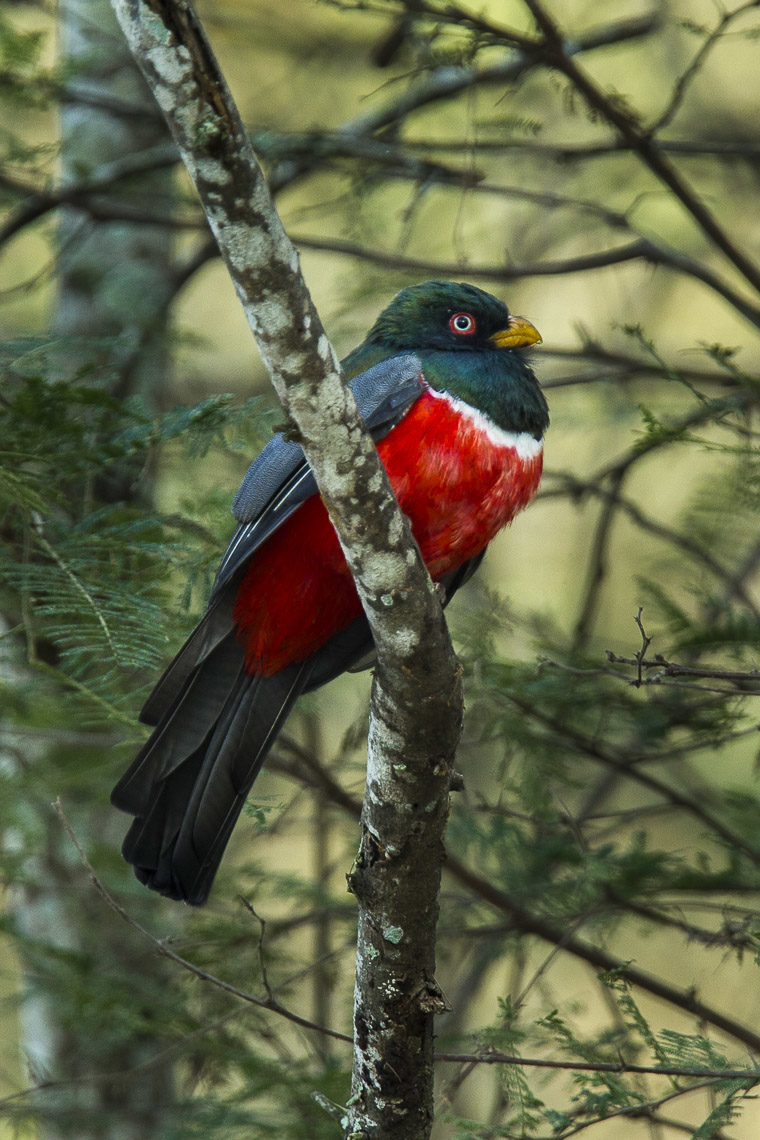
The Ecuadorian Trogon is a medium-sized bird with a length of about 30 cm. Its most striking feature is its vivid green upperparts contrasted by a bright red belly. The male has a more vibrant coloration compared to the female, which tends to have a slightly duller hue. Both sexes share a distinct black face mask and a white undertail with black barring. Juveniles resemble adults but display more muted colors and less defined barring. In flight, the Ecuadorian Trogon exhibits a unique silhouette with broad wings and a long tail, aiding in its identification. When perched, it sits upright, often remaining motionless, making it an ideal target for birdwatchers. Despite these distinctive features, it can sometimes be confused with the similar-looking Gartered Trogon, Trogon caligatus, but the Ecuadorian Trogon lacks the blue breast band present in the latter. Observing the subtle color differences and habitat preferences can aid in proper identification.
Having trouble telling birds apart? Upload a photo to our bird identification tool for an instant species match.
Ecuadorian Trogon Habitat and Range
Preferred Habitat
The Ecuadorian Trogon primarily inhabits tropical and subtropical forests, thriving in the dense foliage of the Chocó-Darién moist forests and the Tumbes-Piura dry forests of Ecuador. These habitats provide ample food resources and nesting sites. Typically found at elevations ranging from sea level to 1,500 meters, they prefer undisturbed forest areas but can occasionally adapt to secondary growth forests. Unlike some other bird species, the Ecuadorian Trogon does not frequent urban areas, relying heavily on the preservation of its natural forested habitats. During the wet season, they may ascend slightly in elevation as food resources become more abundant.
Geographic Range
The Ecuadorian Trogon's range is primarily confined to the western parts of South America, with a stronghold in Ecuador and extending into northern Peru. It occupies a relatively narrow corridor along the Pacific slope, where it is considered a resident bird, showing no significant migratory patterns. Within its range, population densities are higher in protected areas like the Machalilla National Park in Ecuador, where conservation efforts have helped maintain suitable habitats. Although not widespread, the Ecuadorian Trogon is typically found in areas with dense forest cover, avoiding open landscapes and heavily disturbed areas.
Want to know which birds visit your area? Browse our backyard birds by location guides for region-specific species lists.
What Does the Ecuadorian Trogon Eat?
The diet of the Ecuadorian Trogon consists primarily of fruits and insects, reflecting its role as both a frugivore and insectivore. It favors small fruits and berries, which it plucks skillfully from branches while perched. Insects such as beetles and caterpillars also form an essential part of its diet, providing much-needed protein, especially during the breeding season. The Ecuadorian Trogon employs a sit-and-wait strategy, remaining motionless until prey comes into view, then executing a swift sally to capture it. This method conserves energy while maximizing feeding efficiency. Seasonal variations in food availability may influence the proportion of fruit to insects in their diet, with a tendency to consume more fruits during periods of abundance.
Ecuadorian Trogon Behavior and Social Structure
The Ecuadorian Trogon exhibits a solitary or loosely paired social structure, particularly during the breeding season. Males engage in vocal duets with potential mates, a behavior that strengthens pair bonds and establishes territory boundaries. While not particularly aggressive, they may defend their territory from intruders through vocalizations and displays. Courtship involves the male performing aerial displays and offering food to the female as part of the mate-selection process. The Ecuadorian Trogon’s daily activities are primarily diurnal, with peak foraging occurring during the early morning and late afternoon. They exhibit a calm demeanor, often perching quietly for long periods, which aids in predator avoidance. When faced with threats, they rely on their cryptic plumage to blend into the foliage, reducing detection by predators.
Ecuadorian Trogon Nesting and Reproduction
Ecuadorian Trogons nest in tree cavities, often using abandoned woodpecker holes or natural cavities in decaying trees. They prefer nesting sites located 2 to 10 meters above the ground, providing safety from ground-based predators. The nesting cavity is typically lined with minimal material, such as leaves or bark. A typical clutch consists of 2 to 3 eggs, with both parents sharing incubation duties, which last about 17 to 19 days. After hatching, both male and female participate in feeding and caring for the chicks. The fledging period lasts approximately 25 to 30 days, after which the young continue to depend on the parents for food and protection for a few weeks. The Ecuadorian Trogon generally raises one brood per year, timed to coincide with peak food availability.
Ecuadorian Trogon Sounds and Vocalizations
The Ecuadorian Trogon's primary song is a series of soft, melodious whistles, often described as a rhythmic and plaintive 'whee-oo whee-oo.' These calls serve as both territorial signals and mating calls. The bird also produces a variety of call notes, including short, sharp 'chip' sounds used in communication between mates or to alert of potential threats. While not known for a loud dawn chorus, the Ecuadorian Trogon is more vocally active during the early morning hours, when acoustic conditions are most favorable for sound transmission. These vocalizations play a crucial role in maintaining social bonds and coordinating activities within pairs.
Interesting Facts About the Ecuadorian Trogon
- 1Despite their vibrant colors, Ecuadorian Trogons are masters of camouflage, blending seamlessly into leafy backgrounds.
- 2Unlike many birds, Ecuadorian Trogons do not build nests but rely on existing tree cavities for breeding.
- 3The Ecuadorian Trogon's diet includes a significant amount of fruit, contributing to forest seed dispersal.
- 4During courtship displays, male Ecuadorian Trogons perform aerial acrobatics to attract females.
- 5Ecuadorian Trogons can remain motionless for long periods, a behavior that helps them avoid predators.
- 6The species is a non-migratory resident, underscoring the importance of local habitat conservation.
- 7Ecuadorian Trogons have a unique feeding strategy, making swift flights from a perch to capture prey.
Ecuadorian Trogon Conservation Status
The Ecuadorian Trogon is currently listed as Least Concern by the IUCN, though its population trend is considered stable with localized threats. Habitat loss due to deforestation for agriculture and logging remains the primary threat to its survival. Conservation efforts focus on habitat preservation and restoration, particularly in protected areas and national parks where the species is most commonly found. Historical data indicate a decline in some areas with significant human encroachment, but efforts to curb deforestation and promote sustainable land use offer hope for its continued survival.


