
Fan-tailed Berrypecker
Melanocharis versteri
Order: Passeriformes / Family: Melanocharitidae
Wikimedia Commons
About the Fan-tailed Berrypecker
The Fan-tailed Berrypecker, scientifically known as Melanocharis versteri, is a small passerine bird endemic to the mountain forests of New Guinea. This species thrives in dense montane rainforests, where its striking plumage and fan-shaped tail make it a distinct presence among the dense foliage. The Fan-tailed Berrypecker plays a vital role in its ecosystem as both a consumer of fruits and a disperser of seeds, contributing to the health and regeneration of its forest habitats. Found predominantly in elevations ranging from 1,000 to 2,600 meters, this species exhibits a preference for the humid and lush environments provided by the island's mountainous regions. The ecological significance of the Fan-tailed Berrypecker extends beyond its role in seed dispersal. It serves as an indicator species for the health of montane rainforest ecosystems, as its presence correlates with areas of rich biodiversity and minimal human disturbance. Seasonally, the Fan-tailed Berrypecker displays subtle changes in its behavior, adjusting its foraging strategies and elevational range in response to the availability of fruiting plants. During wetter months, it may descend to lower elevations to exploit seasonal fruit abundance, while in the drier periods, it remains at higher altitudes where moisture levels sustain a consistent food supply. The Fan-tailed Berrypecker's adaptability to seasonal shifts in resource availability highlights its resilience and its critical ecological role within New Guinea's montane environments.
The Fan-tailed Berrypecker belongs to the family Melanocharitidae, within the order Passeriformes. These birds typically live average 5-7 years, with a maximum recorded of 10 years..
How to Identify a Fan-tailed Berrypecker
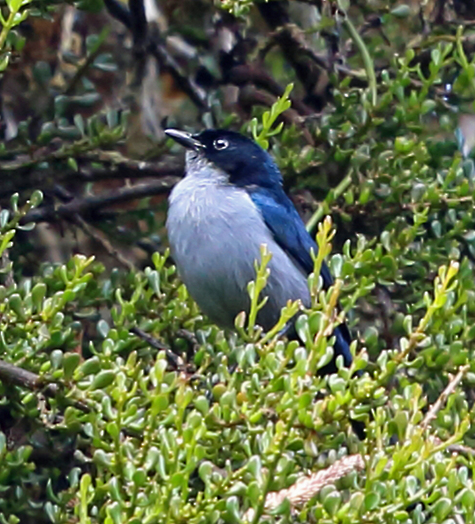
Adult Fan-tailed Berrypeckers are medium-sized songbirds, notable for their vibrant plumage. Males and females exhibit similar coloration, with males displaying slightly more intense hues. The upperparts are primarily olive-green, contrasting with a bright yellow underbelly. A distinctive black mask extends from the base of the bill through the eyes, which is a key feature for identification. Juveniles resemble adults but have duller plumage, lacking the full vibrancy of mature birds. The characteristic fan-shaped tail, from which the species derives its name, aids in identification, particularly in flight. This tail flares open and closes as the bird maneuvers through the forest canopy. The Fan-tailed Berrypecker's flight silhouette is compact, with a slightly rounded tail and rapid wingbeats. When perched, it adopts an upright posture, allowing for unobstructed views of its striking underbelly. While similar in size to the Black Berrypecker, Melanocharis versteri can be distinguished by its coloration and tail structure. Confusion with other berrypecker species is minimized by these distinctive traits.
Having trouble telling birds apart? Upload a photo to our bird identification tool for an instant species match.
Fan-tailed Berrypecker Habitat and Range
Preferred Habitat
The Fan-tailed Berrypecker resides primarily in the montane rainforests of New Guinea, favoring elevations between 1,000 and 2,600 meters. These habitats are characterized by dense vegetation, high humidity, and a diverse array of fruit-bearing plants. The species shows a preference for areas with abundant mid-story and canopy coverage, which provide both foraging opportunities and protection from predators. While primarily a forest-dweller, the Fan-tailed Berrypecker occasionally ventures into adjacent secondary growth and forest edges, particularly when searching for food. Unlike some other species, it is not commonly found in urbanized areas, as it relies heavily on intact forest ecosystems.
Geographic Range
The Fan-tailed Berrypecker is endemic to the island of New Guinea, with its range encompassing both Papua New Guinea and the Indonesian province of Papua. It is predominantly found in the central and eastern mountain ranges, where the montane forests offer suitable habitat. While the species does not engage in long-distance migration, it may exhibit altitudinal movements in response to seasonal changes in food availability. Population densities tend to be higher in areas with less human disturbance, underscoring the bird's reliance on pristine forest environments for survival.
Want to know which birds visit your area? Browse our backyard birds by location guides for region-specific species lists.
What Does the Fan-tailed Berrypecker Eat?
The Fan-tailed Berrypecker primarily feeds on a diet of small fruits and berries, which it gleans from the forest canopy and mid-story. During periods of fruit abundance, it may become more selective, targeting specific plant species known for their nutritional value. In addition to fruits, the bird occasionally consumes insects, especially during the breeding season when protein requirements increase. Foraging behavior involves agile maneuvers among the branches, using its fan-shaped tail for balance. The Fan-tailed Berrypecker typically feeds during the cooler morning and late afternoon hours, when fruit-eating competition is reduced and temperatures are more favorable.
Fan-tailed Berrypecker Behavior and Social Structure
The Fan-tailed Berrypecker exhibits a social structure that is primarily solitary or in pairs, though small family groups are occasionally observed. Territorial behavior is evident, particularly during the breeding season when pairs defend rich foraging areas from competitors. Courtship displays involve both visual and vocal elements, with males showcasing their plumage and engaging in complex song patterns to attract mates. While not typically forming large flocks, the species may participate in mixed-species feeding groups, benefiting from the collective vigilance against predators. Daily activity patterns reveal peaks in morning and late afternoon, aligning with optimal foraging conditions.
Fan-tailed Berrypecker Nesting and Reproduction
Nesting for the Fan-tailed Berrypecker involves the construction of a delicate cup-shaped nest, typically situated in the fork of a tree branch. Preferred nesting materials include moss, fine twigs, and spider silk, providing a secure and camouflaged structure. Nests are usually located at heights ranging from 5 to 20 meters above the ground, offering protection from ground-based predators. The typical clutch consists of two to three eggs, with an incubation period of approximately two weeks. Both parents participate in feeding and caring for the chicks, which fledge about three weeks after hatching. The species generally raises one to two broods per year, depending on environmental conditions.
Fan-tailed Berrypecker Sounds and Vocalizations
The primary song of the Fan-tailed Berrypecker is a series of melodious, flute-like notes, delivered in a rhythmic pattern. This song, often described as sweet and clear, serves both to establish territory and attract mates. In addition to its song, the bird emits a variety of call notes, including sharp, staccato chips used for communication between mates and as alarm signals. During the dawn chorus, its vocalizations contribute to the vibrant acoustic landscape of the montane forests, with a volume comparable to other songbirds of similar size.
Interesting Facts About the Fan-tailed Berrypecker
- 1The Fan-tailed Berrypecker's tail can fan out to nearly double its resting width, aiding in maneuverability through dense foliage.
- 2Despite being a fruit specialist, the Fan-tailed Berrypecker can consume up to 10% of its diet as insects during the breeding season.
- 3The Fan-tailed Berrypecker's song, described as flute-like, can be heard over 100 meters away in dense forest environments.
- 4This species is one of the few berrypeckers known to participate in mixed-species feeding flocks, enhancing its foraging success.
- 5The Fan-tailed Berrypecker's vibrant plumage aids in camouflage among the brightly colored fruits and foliage of its rainforest habitat.
- 6The bird's presence serves as an indicator of healthy montane forest ecosystems, reflecting high biodiversity and minimal disturbance.
- 7Fan-tailed Berrypeckers have an average lifespan of 5 to 7 years in the wild, typical for small passerine birds.
Fan-tailed Berrypecker Conservation Status
The Fan-tailed Berrypecker is currently classified as Least Concern by the IUCN, though its population is believed to be in slow decline due to habitat loss and fragmentation. Primary threats include logging, agricultural expansion, and infrastructure development, which encroach on its montane forest habitats. Conservation efforts focus on protecting large tracts of forest and promoting sustainable land use practices within its range. Historical population data indicate that while the species was once more widespread, increasing human activity has led to localized declines, emphasizing the need for continued conservation attention.
Other Melanocharitidae Species


Birds Similar to the Fan-tailed Berrypecker
These species are often confused with the Fan-tailed Berrypecker due to similar appearance or overlapping range.

