
Forest Owlet
Heteroglaux blewitti
Order: Strigiformes / Family: Strigidae
Wikimedia Commons
About the Forest Owlet
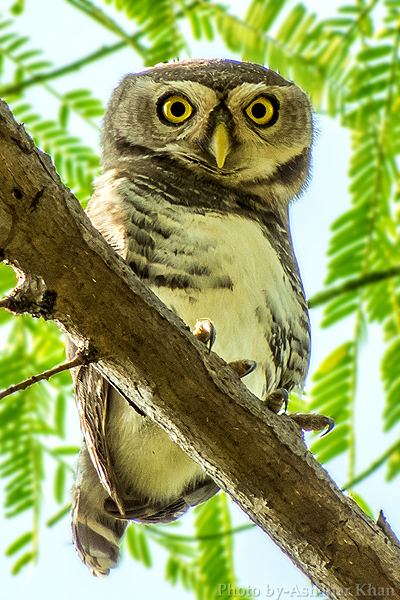
The Forest Owlet (Heteroglaux blewitti) is a critically endangered species endemic to the central Indian forests. Known for its rarity and the decades it remained unseen, the Forest Owlet has captured the interest of ornithologists and conservationists alike. This small owl, measuring about 23 cm in length, exhibits a robust build with a notable rounded head and absence of ear tufts, setting it apart from many of its Strigidae family relatives. Its plumage features a brown and white mottled pattern that provides effective camouflage against the dappled forest light.
Historically, the Forest Owlet was believed extinct until its dramatic rediscovery in 1997 in the Satpura Range of Madhya Pradesh. This event underscored the bird's significance in highlighting biodiversity within India's deciduous forests. The owlet primarily inhabits teak and mixed-deciduous forests, where it plays a crucial ecological role as both predator and prey. By controlling rodent and insect populations, the Forest Owlet helps maintain the delicate balance of its habitat's ecosystem.
The ecological role of the Forest Owlet extends to its interactions with other forest species. As a mid-level predator, it preys on a range of small vertebrates and invertebrates, thus influencing prey population dynamics. Its presence also serves as an indicator of forest health, as it requires large, contiguous tracts of forest to thrive. Observations suggest that the Forest Owlet may exhibit some seasonal behavioral variations, potentially shifting its range slightly within the forest to exploit different prey availability. This adaptability underscores its resilience despite the ongoing threats to its habitat.
Conservation efforts for the Forest Owlet are critical, given its limited and fragmented distribution. The bird's significance extends beyond its rarity, serving as a flagship species for the conservation of the central Indian forests. Protecting its habitat not only ensures the survival of the Forest Owlet but also supports the broader ecological community that shares its environment.
The Forest Owlet belongs to the family Strigidae, within the order Strigiformes. These birds typically live estimated 10-15 years in the wild..
How to Identify a Forest Owlet
Identifying the Forest Owlet requires careful observation due to its elusive nature and excellent camouflage. Adults possess a distinctive rounded head lacking ear tufts, a feature that separates it from many other owls. The facial disc is prominent, aiding in sound localization, and is bordered by dark brown feathers. The plumage is primarily brown with white spots and streaks, providing excellent camouflage against the forest backdrop.
Juvenile Forest Owlets bear a resemblance to adults but are slightly duller in coloration and may exhibit more pronounced streaking on the underparts. Both sexes appear similar, although females are marginally larger. The bird's eyes are strikingly yellow, contrasting with its darker plumage and adding to its piercing gaze that is characteristic of many owl species.
In flight, the Forest Owlet displays broad, rounded wings and a short tail, allowing for agile maneuvering through dense forest canopies. When perched, it frequently adopts an upright posture, showing off its barred underparts and giving it a somewhat stocky appearance. Its call, a repetitive hoot, can be an effective tool for identification during field studies, especially in the twilight hours when the bird is most active.
Having trouble telling birds apart? Upload a photo to our bird identification tool for an instant species match.
Forest Owlet Habitat and Range
Preferred Habitat
The Forest Owlet predominantly inhabits the deciduous forests of central India, with a strong preference for teak and mixed-deciduous forest types. These habitats provide the necessary cover and prey base for survival. The owlet is predominantly found at elevations ranging from 200 to 600 meters, where the complex forest structure supports its predatory lifestyle.
Seasonally, the Forest Owlet may exhibit minor habitat shifts within its range to exploit varying prey abundances. These shifts typically occur within the same forest complex, ensuring that the bird remains within its optimal habitat type. Unlike some other owl species, the Forest Owlet shows little affinity for urban areas, preferring the undisturbed tranquility of rural forest settings. The presence of large, old-growth trees is particularly crucial for the owlet, as these provide suitable nesting sites and roosting cover.
Geographic Range
The Forest Owlet's range is restricted to central India, specifically within the states of Maharashtra, Madhya Pradesh, and Gujarat. Its known population is limited to a few isolated patches of deciduous forest within these regions, making it one of the most geographically constrained owl species globally.
Breeding occurs within these core areas, with no evidence of long-distance migration. However, local movements within its range may occur, possibly in response to prey availability or environmental conditions. Population density hotspots for the Forest Owlet coincide with regions of well-preserved forest, notably the Melghat Tiger Reserve in Maharashtra and the Toranmal Reserve Forest in Madhya Pradesh. Despite being non-migratory, the owlet's restricted and fragmented range makes it particularly vulnerable to habitat loss and environmental changes.
Want to know which birds visit your area? Browse our backyard birds by location guides for region-specific species lists.
What Does the Forest Owlet Eat?
The Forest Owlet's diet primarily consists of small mammals, birds, and insects, reflecting its role as a mid-level predator. Rodents form a significant portion of its diet, with the owlet employing a sit-and-wait strategy from a perch before swooping down to capture its prey. Insects, particularly orthopterans, are also frequent prey items, especially during the monsoon season when they are abundant.
The owlet's foraging behavior is largely crepuscular, with peak hunting activity occurring during dawn and dusk. This behavior maximizes its hunting efficiency, taking advantage of both nocturnal and diurnal prey. Occasionally, the Forest Owlet may hunt during daylight hours, particularly in cloudy or overcast conditions when light levels are lower. The size of prey typically ranges from small insects to birds and rodents up to 10 cm in length, showcasing the owlet's versatility and adaptability in its feeding habits.
Forest Owlet Behavior and Social Structure
The Forest Owlet exhibits solitary behavior, with individuals or pairs often maintaining defined territories within the forest. Territorial disputes occur occasionally, marked by vocal displays and physical posturing. These interactions are more common during the breeding season when competition for mates and nesting sites intensifies.
Courtship displays involve vocal duets and mutual preening, reinforcing pair bonds established in prior seasons. The species is generally monogamous, with pairs often remaining together throughout the year. Defensive behavior against predators includes mobbing and alarm calls, particularly if a nesting site is threatened.
Daily activity patterns show a preference for crepuscular hunting, although the owlet can occasionally be active during the day. During these times, it exhibits a heightened vigilance, often perching in dense foliage to avoid detection by potential predators or rival owls. Despite its solitary nature, the Forest Owlet's vocalizations play a crucial role in maintaining communication across its territory.
Forest Owlet Nesting and Reproduction
The Forest Owlet nests in natural tree cavities, typically within large, mature trees that provide adequate protection from predators and harsh weather. Nest sites are usually chosen based on their proximity to reliable food sources and their relative inaccessibility to ground predators.
A typical clutch consists of 2 to 3 eggs, with incubation lasting approximately 30 days. Both parents participate in incubation, although the female takes on the majority of this duty, while the male primarily focuses on foraging and providing food. After hatching, the chicks remain in the nest for about 4 to 5 weeks before fledging.
Parental care extends beyond fledging, with both adults continuing to feed and protect the young until they are fully independent. The Forest Owlet typically produces one brood per year, although re-nesting may occur if the initial attempt fails due to predation or environmental factors.
Forest Owlet Sounds and Vocalizations
The Forest Owlet's primary vocalization consists of a series of deep, resonant hoots that carry well through the forest. These calls are often repeated in rapid succession, serving both as territorial markers and communication between mates.
In addition to these hoots, the owlet produces a range of call notes, including softer coos and sharp, alarmed screeches when threatened. Dawn choruses often feature an increase in vocal activity, with owlets exchanging calls as they establish their presence in the early light.
The owlet's alarm calls are particularly distinctive, characterized by a rising pitch and urgent quality that can alert other forest inhabitants to potential dangers. These vocalizations play a crucial role in its communication and territorial defense strategies.
Interesting Facts About the Forest Owlet
- 1The Forest Owlet was presumed extinct for over a century before its rediscovery in 1997.
- 2It is one of the few owl species exhibiting a stark sexual size dimorphism, with females larger than males.
- 3The Forest Owlet's rediscovery was akin to 'finding a living dinosaur,' according to some ornithologists.
- 4It primarily inhabits the Satpura Range, one of the oldest mountain ranges in India.
- 5The Forest Owlet's eyes are specialized for low-light conditions, aiding its crepuscular hunting habits.
- 6Historical records of the Forest Owlet date back to 1872, but it was rarely seen again until the late 20th century.
- 7The forest habitat of the owlet supports over 200 bird species, highlighting its rich biodiversity.
Forest Owlet Conservation Status
The IUCN classifies the Forest Owlet as Critically Endangered due to its extremely limited range and small population size. Estimates suggest fewer than 250 mature individuals remain, making its conservation a priority. Primary threats include habitat loss due to deforestation and agricultural expansion, as well as habitat fragmentation that isolates populations. Conservation efforts focus on habitat protection and restoration, including the establishment of protected areas and community-based forest management initiatives. Historical records indicate a significant population decline over the past century, driven by human encroachment and changing land-use practices. Continued efforts to monitor populations, coupled with public awareness campaigns, are essential to secure the future of the Forest Owlet.


