
Fork-tailed Storm-Petrel
Oceanodroma furcata
Order: Procellariiformes / Family: Hydrobatidae

Wikimedia Commons
About the Fork-tailed Storm-Petrel
The Fork-tailed Storm-Petrel (Oceanodroma furcata) is a small seabird belonging to the family Hydrobatidae, which is notable for its unique adaptation to life on the open ocean. This species is particularly significant due to its ability to thrive in harsh marine environments, often far from land. It serves as an indicator of oceanic health, as its presence and population trends can reflect changes in marine ecosystems. Fork-tailed Storm-Petrels are predominantly found in the North Pacific, ranging from the Aleutian Islands in Alaska down to the coastlines of California and across to the Kamchatka Peninsula in Russia. During the breeding season, these birds are closely associated with island habitats where they nest in colonies, often utilizing rocky crevices or burrows. Seasonal behaviors are fascinating as these storm-petrels migrate over vast ocean distances outside the breeding season, displaying remarkable navigational skills. Their ecological role includes controlling marine invertebrate populations, as they primarily feed on plankton, small fish, and crustaceans. The Fork-tailed Storm-Petrel's foraging activities contribute to the nutrient cycling in marine ecosystems, as they often feed on the surface of the water, bringing nutrients back to their nesting areas. In winter, the species disperses over the open ocean, making it less visible to observers, but it remains an integral part of the marine food web. Understanding the biology and ecology of the Fork-tailed Storm-Petrel provides insights into the broader dynamics of oceanic environments, highlighting the interconnectedness of species within this vast habitat.
The Fork-tailed Storm-Petrel belongs to the family Hydrobatidae, within the order Procellariiformes. These birds typically live average lifespan of 15 years with a maximum recorded of over 20 years..
How to Identify a Fork-tailed Storm-Petrel
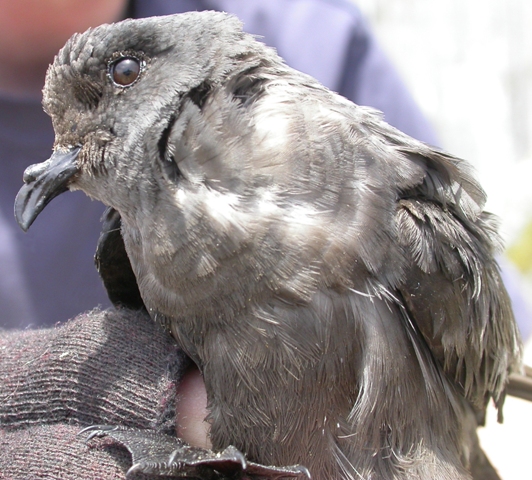
The Fork-tailed Storm-Petrel is notable for its small size, measuring about 20 cm in length with a wingspan of approximately 46 cm. Its plumage is predominantly a pale gray, contrasting with its darker underwing coverts. The bird's tail is distinctly forked, a key feature that sets it apart from other storm-petrels. Juveniles resemble adults but may exhibit slightly darker plumage. There is little sexual dimorphism, so males and females appear similar in the field. In flight, the Fork-tailed Storm-Petrel has a buoyant, fluttering flight pattern, often appearing moth-like as it skims the ocean surface. This flight silhouette, combined with the forked tail and pale coloration, aids in its identification. When perched, typically on nesting grounds or when at rest on the water, the storm-petrel maintains an upright posture. Comparing to similar species, the Leach's Storm-Petrel has a more deeply forked tail and darker plumage, which can help in differentiating it from the Fork-tailed Storm-Petrel.
Having trouble telling birds apart? Upload a photo to our bird identification tool for an instant species match.
Fork-tailed Storm-Petrel Habitat and Range
Preferred Habitat
The Fork-tailed Storm-Petrel inhabits pelagic zones of the North Pacific Ocean, often found far from land except during the breeding season. They favor island habitats for nesting, such as those found in Alaska and the Aleutian Islands. These seabirds nest at elevations ranging from sea level to cliffs high above the ocean, depending on island topography. During the non-breeding season, Fork-tailed Storm-Petrels are less frequently seen near coastlines and are more commonly dispersed across open ocean waters. They do not typically venture into urban areas, as their lifestyle is tightly linked to marine environments. The species exhibits seasonal habitat shifts, moving from breeding islands to expansive oceanic waters as the seasons change.
Geographic Range
The Fork-tailed Storm-Petrel breeds along the coastlines and islands of the North Pacific. Key breeding locations include the Aleutian Islands, Gulf of Alaska, and parts of British Columbia. During the non-breeding season, these seabirds disperse across the North Pacific Ocean, extending their range as far south as California and over to the waters off Japan and Russia. Migration corridors are primarily oceanic, bypassing landmasses and highlighting the species' adaptation to marine life. Population density hotspots are concentrated around breeding colonies, where the birds are most observable during the nesting period. Their extensive range across international waters underscores their resilience and adaptability to different marine conditions.
Want to know which birds visit your area? Browse our backyard birds by location guides for region-specific species lists.
What Does the Fork-tailed Storm-Petrel Eat?
The Fork-tailed Storm-Petrel's diet primarily consists of planktonic crustaceans, small fish, and various marine invertebrates. Seasonal diet variations occur depending on prey availability, with storm-petrels often following ocean currents to access rich feeding grounds. Foraging techniques include surface seizing, where the bird skims the water's surface to snatch prey. Prey size typically ranges from minute plankton to small fish up to a few centimeters long. The feeding schedule of these birds is largely influenced by prey activity, often coinciding with dawn and dusk when marine organisms are more accessible at the water's surface.
Fork-tailed Storm-Petrel Behavior and Social Structure
Fork-tailed Storm-Petrels exhibit a social structure centered around colonial nesting sites. They are not strongly territorial, but they exhibit site fidelity, returning to the same nesting areas year after year. Courtship displays involve aerial acrobatics and vocalizations, strengthening pair bonds. Flocking patterns are evident during migration and at sea, where groups of storm-petrels can be observed feeding together. In response to predators, Fork-tailed Storm-Petrels rely on their agile flight and cryptic nesting sites to avoid detection. Daily activities include extensive foraging flights over the ocean, with activity peaks during early morning and late afternoon. At sea, they show a preference for feeding in areas with upwelling currents that concentrate prey.
Fork-tailed Storm-Petrel Nesting and Reproduction
The nesting habits of the Fork-tailed Storm-Petrel are adapted to the rugged island environments they inhabit. Nests are typically placed in rock crevices, burrows, or sometimes under dense vegetation. Nest materials are minimal, often consisting of whatever natural detritus is available. Clutch size is usually one egg per season, reflecting the energy investment required in such isolated environments. Incubation lasts about 50 days, with both parents sharing duties. After hatching, the chick receives parental care and feeding until it fledges at approximately 60 days old. Typically, only one brood is raised per year due to the demanding nature of their breeding environment.
Fork-tailed Storm-Petrel Sounds and Vocalizations
The Fork-tailed Storm-Petrel's vocalizations are characterized by a series of soft, chattering calls, often described as a 'purr' or 'chirrup.' These calls serve as communication between mates and within the colony. During courtship, males may emit a more complex series of calls to attract females. Alarm calls are sharper and more abrupt, used primarily to signal danger. Unlike songbirds, the Fork-tailed Storm-Petrel does not participate in a dawn chorus, as its vocalizations are more functional than melodic.
Interesting Facts About the Fork-tailed Storm-Petrel
- 1Fork-tailed Storm-Petrels can drink seawater, using specialized glands to excrete excess salt, a remarkable adaptation to their pelagic lifestyle.
- 2These storm-petrels are one of the few bird species that can smell their food, using their developed olfactory senses to locate prey over vast ocean distances.
- 3The Fork-tailed Storm-Petrel's flight is adapted to windy conditions, allowing them to glide effortlessly over rough seas with minimal energy expenditure.
- 4During the non-breeding season, Fork-tailed Storm-Petrels may travel thousands of kilometers, showcasing their impressive long-distance migratory abilities.
- 5Despite their small size, Fork-tailed Storm-Petrels can live for over 20 years in the wild, a testament to their resilience in challenging environments.
- 6These birds play a crucial role in transferring nutrients from the ocean to island ecosystems, supporting plant growth and other wildlife.
- 7Fork-tailed Storm-Petrels are known to visit their breeding colonies at night, reducing the risk of predation from diurnal avian predators.
Fork-tailed Storm-Petrel Conservation Status
The Fork-tailed Storm-Petrel is currently listed as Least Concern by the IUCN, with a stable population trend. However, primary threats include oil spills, plastic pollution, and climate change, which affect sea surface temperatures and prey availability. Conservation efforts focus on protecting breeding habitats and mitigating human impacts on marine ecosystems. Historically, populations have fluctuated with changes in oceanic conditions, highlighting the importance of ongoing monitoring and conservation initiatives to ensure the species' continued survival.
Other Hydrobatidae Species



Birds Similar to the Fork-tailed Storm-Petrel
These species are often confused with the Fork-tailed Storm-Petrel due to similar appearance or overlapping range.
