
Glaucous-blue Grosbeak
Cyanoloxia glaucocaerulea
Order: Passeriformes / Family: Cardinalidae
Wikimedia Commons
About the Glaucous-blue Grosbeak
The Glaucous-blue Grosbeak, scientifically known as Cyanoloxia glaucocaerulea, is a captivating member of the Cardinalidae family. This medium-sized songbird inhabits the subtropical and tropical regions of South America, particularly in countries such as Argentina, Brazil, and Paraguay. Its presence is notable in the Atlantic Forest, a biodiversity hotspot that extends along the Atlantic coast of Brazil into eastern Paraguay and northeastern Argentina. This forest provides a lush habitat for the bird, characterized by dense foliage and a rich diversity of flora and fauna. The grosbeak plays a crucial role in the ecosystem as both a seed disperser and insect predator, helping maintain the ecological balance of its habitat.
The Glaucous-blue Grosbeak is particularly significant due to its striking coloration and melodic song, which contribute to the auditory and visual tapestry of the forests it inhabits. It is a solitary bird but can occasionally be seen in small groups, especially during the breeding season. This grosbeak is known for its adaptability to various environments within its range, including forest edges and secondary growth areas. During the breeding season, which typically occurs from September to December, the bird's melodious songs become more pronounced as males establish territories and attract mates.
In terms of ecological roles, the Glaucous-blue Grosbeak serves as a vital link in the food web. Its diet consists of seeds, fruits, and insects, making it an important seed disperser and pest controller. By consuming and excreting seeds, the grosbeak aids in plant reproduction and forest regeneration. Furthermore, its insectivorous habits help control potential insect outbreaks, benefitting both the natural landscape and human agricultural activities nearby. The grosbeak's ability to thrive in varying habitats underscores its resilience and adaptability in a changing world.
The Glaucous-blue Grosbeak belongs to the family Cardinalidae, within the order Passeriformes. These birds typically live average 5 years, with a maximum recorded of 10 years..
How to Identify a Glaucous-blue Grosbeak
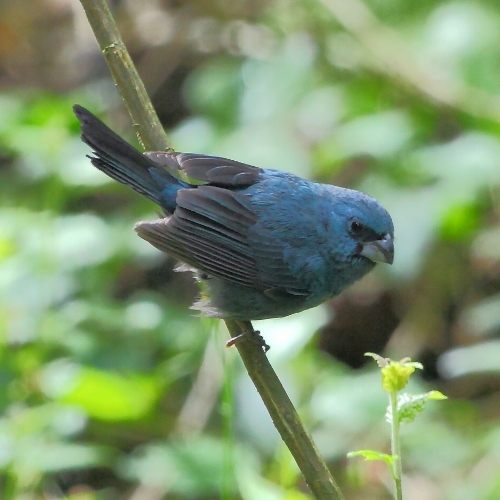
The Glaucous-blue Grosbeak is distinguished by its vivid blue plumage, which is most prominent in adult males. The male's feathers display a rich, deep blue that can appear almost luminous in the right lighting, with the brightest hues concentrated on the head and upper body. The wings and tail are slightly darker, providing a subtle contrast. Females, in contrast, exhibit a more muted coloration, with their plumage tending towards a brownish-gray, tinged with blue on the wings and tail. Juveniles resemble females but with duller shades and less distinct markings.
This species can be confused with other blue-toned birds in its range, such as the Blue-black Grosbeak, but can be distinguished by its larger size and the absence of black in its plumage. The Glaucous-blue Grosbeak's size, typically around 16-18 cm in length, coupled with its robust build and conical bill, are key identification points.
In flight, the grosbeak's broad wings and slightly rounded tail are noticeable, while its deliberate and strong wingbeats give it a distinctive silhouette. When perched, it often adopts an upright posture, showcasing its striking blue plumage while remaining vigilant for potential predators or opportunities for foraging.
Having trouble telling birds apart? Upload a photo to our bird identification tool for an instant species match.
Glaucous-blue Grosbeak Habitat and Range
Preferred Habitat
The Glaucous-blue Grosbeak predominantly inhabits subtropical and tropical moist lowland forests. Within these ecosystems, it prefers areas with dense undergrowth and abundant food sources. It is commonly found in the Atlantic Forest, especially in regions with a mix of primary and secondary growth. This bird is adaptable, also inhabiting forest edges, clearings, and even plantations where its preferred seeds and fruits are available.
While primarily a forest dweller, the grosbeak occasionally ventures into more open areas during certain seasons, particularly when food scarcity in its primary habitat forces it to explore new territories. Elevation-wise, it is typically found at altitudes ranging from sea level to about 1,000 meters, although it may ascend higher in mountainous regions during breeding periods.
Despite its preference for rural and semi-natural environments, the Glaucous-blue Grosbeak sometimes appears in urban parks and gardens, especially those that mimic its natural habitat with dense plantings and minimal human disturbance.
Geographic Range
The Glaucous-blue Grosbeak is native to South America, with its range predominantly covering the southeastern parts of the continent. It breeds across a wide area that includes eastern Paraguay, southern Brazil, and northern Argentina. The species is notably present in the Atlantic Forest, a crucial biodiversity hotspot that stretches along the eastern coast of Brazil and dips into neighboring countries.
During the breeding season, the grosbeak remains in these areas, relying on the dense forest cover and abundant food supply. There is limited information on its migratory behavior, but it is generally considered a resident bird with only local movements in search of food or suitable nesting sites.
Population density tends to be higher in regions where the forest remains relatively intact, although fragmented habitats also support populations of this adaptable grosbeak. Its presence has been recorded in conservation areas where habitat protection efforts aid in maintaining stable population levels.
Want to know which birds visit your area? Browse our backyard birds by location guides for region-specific species lists.
What Does the Glaucous-blue Grosbeak Eat?
The diet of the Glaucous-blue Grosbeak primarily consists of seeds and fruits, which it forages for in the dense undergrowth of its forest habitat. It displays a preference for seeds from various native plants, utilizing its strong conical bill to crack open hard shells and extract the nutritious kernels inside. Fruits, particularly those that are soft and easy to digest, form a significant part of its diet, especially during the breeding season when energy demands are high.
In addition to plant-based foods, this grosbeak also consumes insects, which provide essential proteins and nutrients. It actively hunts for beetles, caterpillars, and other small invertebrates, often gleaning them from leaves and branches or capturing them mid-flight. This insectivorous behavior is especially prominent during the breeding season when adults need to meet the dietary requirements of their growing chicks.
The grosbeak's foraging typically occurs during the early morning and late afternoon, periods when activity is high and temperatures are cooler. Its opportunistic feeding strategy allows it to adapt to seasonal variations in food availability, ensuring survival even in fluctuating environmental conditions.
Glaucous-blue Grosbeak Behavior and Social Structure
The Glaucous-blue Grosbeak exhibits a range of behaviors that reflect its adaptability and ecological niche. It is generally solitary or found in pairs, especially during the breeding season, when males become particularly territorial. They establish and defend their territories through a combination of vocal displays and physical posturing. Males sing from elevated perches to assert dominance and attract potential mates.
Courtship in this species involves elaborate displays, including fluttering flights and the presentation of food offerings by males to females. These behaviors strengthen pair bonds and increase the likelihood of successful mating. Outside of the breeding season, the grosbeak may join mixed-species flocks, which offer increased protection from predators and more efficient foraging opportunities.
The grosbeak is active during daylight hours, with peak activity occurring in the early morning and late afternoon. It remains vigilant against predators such as raptors and snakes, utilizing its keen eyesight and strategic positioning within the forest canopy to detect threats early. When alarmed, the grosbeak emits sharp call notes and may take flight to safer locations.
Glaucous-blue Grosbeak Nesting and Reproduction
The Glaucous-blue Grosbeak constructs its nest in dense foliage, often choosing the fork of a tree branch or a shrub as a secure location. The nest is a cup-shaped structure made from twigs, grasses, and leaves, lined with softer materials like feathers and plant down to provide a comfortable environment for the eggs and chicks.
The breeding season runs from September to December, aligned with the Southern Hemisphere's spring and early summer. During this period, the female lays a clutch of 2 to 4 eggs, which she incubates for approximately 12 to 14 days. Both parents participate in feeding the chicks, which fledge after about two to three weeks, though they remain dependent on their parents for food for several more weeks.
The grosbeak typically raises one brood per season, though favorable conditions may allow for a second. Parental roles are shared, with both male and female involved in nest-building, incubation, and chick-rearing, ensuring high survival rates for their offspring.
Glaucous-blue Grosbeak Sounds and Vocalizations
The Glaucous-blue Grosbeak is known for its melodious song, a series of rich, clear whistles that rise and fall in pitch. This primary song serves as both a territorial marker and an attractant for mates. Males sing frequently during the breeding season, often from elevated perches that allow their calls to carry over long distances.
In addition to their song, these grosbeaks produce a variety of call notes. Alarm calls are sharp and staccato, alerting other birds to potential threats. These calls are often used in conjunction with visual displays such as rapid wing flicking or tail fanning. During the dawn chorus, the grosbeak's song blends with those of other forest birds, creating a vibrant soundscape in its habitat.
The grosbeak's vocalizations are an essential component of its social interactions, playing a critical role in territory defense and mate attraction. Birdwatchers often use these distinctive sounds to locate and identify the species in dense woodland settings.
Interesting Facts About the Glaucous-blue Grosbeak
- 1The Glaucous-blue Grosbeak's vibrant blue coloration is not due to pigments but rather the microscopic structure of its feathers that refracts light.
- 2Unlike many bird species, both male and female grosbeaks share the responsibility of nest building, showcasing their cooperative breeding strategy.
- 3The grosbeak's song can carry over 500 meters in dense forest, allowing it to communicate effectively over long distances.
- 4This species can consume seeds that are toxic to many other birds, thanks to its specialized digestive system that neutralizes harmful compounds.
- 5Researchers have recorded grosbeaks forming mixed-species flocks with tanagers and woodcreepers, highlighting their social adaptability.
- 6The Glaucous-blue Grosbeak has a unique foraging technique that involves hanging upside down from branches to access hard-to-reach fruits.
- 7During the breeding season, males engage in aerial displays that can last up to 10 minutes, showcasing their agility and stamina.
Glaucous-blue Grosbeak Conservation Status
The Glaucous-blue Grosbeak currently holds a conservation status of Least Concern according to the IUCN Red List. Despite facing habitat loss from deforestation and agricultural expansion, the species maintains relatively stable population levels across its native range. Ongoing conservation efforts in the Atlantic Forest, including habitat restoration and protection initiatives, are crucial in preserving the grosbeak's environment. The population trend is generally stable, although certain areas experience localized declines due to land use changes. Conservation organizations focus on protecting large tracts of forest and establishing corridors to connect fragmented habitats, facilitating movement and genetic exchange among grosbeak populations. Historical data suggest that while the grosbeak's range has contracted in some areas, effective conservation strategies have mitigated severe declines, highlighting the importance of continued habitat management and protection measures.


