
Golden Grosbeak
Pheucticus chrysogaster
Order: Passeriformes / Family: Cardinalidae
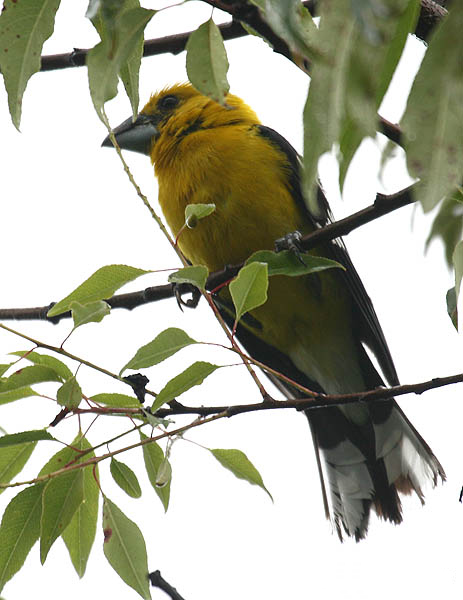
Wikimedia Commons
About the Golden Grosbeak
The Golden Grosbeak (Pheucticus chrysogaster), a member of the Cardinalidae family, is a vibrant songbird found predominantly in the Andean regions of South America. Known for its striking appearance, this bird plays a vital role in its ecosystem, acting as both a seed disperser and a consumer of various insects. The Golden Grosbeak is most commonly found in countries such as Colombia, Ecuador, Peru, and Bolivia, thriving in montane forests and scrublands. Its presence is often a reliable indicator of healthy, biodiverse forest ecosystems. In terms of seasonal behavior, the Golden Grosbeak does not typically migrate long distances. However, it may exhibit altitudinal movements in response to changes in food availability or climatic conditions. During the breeding season, which generally occurs from October to March, these birds become more vocal and territorial, making them easier to locate by their distinctive songs. The ecological significance of the Golden Grosbeak extends beyond its role as a seed disperser. By feeding on a variety of insects, this bird helps control insect populations, maintaining a balanced ecosystem. Additionally, as a prey species for larger birds and mammals, it contributes to the food web, supporting the diverse wildlife communities in the Andes. Despite its colorful appearance, the Golden Grosbeak can be surprisingly elusive. It tends to inhabit dense vegetation, where it forages for seeds and insects, often remaining hidden from sight. Bird watchers often rely on its melodious calls to detect its presence. This bird’s adaptability to different altitudinal ranges showcases its resilience in the face of environmental changes. In areas where its habitat overlaps with human settlements, the Golden Grosbeak can occasionally be found visiting fruiting trees and feeders, particularly during times of food scarcity in the wild. This behavior not only enhances its visibility to bird enthusiasts but also highlights the importance of preserving habitats that support a wide range of species. Overall, the Golden Grosbeak is a fascinating subject for both ornithologists and casual birders, offering insights into the complex interactions within Andean ecosystems.
The Golden Grosbeak belongs to the family Cardinalidae, within the order Passeriformes. These birds typically live average 5-8 years, with a maximum recorded of 12 years..
How to Identify a Golden Grosbeak
The Golden Grosbeak displays a vibrant yellow plumage, making it relatively easy to identify among the dense vegetation it inhabits. Adults typically exhibit a bright yellow underbelly, contrasted sharply with black wings and tail feathers. The wing coverts are edged in white, adding a distinctive pattern that aids in identification. Males and females share similar coloration, though females may appear slightly less vibrant. Juveniles, on the other hand, often show a more muted yellow with brownish tinges, gradually acquiring the adult coloration as they mature. One of the most distinctive features of the Golden Grosbeak is its thick, conical bill, perfectly adapted for cracking seeds. This feature, combined with its robust body shape, contributes to its classification within the grosbeak group. When in flight, the Golden Grosbeak presents a striking silhouette, with broad wings and a relatively short tail. This bird typically perches upright on branches, often remaining motionless to avoid detection. Similar species, such as the Black-backed Grosbeak, can cause confusion, but the Golden Grosbeak's yellow underparts and white wing patches are key differentiators. Observing it in its natural habitat, the Golden Grosbeak’s coloration provides effective camouflage against the foliage, despite its bright hues.
Having trouble telling birds apart? Upload a photo to our bird identification tool for an instant species match.
Golden Grosbeak Habitat and Range
Preferred Habitat
The Golden Grosbeak thrives in montane forests and scrublands of the Andes, favoring elevations between 1,500 and 3,000 meters. It is commonly found in regions with dense vegetation, where it can forage for food and seek shelter from predators. This bird often inhabits areas with a mix of open spaces and dense thickets, allowing it to navigate easily while remaining hidden. Seasonal habitat shifts may occur as the Golden Grosbeak moves to lower elevations during colder months or in search of food. In urban settings, the Golden Grosbeak occasionally visits fruiting trees and bird feeders, particularly in gardens adjacent to forested areas. Despite its adaptability, it remains more prevalent in rural regions, where its natural habitat is less disrupted.
Geographic Range
The Golden Grosbeak's range spans several Andean countries in South America, including Colombia, Ecuador, Peru, and Bolivia. It primarily breeds in montane regions, where it finds suitable nesting sites and abundant food sources. During the non-breeding season, it remains within the same general area, although some individuals may undertake short altitudinal migrations. Bird watchers often report higher population densities in the cloud forests of Ecuador and Peru, where the species is commonly spotted. These areas, rich in biodiversity, provide ideal conditions for the Golden Grosbeak to thrive. Although not a long-distance migrant, the Golden Grosbeak's ability to adapt to varying elevations allows it to exploit different ecological niches throughout its range.
Want to know which birds visit your area? Browse our backyard birds by location guides for region-specific species lists.
What Does the Golden Grosbeak Eat?
The Golden Grosbeak primarily feeds on seeds and fruits, making it an important seed disperser in its habitat. Its diet changes seasonally, with insects becoming a significant component during the breeding season when protein demands increase. The bird's thick, conical bill is well-suited for cracking open hard seeds, while its agile foraging techniques enable it to capture insects from foliage. It often feeds alone or in pairs, using a combination of gleaning and hovering to access food. Fruits from native trees and shrubs form a substantial part of the diet, particularly during the wet season when they are more abundant. The Golden Grosbeak typically feeds during the early morning and late afternoon, taking advantage of cooler temperatures and reduced competition from other foraging species.
Golden Grosbeak Behavior and Social Structure
The Golden Grosbeak exhibits a variety of behaviors that highlight its adaptability and social nature. It often forms loose flocks outside the breeding season, which can include other grosbeak species and tanagers. These mixed-species flocks provide increased protection from predators and enhance foraging efficiency through cooperative behaviors. Territorial behavior becomes more pronounced during the breeding season, with males establishing and defending territories through song. Courtship displays involve both visual and vocal elements, as males showcase their vibrant plumage while singing to attract females. The Golden Grosbeak is generally active during daylight hours, engaging in foraging, preening, and social interactions. When threatened by predators, it relies on dense vegetation for cover and may emit alarm calls to alert others in the vicinity. This bird's response to predation threats often includes rapid, erratic flights into thickets, where it is difficult for predators to follow.
Golden Grosbeak Nesting and Reproduction
The Golden Grosbeak constructs cup-shaped nests, typically located in the fork of a tree branch, well-concealed by surrounding foliage. Nest construction involves both male and female, using materials such as twigs, grasses, and leaves. The choice of nest site is crucial for avoiding predators, and the birds often select locations in dense thickets or forest edges. A typical clutch consists of two to three eggs, which the female incubates for approximately 12 to 14 days. During this period, the male provides food for the female. Once hatched, the young are altricial, requiring considerable parental care. Both parents participate in feeding the chicks, which fledge after about two to three weeks. The Golden Grosbeak usually raises one or two broods per year, depending on environmental conditions and food availability. Parental roles are well-defined, with both sexes sharing responsibilities to ensure the survival of their offspring.
Golden Grosbeak Sounds and Vocalizations
The primary song of the Golden Grosbeak is a melodious series of whistles and warbles, varying in pitch and rhythm. It often sings from a high perch, especially during the breeding season, to establish territory and attract mates. Call notes are short and sharp, serving as contact calls between individuals or as alerts to potential threats. Alarm calls are more abrupt and can escalate in intensity, signaling imminent danger. During the dawn chorus, the Golden Grosbeak's song blends with those of other avian species, contributing to the rich soundscape of its habitat. Its song, while distinct, shares some similarities with other grosbeak species, requiring attentive listening to differentiate.
Interesting Facts About the Golden Grosbeak
- 1The Golden Grosbeak can often be found in mixed-species flocks, enhancing its foraging success and predator avoidance.
- 2Unlike many grosbeak species, the Golden Grosbeak shows little sexual dimorphism, with both sexes appearing similar in plumage.
- 3The Golden Grosbeak's adaptability to different elevations allows it to exploit a wide range of ecological niches within the Andes.
- 4During the breeding season, the male Golden Grosbeak's song becomes more frequent and complex, a key factor in mate attraction.
- 5Golden Grosbeaks utilize a variety of foraging techniques, including gleaning and hovering, to access diverse food sources.
- 6Despite their vibrant plumage, Golden Grosbeaks are adept at hiding in dense foliage, using their coloration as effective camouflage.
- 7Their robust, conical bill is a hallmark of the Cardinalidae family, enabling them to efficiently crack open hard seeds.
Golden Grosbeak Conservation Status
The IUCN currently lists the Golden Grosbeak as a species of Least Concern, with a stable population trend. Despite its stable status, habitat loss due to deforestation poses a significant threat to its long-term survival. Conservation efforts focus on preserving montane forest habitats and promoting sustainable land use practices in the Andes. Historical population changes have been influenced by agricultural expansion and urban development, leading to localized declines in some areas. Ongoing research and monitoring aim to ensure that the Golden Grosbeak and its habitat remain protected, supporting both biodiversity and local communities.


