
Grand Munia
Lonchura grandis
Order: Passeriformes / Family: Estrildidae
Wikimedia Commons
About the Grand Munia
The Grand Munia (Lonchura grandis) stands out as the largest species within the Estrildidae family, an assemblage of small passerine birds known for their vibrant colors and gregarious nature. Native to the region surrounding New Guinea, this species thrives in the tropical lowlands and adjacent areas, where it fulfills a significant ecological role as both a seed disperser and a prey species for avian predators. The Grand Munia's presence in the ecosystem is crucial, supporting a delicate balance by participating in seed distribution that promotes plant diversity, which in turn supports various trophic levels within its habitat. This bird's significance extends beyond its ecological role, as it contributes to the rich tapestry of biodiversity in the tropical regions of Oceania. Across New Guinea and nearby islands, the Grand Munia frequents grasslands, marshes, and agricultural lands. It showcases a remarkable adaptability to various habitats, including rice paddies and fallow fields, where it can often be seen foraging in flocks. The adaptability of the Grand Munia to modified landscapes underscores its resilience and underscores its role in human-altered ecosystems. Seasonally, the Grand Munia exhibits little migratory behavior, preferring to remain within its established range year-round. However, some local movements may occur in response to food availability or environmental conditions, ensuring access to optimal foraging grounds. During breeding season, these birds engage in lively courtship displays, which involve intricate dances and vocalizations that strengthen pair bonds and signal readiness for reproduction. The Grand Munia's contribution to biodiversity, its adaptability to human-altered landscapes, and its role in seed dispersal and food webs affirm its ecological significance.
The Grand Munia belongs to the family Estrildidae, within the order Passeriformes. These birds typically live average 4-6 years, with a maximum recorded of 8 years..
How to Identify a Grand Munia
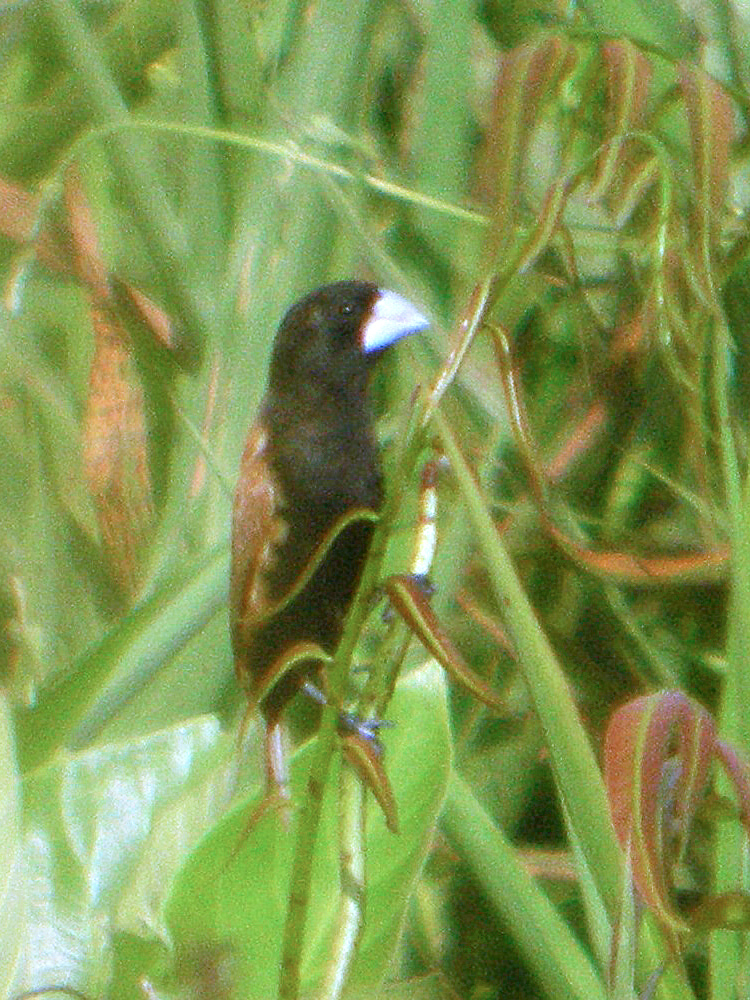
The Grand Munia is readily identifiable by its large size relative to other munias, measuring approximately 15 cm in length. Adult plumage features a rich brown body contrasted by white underparts, a characteristic that sets it apart from similar species. The belly and vent are distinctly white, creating a striking contrast with the darker upper parts. Juvenile Grand Munias, on the other hand, exhibit more subdued coloration, with pale brown underparts that gradually transition to the adult plumage as they mature. Males and females appear similar, though males may display slightly brighter plumage during the breeding season. This can lead to some confusion with other munias, such as the Chestnut Munia, which also has a white belly but lacks the Grand Munia's overall size and robust build. In flight, the Grand Munia showcases a compact silhouette with rapid wingbeats, a characteristic flight pattern shared by many estrildids. When perched, they maintain an upright posture, often aligning themselves with vertical stems or branches, which aids in their camouflage within grasslands and shrubby areas.
Having trouble telling birds apart? Upload a photo to our bird identification tool for an instant species match.
Grand Munia Habitat and Range
Preferred Habitat
The Grand Munia inhabits a variety of tropical lowland environments, primarily in and around New Guinea. It thrives in grasslands, marshes, and agricultural areas such as rice paddies and fallow fields. This species prefers elevations from sea level up to 1,500 meters, adapting well to both rural and peri-urban landscapes. Seasonal shifts in habitat are minimal, although local movements may occur to exploit changes in food resource availability. Unlike some other bird species, the Grand Munia shows a strong preference for open habitats over densely forested areas, which aligns with its foraging habits and social behavior.
Geographic Range
The Grand Munia is primarily found in New Guinea and the surrounding islands, where it occupies a stable range year-round. It exhibits little migratory behavior, opting instead for localized movements that align with seasonal food availability. Breeding populations are concentrated in regions with abundant grasslands and marshes, with the densest populations occurring in the lowland areas of Papua New Guinea. Although its range does not extend far beyond New Guinea, the Grand Munia's adaptability to agricultural landscapes has allowed it to maintain a stable presence in regions where such habitats are prevalent.
Want to know which birds visit your area? Browse our backyard birds by location guides for region-specific species lists.
What Does the Grand Munia Eat?
The diet of the Grand Munia consists predominantly of seeds, particularly those of grasses and crops, which it skillfully extracts using its conical bill. During the breeding season, when nutritional demands are higher, it may supplement its diet with small invertebrates such as insects and larvae, providing essential proteins for growing chicks. The Grand Munia exhibits a ground-foraging technique, often seen hopping through grasses and fields in search of food. Its feeding schedule is diurnal, with peak activity occurring in the cooler hours of the morning and late afternoon, allowing it to avoid the midday heat. The versatility of its diet enables the Grand Munia to exploit various food sources throughout the year, contributing to its adaptability in diverse habitats.
Want to attract Grand Munias to your yard? See our recommended feeders and seed types for the best results.
Grand Munia Behavior and Social Structure
The Grand Munia is a highly social bird, often observed in flocks ranging from small family groups to larger assemblages of dozens of individuals. Its social structure is complex, with flocks maintaining loose hierarchies that facilitate cooperative foraging and predator vigilance. During the breeding season, the Grand Munia becomes territorial, with males engaging in elaborate displays that include singing, wing flapping, and tail fanning to attract mates and establish dominance within the flock. These courtship displays are integral to pair formation and mating success. Flocking behavior is particularly notable outside the breeding season, when large groups congregate to roost in reed beds or tall grasses, providing safety in numbers from predators such as raptors. The Grand Munia exhibits a predictable daily pattern, with peak activity at dawn and dusk. Throughout the day, it engages in various activities including feeding, preening, and social interactions, contributing to its dynamic role within its ecosystem.
Grand Munia Nesting and Reproduction
The nesting habits of the Grand Munia are characterized by its preference for constructing dome-shaped nests using grasses and other plant materials. These nests are typically situated in dense vegetation, such as tall grasses or reeds, providing concealment from predators. The clutch size ranges from 4 to 6 eggs, which are incubated by both parents for approximately 12 to 14 days. After hatching, the fledglings remain in the nest for an additional 18 to 20 days before they fledge. Both parents share in feeding and caring for the young, ensuring a high survival rate. The Grand Munia is capable of raising multiple broods per year, which contributes to its stable population numbers in suitable habitats.
Grand Munia Sounds and Vocalizations
The Grand Munia's primary song is a series of soft, melodious notes that are often delivered in a rhythmic sequence. This song serves as both a territorial and mating call, with males prominently displaying their vocal prowess during the breeding season. In addition to the primary song, the Grand Munia produces a variety of call notes, including sharp 'tik' sounds used for communication within flocks and soft alarm calls to warn of potential danger. The dawn chorus of the Grand Munia is a delightful blend of these vocalizations, creating a harmonious backdrop to the early morning activities of the flock. Its vocalizations are reminiscent of other munias, though the Grand Munia's larger size often results in a deeper, more resonant quality.
Interesting Facts About the Grand Munia
- 1The Grand Munia is the largest species within the Estrildidae family, measuring around 15 cm in length.
- 2Unlike many other munias, the Grand Munia can thrive in altered landscapes such as agricultural fields.
- 3The Grand Munia's diet is predominantly seed-based, but it includes insects during the breeding season for extra protein.
- 4This species forms large flocks outside the breeding season, with numbers ranging into the dozens.
- 5Despite its social nature, the Grand Munia becomes territorial during breeding, with males displaying elaborate courtship rituals.
- 6The Grand Munia constructs dome-shaped nests in dense vegetation, using grasses and plant fibers.
- 7In addition to its song, the Grand Munia uses a variety of call notes for communication and alarm.
Grand Munia Conservation Status
Currently, the Grand Munia is classified as Least Concern by the IUCN, with stable population trends across its range. Primary threats include habitat destruction due to agricultural expansion and potential predation by introduced species. Conservation efforts focus on habitat preservation and monitoring population dynamics to ensure long-term viability. Historically, the Grand Munia's adaptability to modified landscapes has buffered it against significant declines, but ongoing vigilance is necessary to mitigate emerging threats such as climate change and increased human encroachment.
Attracting Grand Munias to Your Feeder
The Grand Munia is a regular visitor to backyard bird feeders across its range. At the Eye On The Fly feeding station, we observe Grand Munias regularly and capture footage with our feeder cameras.


