
Gray-headed Bristlebill
Bleda canicapillus
Order: Passeriformes / Family: Pycnonotidae
Wikimedia Commons
About the Gray-headed Bristlebill
The Gray-headed Bristlebill, known scientifically as Bleda canicapillus, is a medium-sized songbird belonging to the Pycnonotidae family. This species thrives predominantly in the dense, humid forests of West and Central Africa, where its presence is often more heard than seen due to its elusive nature and preference for dense foliage. The bird's significance extends beyond its striking appearance; it plays a crucial ecological role in these forests. As a frugivore, the Gray-headed Bristlebill aids in seed dispersal, which is vital for maintaining the diversity and health of its forest habitat.
Found from Sierra Leone and Liberia in the west, across the Ivory Coast and Ghana, and further east through Nigeria and Cameroon to the Central African Republic and the Democratic Republic of the Congo, the Gray-headed Bristlebill is a key species in these regions' avian communities. Its range overlaps with several protected areas, contributing to the conservation of forest ecosystems. Seasonal behaviors of the Gray-headed Bristlebill include a notable increase in vocal activity during the breeding season, which peaks with the onset of the rains. This period of heightened vocalization, often marked by duets between males and females, is essential for establishing territories and facilitating pair bonding.
The ecological role of the Gray-headed Bristlebill is underscored by its interactions with other forest species. By consuming fruit from various tree species, it inadvertently supports the regeneration of these forests. The bird's diet also contributes to controlling insect populations, thus maintaining ecological balance. As forests face increasing threats from logging and agricultural expansion, the Gray-headed Bristlebill serves as an indicator species, reflecting the health of its habitat. Conservation efforts aimed at protecting the habitats of such species not only preserve the bristlebill but also countless other organisms that depend on these forests.
The Gray-headed Bristlebill belongs to the family Pycnonotidae, within the order Passeriformes. These birds typically live average 5-7 years; max recorded 10 years.
How to Identify a Gray-headed Bristlebill
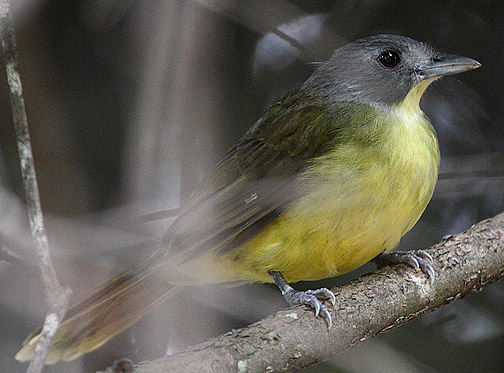
The Gray-headed Bristlebill is easily recognized by its gray head, contrasting sharply with its olive-green upperparts and yellowish underparts. The bird measures approximately 20 to 22 centimeters in length and weighs around 35 to 45 grams, placing it in the medium size class among songbirds. Adults exhibit a distinctive bristled appearance on the forehead, a feature that gives this species its common name. The eyes are dark, and the bill is stout and black, suitable for its frugivorous diet.
Juvenile Gray-headed Bristlebills are duller in coloration, lacking the pronounced gray head of adults. Instead, they display a more uniform olive-green color throughout their plumage, which gradually develops into the adult coloration as they mature. There is minimal sexual dimorphism in this species, with males and females appearing similar in plumage and size. However, during the breeding season, subtle differences in behavior, such as increased vocalizations in males, may aid in distinguishing between the sexes in the field.
In terms of silhouette, the Gray-headed Bristlebill presents a robust, compact form with a slightly rounded tail. When perched, it often sits upright, showcasing its characteristic head and body colors. In flight, the bird's wings appear broad and rounded, contributing to its agile maneuvers through dense foliage. While it may be confused with other bristlebill species, particularly within its geographic range, the unique combination of its gray head and olive-green body is a reliable identifier for birdwatchers and researchers alike.
Having trouble telling birds apart? Upload a photo to our bird identification tool for an instant species match.
Gray-headed Bristlebill Habitat and Range
Preferred Habitat
The Gray-headed Bristlebill prefers the humid lowland and montane forests of West and Central Africa. It thrives in regions with thick undergrowth and plentiful fruiting trees, often seen in primary and mature secondary forests, where it can find abundant food sources and suitable nesting sites. This bird is typically found at elevations ranging from sea level up to 1,500 meters, though it most commonly inhabits areas below 1,000 meters.
In terms of seasonal habitat shifts, the Gray-headed Bristlebill shows some adaptability but remains primarily within forested areas year-round. Unlike some other species that might venture into more open or degraded habitats during certain times of the year, this bird tends to avoid areas with significant human disturbance. While it is not typically found in urban environments, the bristlebill can persist in forest edges and patches of vegetation near human settlements, provided these areas offer sufficient cover and food resources.
The bird's reliance on dense forest habitats underscores the importance of conservation efforts aimed at preserving these environments. As deforestation and habitat fragmentation continue to threaten tropical forests, maintaining large, contiguous areas of suitable habitat remains crucial for the survival of the Gray-headed Bristlebill and other forest-dependent species.
Geographic Range
The Gray-headed Bristlebill's range extends across a significant portion of West and Central Africa. It is a resident breeder in countries such as Sierra Leone, Liberia, Ivory Coast, Ghana, and Nigeria, continuing eastward through Cameroon, Central African Republic, and the Democratic Republic of the Congo. The bird's presence in these regions is closely tied to the availability of dense, forested habitats, which provide the necessary resources for feeding and nesting.
Unlike many migratory birds, the Gray-headed Bristlebill does not undertake long-distance migrations. Instead, it remains largely sedentary throughout the year, although local movements may occur in response to food availability and seasonal changes in habitat conditions. During the breeding season, the bird's distribution may become more concentrated in areas with optimal nesting sites and abundant food resources.
Within its range, population density hotspots often coincide with protected areas, where forest habitats remain relatively intact. The bird's preference for primary and mature secondary forests means that its presence can serve as a useful indicator of environmental health. Efforts to map and monitor the distribution of the Gray-headed Bristlebill can aid in identifying critical habitats in need of conservation, ultimately supporting broader biodiversity preservation initiatives across its range.
Want to know which birds visit your area? Browse our backyard birds by location guides for region-specific species lists.
What Does the Gray-headed Bristlebill Eat?
The Gray-headed Bristlebill primarily feeds on a diet of fruits, making it an important frugivore within its ecosystem. This bird plays a key role in seed dispersal, as it consumes a variety of fruits from different tree species, including figs and berries. In addition to fruits, the Gray-headed Bristlebill supplements its diet with insects, which provide essential proteins and nutrients, particularly during the breeding season when energy demands are higher.
Seasonal changes influence the bird's diet, with fruit availability peaking during certain times of the year. During these periods, the Gray-headed Bristlebill may focus more heavily on fruit consumption, while in other seasons, it may rely more on insects to meet its nutritional needs. The bird employs a foraging technique characterized by short flights and hops through vegetation, picking off insects from leaves and branches or plucking ripe fruits.
The size of prey consumed by the Gray-headed Bristlebill is generally small, consistent with its medium size and agile foraging behavior. Feeding typically occurs throughout the day, with peaks during early morning and late afternoon hours when the bird is most active. Understanding the dietary preferences of the Gray-headed Bristlebill can provide insights into the types of habitats that support healthy populations and highlight the importance of preserving diverse plant communities within its range.
Gray-headed Bristlebill Behavior and Social Structure
The social structure of the Gray-headed Bristlebill is primarily monogamous, with pairs often seen foraging and nesting together. This bird exhibits strong territorial behavior during the breeding season, with males and females working together to defend their territory from intruders. Vocal displays, including duets and counter-singing, play a crucial role in maintaining these territories and reinforcing pair bonds.
Courtship displays in the Gray-headed Bristlebill are subtle, often involving mutual preening and synchronized movements between partners. These displays help strengthen the pair bond and ensure successful coordination during nesting and rearing of young. Flocking behavior is not commonly observed in this species, as individuals tend to remain within their established territories.
In response to predators, the Gray-headed Bristlebill relies on its cryptic plumage and dense forest habitats for protection. When threatened, the bird may emit alarm calls to warn its mate or any nearby conspecifics. Daily activity patterns of the Gray-headed Bristlebill are diurnal, with most foraging and social interactions occurring during daylight hours. The bird's activity often peaks during the cooler morning and late afternoon periods, aligning with the availability of food resources and optimal foraging conditions.
Gray-headed Bristlebill Nesting and Reproduction
The Gray-headed Bristlebill constructs its nest in dense shrubbery or small trees within its forest habitat. The nest itself is a cup-shaped structure made from twigs, leaves, and grasses, often lined with softer materials like feathers or plant fibers. This construction provides both camouflage and protection for the eggs and developing chicks.
Preferred nesting locations are typically low to the ground, ranging from 1 to 3 meters in height, which aids in shielding the nest from predators. The clutch size of the Gray-headed Bristlebill usually consists of 2 to 3 eggs, which are incubated by both parents for about 14 to 16 days. This shared incubation duty ensures that one parent can always monitor the nest while the other forages for food.
After hatching, the young bristlebills are altricial, requiring extensive parental care. Both parents participate in feeding and caring for the chicks, which fledge approximately 16 to 20 days after hatching. The number of broods per year is typically one or two, depending on environmental conditions and food availability. The parental roles in the Gray-headed Bristlebill's nesting cycle highlight the cooperative nature of this species and its reliance on stable, forested environments for reproductive success.
Gray-headed Bristlebill Sounds and Vocalizations
The primary song of the Gray-headed Bristlebill is a melodious series of whistles and trills, characterized by a rhythmic pattern. The pitch is moderate, with a clear, flute-like quality that carries well through dense forest habitats. This song is often used by males to establish territory and attract mates, typically performed from a concealed perch within the canopy.
In addition to their song, these birds produce a variety of call notes, including sharp, metallic 'chip' sounds used in communication between mates or as contact calls. Alarm calls are more rapid and harsh, serving to alert other birds of potential threats, such as predators or intruders within their territory.
The Gray-headed Bristlebill participates in the dawn chorus, contributing to the symphony of sounds that marks the start of the day in tropical forests. This behavior underscores the bird's role in the acoustic landscape of its ecosystem, providing both social and territorial information to other members of the avian community.
Interesting Facts About the Gray-headed Bristlebill
- 1The Gray-headed Bristlebill's name comes from the stiff bristles on its forehead, which are unique among its family.
- 2Despite its vibrant plumage, the Gray-headed Bristlebill's preference for dense foliage makes it a challenging bird to spot in the wild.
- 3This species often sings in duets, with males and females coordinating their calls to strengthen pair bonds.
- 4The Gray-headed Bristlebill is a non-migratory bird, remaining in its forest habitat throughout the year.
- 5Fruit comprises up to 70% of the Gray-headed Bristlebill's diet, highlighting its role in seed dispersal.
- 6The bird's call is so distinct that it is often used by birdwatchers to locate the species despite its elusive nature.
- 7The Gray-headed Bristlebill's presence in a forest can indicate a healthy, undisturbed ecosystem.
Gray-headed Bristlebill Conservation Status
The Gray-headed Bristlebill is currently listed as Least Concern on the IUCN Red List, indicating that its populations are relatively stable at present. However, ongoing deforestation and habitat fragmentation pose significant threats to its forested environments, potentially impacting future population trends. As primary forests are cleared for agriculture, logging, and infrastructure development, the availability of suitable habitats for the Gray-headed Bristlebill diminishes. Conservation efforts focus on preserving large tracts of continuous forest, which are essential for maintaining viable populations of this species. Protected areas and national parks within the bird's range serve as critical refuges, helping to mitigate the impacts of habitat loss. Additionally, community-based conservation initiatives aim to promote sustainable land-use practices that balance human needs with biodiversity preservation. Historical population changes are not well-documented for the Gray-headed Bristlebill, but ongoing monitoring is necessary to detect potential declines and inform conservation strategies. By safeguarding the habitats of the Gray-headed Bristlebill, conservationists also benefit a multitude of other species that share its forest home.


