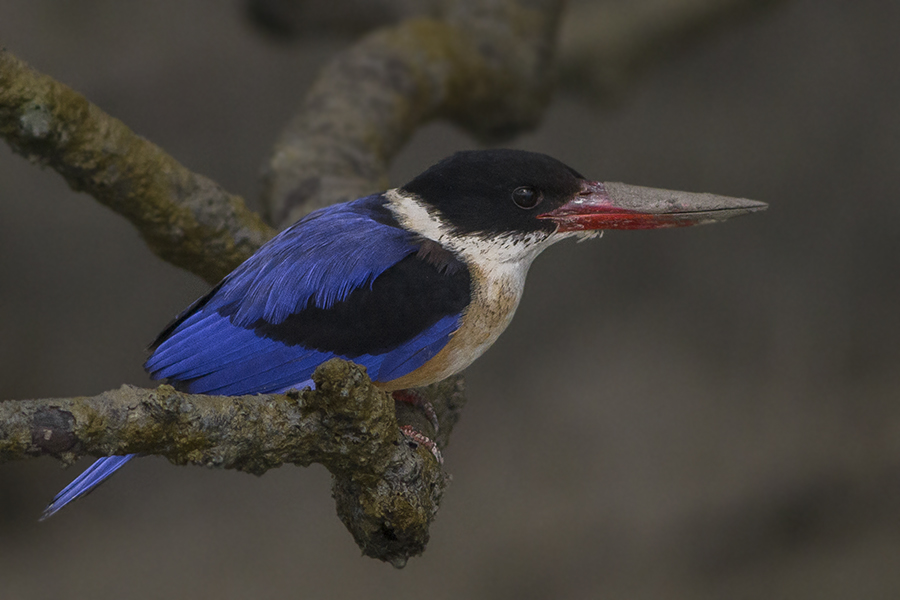
Gray-headed Kingfisher
Halcyon leucocephala
Order: Coraciiformes / Family: Alcedinidae

Wikimedia Commons
About the Gray-headed Kingfisher
The Gray-headed Kingfisher (Halcyon leucocephala) is a captivating bird that belongs to the Alcedinidae family, renowned for its vibrant plumage and diverse habitats. This species primarily resides in sub-Saharan Africa and extends its range to the southwestern part of the Arabian Peninsula. With a body length of approximately 21 to 24 centimeters and a wingspan ranging from 26 to 29 centimeters, it is a medium-sized kingfisher that captivates birders with its appearance and behaviors. Gray-headed Kingfishers thrive in a variety of environments, including open woodlands, savannas, and mangrove regions. Their adaptability allows them to inhabit areas close to human settlements, although they prefer natural habitats rich in prey. During the breeding season, which typically occurs in the rainy months, these birds are highly territorial, often defending their chosen nesting sites with vigor. Ecologically, the Gray-headed Kingfisher plays a significant role as both predator and prey. Their diet consists primarily of insects, small reptiles, and amphibians, making them crucial in controlling pest populations. In turn, they serve as prey for larger avian predators, balancing the local ecosystem. These kingfishers also contribute to the biodiversity of their habitats by providing a link in the food chain and aiding in the pollination process as they move between flowering plants. Seasonally, the Gray-headed Kingfisher may exhibit some local movement patterns in response to food availability and climatic conditions, although they are generally considered sedentary. This species' resilience and adaptability highlight its ecological importance and the need to ensure habitat conservation to maintain its populations.
The Gray-headed Kingfisher belongs to the family Alcedinidae, within the order Coraciiformes. These birds typically live average 5 years, with a maximum recorded of 9 years..
How to Identify a Gray-headed Kingfisher
The Gray-headed Kingfisher is easily recognized by its distinctive gray head, contrasting with a rich chestnut belly and a bright blue rump and tail. The adults exhibit a vibrant blue back, while the wings are a mix of blue and black with a hint of white. Unlike many bird species, male and female Gray-headed Kingfishers are similar in appearance, making sex differentiation challenging in the field. Juveniles, however, can be distinguished by their duller plumage and the presence of brown tips on their feathers, which gradually wear off as they mature. In flight, the Gray-headed Kingfisher displays a swift and direct movement, characterized by rapid wingbeats and occasional glides. When perched, it often sits upright on exposed branches, scanning the surroundings for prey. This posture, combined with its striking coloration, makes it a conspicuous presence in its habitat. While its appearance is unique, it can sometimes be confused with the Woodland Kingfisher, which shares a similar range. However, the Gray-headed Kingfisher lacks the Woodland Kingfisher's bright red bill and more extensive blue markings on the head.
Having trouble telling birds apart? Upload a photo to our bird identification tool for an instant species match.
Gray-headed Kingfisher Habitat and Range
Preferred Habitat
The Gray-headed Kingfisher inhabits a diverse range of environments, predominantly in open woodlands, savannas, and scrublands. It shows a preference for areas with scattered trees and bushes, which provide ample perching sites for hunting. This bird can also be found in mangrove areas along coastal regions, where it benefits from the rich biodiversity. Although primarily found at low altitudes, it can occasionally be seen in montane regions up to 2,000 meters, particularly in East Africa. During the dry season, some individuals may move to areas with more permanent water sources, though they are not strictly water-dependent. The Gray-headed Kingfisher's ability to thrive in both rural and semi-urban areas highlights its adaptability, though it maintains a preference for natural habitats over urban landscapes.
Geographic Range
The Gray-headed Kingfisher's range extends across much of sub-Saharan Africa and parts of the Arabian Peninsula. It is widely distributed from Senegal and Gambia in the west, across Central Africa, to Ethiopia and Somalia in the east, and southward to South Africa. In the Arabian Peninsula, it is primarily found in Yemen and southwestern Saudi Arabia. While considered a resident species, some populations, particularly those in more arid regions, exhibit partial migratory behaviors, moving locally in response to rainfall patterns and prey availability. Population densities vary, with higher concentrations found in regions with abundant food and suitable nesting sites, such as riparian woodlands and forest edges.
Want to know which birds visit your area? Browse our backyard birds by location guides for region-specific species lists.
What Does the Gray-headed Kingfisher Eat?
The Gray-headed Kingfisher primarily feeds on insects, including beetles, grasshoppers, and locusts, which it captures with precision from the ground or vegetation. It also consumes small reptiles, amphibians, and occasionally fish, showcasing its versatility as a hunter. During the breeding season, when insect populations flourish, its diet shifts to capitalize on this abundance. The foraging technique of this kingfisher involves perching quietly on a branch or wire, watching the ground below for movement. Once prey is spotted, it dives swiftly, seizing its target with its sharp bill. The prey size is usually small, with insects forming the bulk of its diet, though it can tackle larger prey like small lizards when the opportunity arises. Its feeding schedule is largely diurnal, with peak activity in the early morning and late afternoon when prey is most active.
Gray-headed Kingfisher Behavior and Social Structure
Gray-headed Kingfishers exhibit a variety of behaviors, both solitary and territorial. They are generally seen alone or in pairs, particularly during the breeding season, when they become highly territorial and aggressive towards intruders. Courtship displays involve a series of vocalizations and aerial maneuvers, where males often present food items to females as part of the mating ritual. These birds maintain a defined territory during the breeding season, using both vocal and visual displays to ward off competitors. Outside the breeding season, they may form loose associations with other kingfishers, though social interactions remain limited. In response to predators, Gray-headed Kingfishers rely on their agility, often taking flight to dense cover to escape threats. Daily activity patterns reveal a preference for early morning and late afternoon activity, when they are most likely to forage and engage in social behaviors.
Gray-headed Kingfisher Nesting and Reproduction
The nesting habits of the Gray-headed Kingfisher involve excavating burrows in vertical banks or termite mounds, where they lay their eggs. These nests are typically positioned 1 to 3 meters above ground, providing protection from ground predators. The chosen nesting sites are often near water sources, which ensures a reliable food supply for the growing chicks. A typical clutch consists of 3 to 5 eggs, which both parents incubate over a period of approximately 18 to 21 days. After hatching, the chicks remain in the nest for another 20 to 25 days before fledging. Both parents actively participate in feeding and caring for the young, ensuring a high survival rate. The Gray-headed Kingfisher may produce one or two broods per year, depending on environmental conditions and food availability.
Gray-headed Kingfisher Sounds and Vocalizations
The Gray-headed Kingfisher's vocalizations are a distinctive feature, with primary calls comprising a series of high-pitched, chattering notes. These calls, often heard during territorial displays, serve as both a warning to intruders and a communication tool between mated pairs. The bird's song is a varied series of trills and whistles, delivered with a rhythm that can be both fast-paced and intermittent. During the dawn chorus, these calls are particularly prominent, adding a lively dimension to its habitat. Alarm calls are sharper and more urgent, designed to alert nearby individuals to potential threats. The sound has a quality reminiscent of a mechanical rattle, setting it apart from many other birds in its range.
Interesting Facts About the Gray-headed Kingfisher
- 1The Gray-headed Kingfisher can dive at speeds exceeding 40 kilometers per hour when pursuing prey.
- 2Unlike many kingfishers, this species is not primarily dependent on water bodies for foraging.
- 3During the breeding season, Gray-headed Kingfishers may engage in dramatic aerial chases as part of courtship.
- 4The species' bright plumage not only attracts mates but also serves as a deterrent to potential competitors.
- 5Gray-headed Kingfishers often reuse old termite mounds for nesting, taking advantage of their sturdy structure.
Gray-headed Kingfisher Conservation Status
The Gray-headed Kingfisher is currently classified as a species of Least Concern by the IUCN, reflecting its widespread and stable population. However, ongoing habitat destruction, particularly the clearing of woodland areas and the degradation of riverine environments, poses a threat to its habitat. Conservation efforts focus on preserving natural habitats and mitigating the impacts of urbanization and agriculture. Historically, the population has remained relatively stable, though localized declines have been noted in areas with significant environmental changes. Continued monitoring and habitat protection are essential to ensure the species' long-term survival.
Other Alcedinidae Species


Birds Similar to the Gray-headed Kingfisher
These species are often confused with the Gray-headed Kingfisher due to similar appearance or overlapping range.