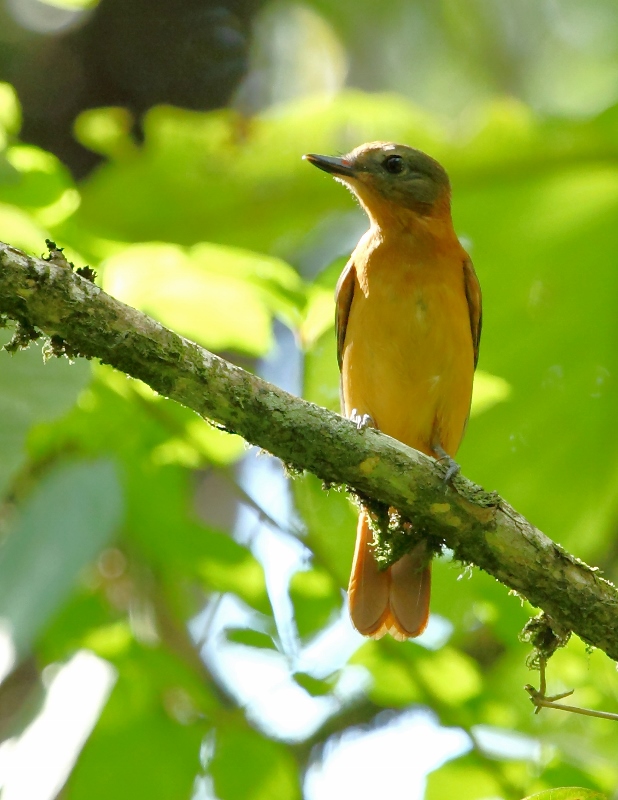
Gray-hooded Attila
Attila rufus
Order: Passeriformes / Family: Tyrannidae

Wikimedia Commons
About the Gray-hooded Attila
The Gray-hooded Attila, scientifically known as Attila rufus, is a striking bird native to the Atlantic Forest of southeastern Brazil. This species, belonging to the Tyrannidae family, plays a significant role in the ecology of these rich and diverse habitats. The Gray-hooded Attila is predominantly found in states such as São Paulo, Rio de Janeiro, and Espírito Santo. Its presence is crucial for the forest's health, as it participates in seed dispersal and acts as both predator and prey within its ecosystem. The Gray-hooded Attila is a medium-sized bird, measuring around 20 centimeters in length. It is known for its distinctive vocalizations, which can be heard throughout its range, particularly during the breeding season. This bird's call is a series of loud, melodic whistles, which help it establish territories and attract mates. Its vocal prowess is a key feature that birdwatchers and researchers use to identify it in the dense forest canopy. The Atlantic Forest, where the Gray-hooded Attila resides, is one of the most biodiverse regions in the world but also one of the most threatened. This bird's presence is a positive indicator of forest health, as it requires well-preserved habitats to thrive. Its role in controlling insect populations benefits the ecosystem by maintaining a balance and preventing pest outbreaks. During the breeding season, which typically occurs from September to December, the Gray-hooded Attila becomes more conspicuous as males sing to declare their territories and attract females. The species is largely sedentary, with some local movements in response to food availability. Outside of the breeding season, the Gray-hooded Attila may be less vocal, blending into the background of the forest. Its adaptability to various forest types, from lowland rainforests to montane regions, highlights its ecological versatility. However, habitat loss due to deforestation and urban expansion poses a significant threat to its population. Conservation efforts focus on preserving the remaining tracts of the Atlantic Forest and ensuring connectivity between fragmented habitats. By safeguarding these areas, the future of the Gray-hooded Attila and countless other species that share its home becomes more secure. The bird's ecological role, beautiful plumage, and melodic calls make it a species of both scientific interest and aesthetic appreciation.
The Gray-hooded Attila belongs to the family Tyrannidae, within the order Passeriformes. These birds typically live average 6 years, with a maximum recorded of 10 years..
How to Identify a Gray-hooded Attila
The Gray-hooded Attila can be easily identified by its distinctive gray hood, which contrasts sharply with its olive-green back and wings. Its underparts are a lighter, more muted yellowish color, making it a colorful yet subtle presence in the canopy. Adult Gray-hooded Atillas have a robust bill which is slightly hooked at the tip, an adaptation that aids in its insectivorous diet. Juveniles tend to have a somewhat duller plumage compared to adults, with less pronounced gray on the head. Both males and females exhibit similar coloration, making gender differentiation in the field challenging without observing behavioral cues during the breeding season. In flight, the Gray-hooded Attila displays broad wings and a relatively short tail. Its flight is somewhat undulating, typical of many forest-dwelling passerines. When perched, this bird often maintains a horizontal posture, sitting quietly on a branch as it surveys for prey. Birdwatchers might confuse the Gray-hooded Attila with other Attila species or similar-sized flycatchers. However, its unique combination of a gray hood and melodious song usually allows for accurate identification. Listening for its distinctive whistle-like calls is the best method to confirm its presence.
Having trouble telling birds apart? Upload a photo to our bird identification tool for an instant species match.
Gray-hooded Attila Habitat and Range
Preferred Habitat
The Gray-hooded Attila thrives in the humid, subtropical, and tropical moist lowland forests of southeastern Brazil. It prefers dense, primary forests but can also inhabit secondary forests and forest edges, provided there is sufficient canopy cover. This adaptability allows it to survive in fragmented habitats, though it thrives in undisturbed areas. The species is primarily found at elevations ranging from sea level to about 1,200 meters. It tends to avoid urban areas, favoring the tranquility and resources of rural forest environments. Seasonal habitat shifts are minimal, as the Gray-hooded Attila is largely sedentary, relying on the stable climate of its range. However, it may make slight altitudinal movements in response to food availability, especially during breeding, when demands are higher.
Geographic Range
The Gray-hooded Attila's range is largely confined to the Atlantic Forest of southeastern Brazil, a biodiversity hotspot. It is primarily found in the coastal regions of São Paulo, Rio de Janeiro, and Espírito Santo, with occasional sightings in Paraná and Minas Gerais. Unlike many other passerines, the Gray-hooded Attila is non-migratory and remains within its range year-round. Its population density is highest in well-preserved forest areas, where it can find ample food and nesting sites. However, the bird is becoming scarcer in areas where deforestation and habitat fragmentation are more pronounced. Conservation efforts in national parks and reserves within its range aim to protect this species by preserving the forest tracts it depends on.
Want to know which birds visit your area? Browse our backyard birds by location guides for region-specific species lists.
What Does the Gray-hooded Attila Eat?
The Gray-hooded Attila is primarily insectivorous, feeding on a variety of insects and arthropods. Its diet includes beetles, ants, and caterpillars, which it gleans from leaves and branches or catches mid-air. Occasionally, it supplements its diet with small fruits and berries, particularly during the breeding season when energy demands increase. The bird employs a sit-and-wait strategy, perching quietly before making quick, darting flights to capture prey. Its robust bill is well-suited for handling a range of prey sizes, from small insects to larger arthropods. Feeding activity peaks in the early morning and late afternoon when insect activity is at its highest.
Gray-hooded Attila Behavior and Social Structure
Gray-hooded Attilas are generally solitary, except during the breeding season when they form monogamous pairs. They are territorial birds, with males singing loudly to defend their territories from intruders. These vocal displays also play a crucial role in courtship, as males attract females with their melodic songs. During the breeding season, courtship involves not only song but also displays of plumage and short flight chases. Outside the breeding season, the Gray-hooded Attila is less vocal, focusing on foraging and maintaining its territory. It is most active during the day, with peak feeding times in the early morning and late afternoon. When threatened by predators, the bird gives harsh alarm calls and may engage in mobbing behavior if the threat is significant.
Gray-hooded Attila Nesting and Reproduction
The Gray-hooded Attila constructs a cup-shaped nest, often hidden among dense foliage in the forest canopy. Nests are typically built 3-10 meters above the ground, providing safety from ground predators. The nest is composed of twigs, leaves, and other plant materials, intricately woven to create a stable structure. A typical clutch consists of 2-3 eggs, which are incubated primarily by the female for about 16-18 days. Both parents participate in feeding the chicks, bringing a steady supply of insects to the nest. The fledging period lasts approximately 18-21 days, after which the young leave the nest but remain dependent on their parents for some time. The Gray-hooded Attila usually raises one brood per year, although favorable conditions may allow for a second.
Gray-hooded Attila Sounds and Vocalizations
The Gray-hooded Attila's primary song consists of a series of clear, melodious whistles, often described as flute-like in quality. The rhythm is deliberate, with a few notes repeated in quick succession, followed by a pause before resuming. These vocalizations are most prominent during the breeding season, serving to establish territory and attract a mate. In addition to its song, the Gray-hooded Attila produces a variety of call notes, including harsh chattering sounds used in alarm situations. During the dawn chorus, its song stands out as one of the more melodious contributions, cutting through the cacophony of the forest.
Interesting Facts About the Gray-hooded Attila
- 1The Gray-hooded Attila's song is known to carry over long distances, making it an excellent indicator of the bird's presence in dense forests.
- 2Despite its bright plumage, the Gray-hooded Attila is often difficult to spot, as it blends well into the forest canopy.
- 3The species' Latin name, Attila rufus, derives from 'rufus,' meaning red or reddish, possibly referring to its subtly rufous wings.
- 4The Gray-hooded Attila plays a vital role in controlling insect populations, helping maintain ecological balance in its habitat.
- 5This bird's territory can cover several hectares, highlighting the need for large, contiguous forest areas for its conservation.
- 6The Gray-hooded Attila's diet shifts slightly during the breeding season, with an increased intake of fruit to supplement its energy needs.
- 7Despite its name, the Gray-hooded Attila shares little in common with the famous Hun leader, except perhaps its territorial nature.
Gray-hooded Attila Conservation Status
Currently, the Gray-hooded Attila is classified as Least Concern by the IUCN. However, its population is believed to be decreasing due to ongoing habitat loss and fragmentation in the Atlantic Forest. Primary threats include deforestation for agriculture, urban expansion, and logging. Conservation efforts focus on protecting and restoring Atlantic Forest habitats through reserves and sustainable land management practices. Historical population data suggests a decline in numbers, linked to the extensive loss of forest cover in southeastern Brazil. Continued efforts are necessary to ensure the longevity of this species and the biodiversity of its habitat.
Other Tyrannidae Species


Birds Similar to the Gray-hooded Attila
These species are often confused with the Gray-hooded Attila due to similar appearance or overlapping range.