
Gray-necked Bunting
Emberiza buchanani
Order: Passeriformes / Family: Emberizidae
Wikimedia Commons
About the Gray-necked Bunting
The Gray-necked Bunting (Emberiza buchanani) is a passerine bird belonging to the family Emberizidae, notable for its striking gray neck which contrasts with its rich chestnut body. This species inhabits the arid and semi-arid regions of Central Asia, extending its range from Kazakhstan through Uzbekistan, Turkmenistan, and into parts of Iran. It is a bird of open landscapes, often found in scrubby areas and rocky hillsides, where it plays a crucial ecological role in seed dispersion and as prey for larger avian predators. The Gray-necked Bunting is a migratory species, breeding in the temperate zones of its range and moving to milder wintering grounds in India and Pakistan. During the breeding season, these birds are often seen in pairs or small groups, exhibiting an array of courtship behaviors that include singing and aerial displays. Their migratory patterns are influenced by climatic conditions, with the birds typically returning to their breeding grounds by late March or early April. In its ecological niche, the Gray-necked Bunting contributes to the balance of the ecosystems it inhabits, particularly in terms of seed dispersal from the various grasses and shrubs it consumes. This bunting is also an indicator of environmental health, as its presence in an area often signals a well-balanced ecosystem. Its seasonal movements and habitat preferences make it an intriguing subject of study for ornithologists and naturalists, providing insights into the impacts of climate change and habitat loss.
The Gray-necked Bunting belongs to the family Emberizidae, within the order Passeriformes. These birds typically live average 4 years..
How to Identify a Gray-necked Bunting
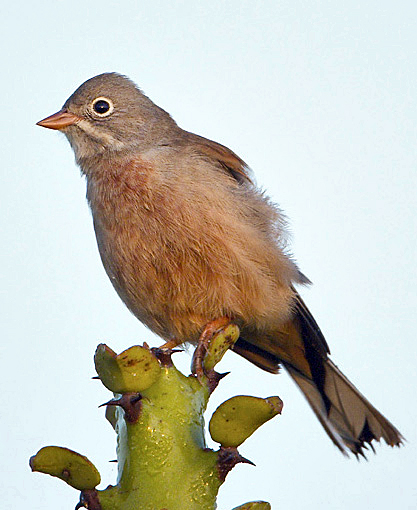
The adult Gray-necked Bunting is easily identified by its distinctive plumage, which features a gray head and neck that sharply contrasts with its warm chestnut back and wings. Males typically show more vivid coloring than females, with richer chestnut tones and a clearer gray on the neck and head. Juveniles resemble females but are generally duller in coloration. In flight, the Gray-necked Bunting displays a unique silhouette with its pointed wings and slightly forked tail. When perched, it exhibits a characteristic upright posture, often seen on top of low shrubs or rocks. It can be confused with the Ortolan Bunting, but the Gray-necked Bunting's more pronounced gray neck and lack of yellow coloration help distinguish it. During the non-breeding season, their plumage becomes more subdued, which aids in camouflage within their winter habitats.
Having trouble telling birds apart? Upload a photo to our bird identification tool for an instant species match.
Gray-necked Bunting Habitat and Range
Preferred Habitat
The Gray-necked Bunting occupies a range of arid and semi-arid habitats across Central Asia. It is commonly found in open grassy areas, rocky hillsides, and scrublands. It prefers elevations ranging from lowland plains to foothills, typically between 200 and 1500 meters. During the breeding season, these buntings favor areas with sparse vegetation, which provides both feeding opportunities and nesting sites. In winter, they shift to more wooded areas and agricultural lands, where food sources are more abundant. Although primarily associated with rural environments, they are occasionally seen in urban fringes, particularly in areas where natural habitats have been encroached upon by human development.
Geographic Range
The Gray-necked Bunting's breeding range spans across Kazakhstan, Uzbekistan, Turkmenistan, northern Afghanistan, and parts of Iran. Come winter, they migrate to the Indian subcontinent, primarily wintering in northwestern India and Pakistan. The migration corridors they use are influenced by geographical features such as mountain ranges and deserts, which act as guides during their seasonal movements. Population density is higher in areas where open scrubland is prevalent, offering ample feeding and breeding sites. These areas are often characterized by sparse human population, which minimizes habitat disturbance.
Want to know which birds visit your area? Browse our backyard birds by location guides for region-specific species lists.
What Does the Gray-necked Bunting Eat?
The diet of the Gray-necked Bunting consists primarily of seeds and grains, supplemented by insects during the breeding season. In the summer months, they forage for seeds from grasses and shrubs, utilizing their strong bills to crack open tougher seed casings. Insects and other small invertebrates are crucial during the breeding season, providing the necessary protein for chick development. Foraging typically occurs in the early morning and late afternoon when temperatures are cooler, and the birds exhibit a hopping gait as they move through vegetation in search of food. They are also known to visit agricultural fields, foraging on leftover grains and seeds.
Gray-necked Bunting Behavior and Social Structure
The Gray-necked Bunting exhibits territorial behavior during the breeding season, with males establishing and defending territories through song and display flights. These territories are marked by prominent perches where males sing to attract mates and deter rivals. Courtship involves a mix of vocal and visual displays, with males performing song flights that display their plumage to potential mates. Outside of the breeding season, they become more social, often forming small flocks that forage together. Their response to predators includes a mix of flight and concealment, often diving into dense vegetation to evade capture. Daily activity patterns are diurnal, with peak activity occurring during the cooler parts of the day.
Gray-necked Bunting Nesting and Reproduction
Gray-necked Buntings build cup-shaped nests, usually located on the ground or low in a bush, constructed from grass, twigs, and lined with softer materials like feathers. They prefer nesting sites that are well-concealed by vegetation, offering protection from predators. Clutch size ranges from 3 to 5 eggs, which are incubated primarily by the female for about 12 to 14 days. Both parents participate in feeding the chicks, which fledge approximately 10 to 12 days after hatching. Typically, they produce one brood per year, although a second brood is possible in favorable conditions.
Gray-necked Bunting Sounds and Vocalizations
The primary song of the Gray-necked Bunting is a melodious series of whistles, often described as sweet and descending in pitch. These songs serve as both territorial calls and mating advertisements. Their call notes are sharp and metallic, used as contact calls between individuals. Alarm calls are harsher and more insistent, warning others of potential danger. During the dawn chorus, males sing vigorously, asserting their presence and fitness to nearby rivals and potential mates.
Interesting Facts About the Gray-necked Bunting
- 1The Gray-necked Bunting migrates over 2000 kilometers from its breeding grounds to wintering sites.
- 2During migration, they can form flocks of up to 100 individuals, providing safety in numbers.
- 3Despite their small size, Gray-necked Buntings are known for their strong flight capabilities.
- 4The species was first described in 1839 by the ornithologist Edward Blyth.
- 5Gray-necked Buntings are effective seed dispersers, aiding in the propagation of several plant species.
- 6Their song, often described as sweet and melodious, can be heard from over 100 meters away.
- 7These buntings can adapt to a variety of habitats, from deserts to agricultural fields.
Gray-necked Bunting Conservation Status
The Gray-necked Bunting is currently listed as a species of Least Concern by the IUCN, but it faces threats from habitat loss and degradation due to agricultural expansion and urbanization. The population trend appears stable, although localized declines have been noted in areas where natural habitats have been heavily altered. Conservation efforts focus on preserving important breeding and wintering habitats, as well as conducting further research to monitor population trends and threats. Historically, the species has maintained a relatively stable population, although ongoing environmental changes could impact its future status.


