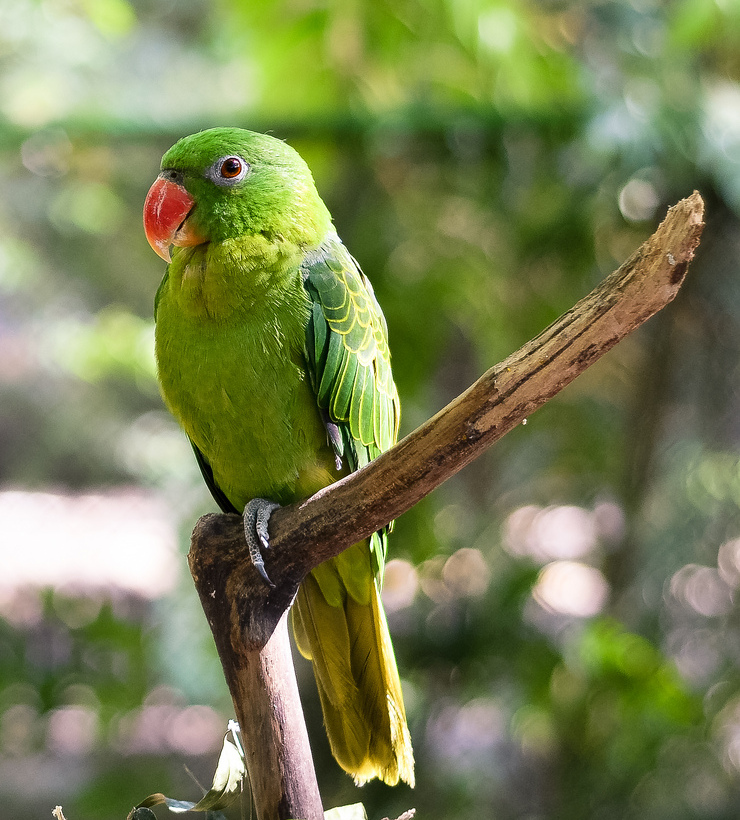
Great-billed Parrot
Tanygnathus megalorynchos
Order: Psittaciformes / Family: Psittacidae

Wikimedia Commons
About the Great-billed Parrot
The Great-billed Parrot (Tanygnathus megalorynchos), a member of the Psittacidae family, is a striking figure in the avian world. Renowned for its oversized red bill, this parrot is native to a range of tropical regions, including the Philippines, Indonesia, and parts of Papua New Guinea. This species plays a significant ecological role, particularly in seed dispersal, which aids in the maintenance of its native forest ecosystems. The Great-billed Parrot prefers dense, humid forests, often at elevations ranging from sea level to 1,200 meters. Its presence is a sign of healthy forest environments. These birds are predominantly found in lowland rainforests, secondary forests, and sometimes mangrove forests, which provide the necessary resources for their survival. Seasonal behaviors of the Great-billed Parrot include local movements in search of food sources, although they are not considered migratory. Their breeding season typically aligns with the wet season, ensuring ample food supply for raising their young. Ecologically, this parrot contributes significantly to the forest habitats it occupies. By feeding on a variety of fruits and seeds, the Great-billed Parrot helps in the germination and spread of plant species. This interaction highlights the importance of maintaining their natural habitats, as the loss of these birds could lead to negative impacts on forest regeneration. Additionally, the parrot is culturally significant in its native regions, often featuring in local folklore and traditional practices. Despite facing threats from habitat loss and the pet trade, the Great-billed Parrot remains an integral part of the ecosystems it inhabits.
The Great-billed Parrot belongs to the family Psittacidae, within the order Psittaciformes. These birds typically live average 20-25 years in the wild, up to 30 years in captivity..
How to Identify a Great-billed Parrot
The Great-billed Parrot is easily identifiable due to its large, vibrant red bill, which stands out against its predominantly green plumage. Adults possess a robust body, approximately 38 to 40 cm in length, with a wingspan reaching 48 to 50 cm. The plumage is bright green with a subtle blue hue on the wings and tail feathers. There are no significant sexual dimorphisms in this species, making males and females look similar. Juvenile Great-billed Parrots resemble adults but have a duller plumage and a smaller bill that gradually grows as they mature. In terms of field identification, the parrot's loud, squawking call is often heard before the bird is seen. The Great-billed Parrot can be confused with similar green parrot species, like the Blue-naped Parrot, but the latter lacks the characteristic oversized red bill. When in flight, the parrot displays a slightly undulating pattern, with a strong wingbeat that helps it navigate through forest canopies. Its flight silhouette shows a broad-winged and short-tailed profile. Perching posture is upright, often on high branches where it can survey the surrounding area. Observers may also note the parrot's frequent use of its bill for climbing and handling food.
Having trouble telling birds apart? Upload a photo to our bird identification tool for an instant species match.
Great-billed Parrot Habitat and Range
Preferred Habitat
The Great-billed Parrot primarily inhabits tropical and subtropical forests. It thrives in lowland rainforests, where the dense canopy provides shelter and abundant food sources. This species is also found in secondary growth forests, which offer similar ecological conditions. Occasionally, they inhabit mangrove forests along coastal areas. Elevation ranges from sea level to about 1,200 meters, with a preference for lowland areas. Seasonal habitat shifts are minimal, as these parrots are non-migratory, but they may relocate within their range in response to food availability. In urban settings, the Great-billed Parrot is less commonly seen, as it prefers intact forest environments. However, they may venture into agricultural areas where fruit and seed crops are available. The presence of this parrot in a habitat often indicates a biodiverse and healthy ecosystem, as they rely on extensive forest cover.
Geographic Range
The Great-billed Parrot's range is extensive across Southeast Asia and the western Pacific. It is predominantly found in the Philippines, where it inhabits several islands, including Luzon, Mindanao, and Palawan. In Indonesia, the parrot is present on islands such as Sulawesi, the Moluccas, and the Lesser Sundas. Papua New Guinea also hosts populations of this species, primarily in lowland and coastal regions. These parrots do not undertake long-distance migrations but may exhibit localized movements in search of food. Population density is highest in regions with abundant forest cover and minimal human disturbance. Despite its broad range, the Great-billed Parrot is not uniformly distributed and is more concentrated in areas with suitable habitats. Conservation efforts focus on protecting these key areas from deforestation and fragmentation.
Want to know which birds visit your area? Browse our backyard birds by location guides for region-specific species lists.
What Does the Great-billed Parrot Eat?
The Great-billed Parrot primarily feeds on a diet of fruits, seeds, and nuts. Their strong, curved bill is well-adapted for cracking open hard seeds and accessing fleshy fruits. They exhibit a preference for tropical fruit species, such as figs and durians, which are abundant in their native habitats. Seasonal changes in diet occur as different fruiting trees become available. They also consume flowers and buds, supplementing their nutritional intake. Foraging occurs both in the canopy and occasionally on the ground, where they may search for fallen fruits. The Great-billed Parrot practices a methodical foraging technique, using its bill to manipulate food and extract edible parts. Feeding usually happens during the early morning and late afternoon, with the birds resting during the heat of the day. This diet not only sustains the parrot but also aids in the dispersal of seeds, contributing to forest regeneration.
Great-billed Parrot Behavior and Social Structure
Great-billed Parrots exhibit complex social behaviors and tend to live in pairs or small family groups. They are known for their strong pair bonds, which are maintained through mutual preening and synchronized activities. Territorial behavior is evident during the breeding season, with pairs defending their nest sites aggressively. Courtship displays include vocalizations and intricate flight patterns, often accompanied by mutual feeding between mates. Outside of the breeding season, these parrots may form loose flocks, especially when foraging. Their response to predators involves loud alarm calls and evasive flight maneuvers. Daily activity patterns are diurnal, with feeding and social interactions occurring primarily in the morning and early evening. During midday, the parrots often retreat to shaded areas to avoid the heat. Their complex vocalizations and social structures highlight a high level of intelligence and adaptability.
Great-billed Parrot Nesting and Reproduction
The Great-billed Parrot nests in tree cavities, often selecting large, mature trees that provide ample space and security. Nesting materials are minimal, as these parrots rely on the natural hollows of trees to rear their young. Preferred nesting sites are in tall trees within dense forests, providing protection from predators and proximity to food sources. The clutch size typically ranges from two to four eggs, with an incubation period of approximately 24 to 28 days. Both parents share incubation duties, although the female spends more time in the nest. After hatching, the chicks remain in the nest for about eight weeks before fledging. Parental roles are well-defined, with both adults involved in feeding and protecting the young. The Great-billed Parrot can raise one or two broods per year, depending on environmental conditions and food availability.
Great-billed Parrot Sounds and Vocalizations
The primary vocalization of the Great-billed Parrot is a loud, squawking call that carries over long distances. These calls are harsh and repetitive, often used to communicate with other members of their group. The rhythm is typically fast-paced, with a series of short, sharp notes. In addition to their primary call, these parrots produce softer chattering sounds when engaged in close interactions with mates or family members. Alarm calls are more intense and higher-pitched, serving to alert others of potential threats. During the dawn chorus, Great-billed Parrots are particularly vocal, announcing their presence as they begin their daily activities. Their vocal repertoire is varied, and while not melodious, the calls serve crucial social and territorial functions.
Interesting Facts About the Great-billed Parrot
- 1The Great-billed Parrot's bill makes up nearly one-third of its head size, an adaptation for cracking tough seeds.
- 2In the wild, the Great-billed Parrot can live up to 30 years, a testament to its adaptability and resilience.
- 3These parrots are known to mimic sounds, although they are not as proficient as some other parrot species.
- 4Despite their size, Great-billed Parrots are expert fliers, capable of navigating dense forest canopies with ease.
- 5During the breeding season, pairs can be observed engaging in mutual feeding, a behavior that reinforces their bond.
- 6Great-billed Parrots play a crucial role in their ecosystem by dispersing seeds of over 20 plant species.
- 7Their ability to thrive in secondary forests suggests a degree of adaptability to habitat changes.
Great-billed Parrot Conservation Status
The Great-billed Parrot is currently listed as Least Concern by the IUCN. However, its populations are experiencing pressures from habitat loss due to deforestation and the illegal pet trade. The population trend is decreasing, highlighting the need for increased conservation efforts. Historical population changes indicate that these parrots were once more widespread but have become locally scarce in areas with significant habitat destruction. Conservation measures focus on habitat protection and legal enforcement against poaching. Community-based programs aim to raise awareness about the ecological importance of this species. Continued monitoring and habitat restoration are vital to ensure the survival of the Great-billed Parrot in the wild.
Other Psittacidae Species


Birds Similar to the Great-billed Parrot
These species are often confused with the Great-billed Parrot due to similar appearance or overlapping range.